
esg reporting, uk srs, sustainability, esg guide, cdp
ESG Reporting in the UK: A Practical Guide to Compliance
By ESG Consulting Team · · 14 min read
You've finished the annual report, gathered the energy invoices and asked business units for their climate data. Then the reviewer asks a simple question: “Show me how this figure was calculated.” The number may be reasonable, but the evidence is scattered across spreadsheets, supplier emails and billing portals. The methodology has changed since last year, and nobody can explain precisely why.
That gap between a plausible disclosure and an assurance-ready ESG report is where many UK organisations struggle. Compliance depends on more than understanding the requirements. It depends on consistent boundaries, controlled calculations, named owners and an evidence trail that an external reviewer can follow without reconstructing the process from scratch.
Table of Contents
- Understanding the UK ESG Reporting Landscape
- Navigating Major Frameworks and Standards
- Building an Assurance-Ready Evidence Pack
- Implementing Robust Data Collection and Mapping
- Preparing for First-Cycle UK SRS Reporting
- Avoiding Common Reporting Pitfalls
- Finalising Your Strategy and Next Steps
Understanding the UK ESG Reporting Landscape
UK ESG reporting has moved from a largely voluntary exercise into a regulated discipline connected to corporate governance, financial risk and decarbonisation planning. Streamlined Energy and Carbon Reporting, or SECR, began applying from 2019, bringing energy consumption, emissions and related narrative disclosures into the annual reporting process. The UK then became the first G20 country to mandate TCFD-aligned climate disclosures for large businesses, certain FCA-regulated firms and listed companies in 2021. Large UK registered companies were brought into mandatory climate-related disclosure requirements under the Companies Act 2006 from 2022, as set out in the UK sustainability regulation timeline.
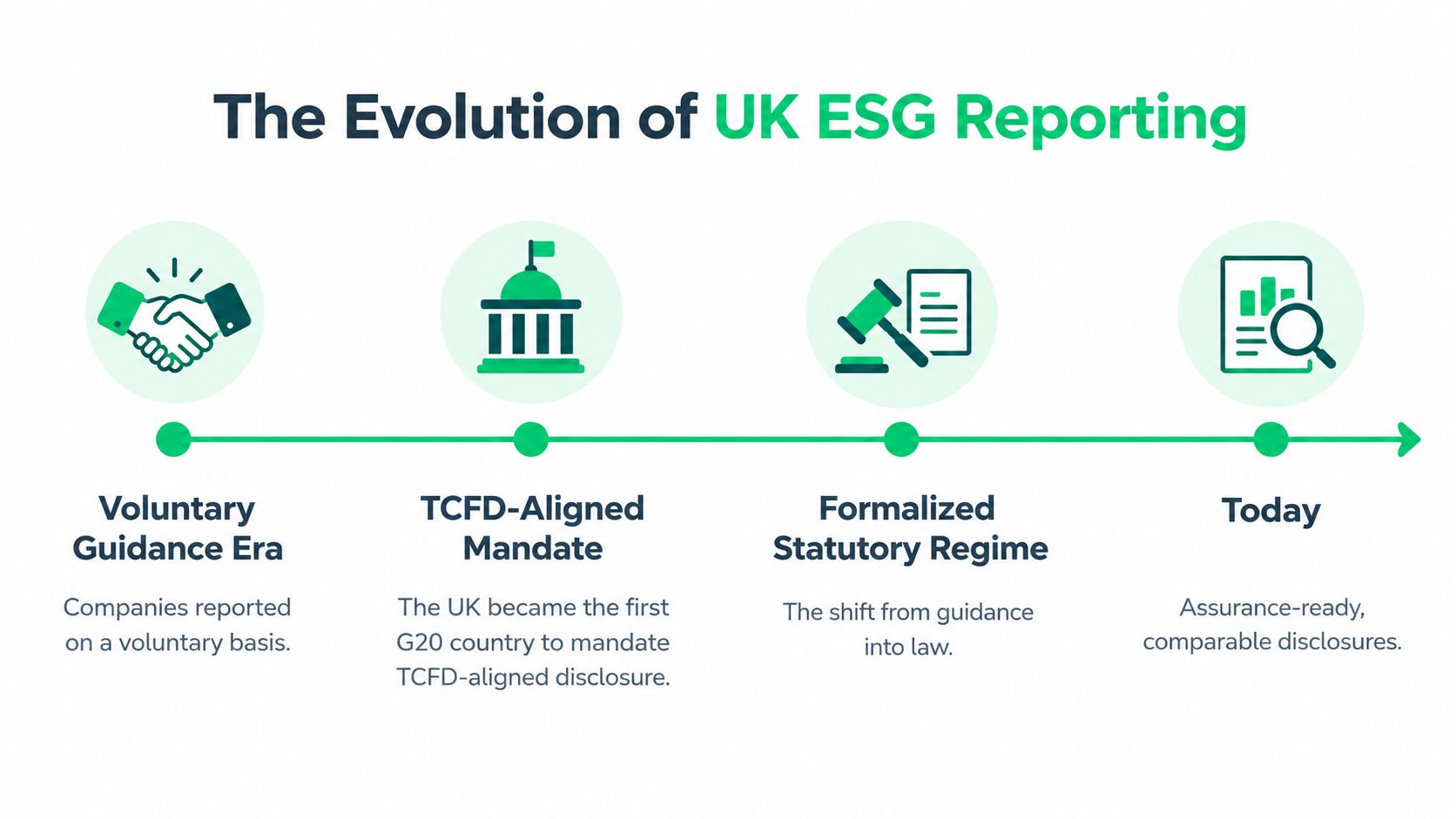
The structural change matters. A voluntary sustainability narrative can prioritise aspiration and presentation. A statutory disclosure must identify responsibility, define the reporting boundary, explain material risks and support figures with evidence. Climate risk is no longer confined to a sustainability team's annual publication. It sits alongside governance, strategy, risk management and performance reporting.
Why the regulatory shift changes the operating model
The Climate Change Act 2008 established a legally binding framework aimed at reaching net zero by 2050 and requires carbon budgets as milestones towards that target. This policy architecture gives climate reporting a direction beyond disclosure alone. Organisations increasingly need to show how emissions data informs capital allocation, operational decisions, resilience planning and transition activity, as described in the IFRS UK jurisdiction snapshot.
The standards framework has continued to develop. The International Sustainability Standards Board published IFRS S1 and S2 on 26 June 2023, while the UK government published finalised UK SRS S1 and S2 in 2024, creating a route towards potential mandatory reporting against UK-endorsed standards. That development doesn't replace existing SECR or TCFD-aligned work. It raises the expected quality of governance, risk analysis, controls and traceability.
Practical implication: Treat the annual ESG report as the visible output of a year-round control process, not as a document assembled after the financial close.
Organisations also need to distinguish UK requirements from adjacent regimes. A business with European operations, EU investors or customers may need to assess how CSRD affects its reporting obligations, but it shouldn't assume that one framework automatically satisfies another. The disciplined approach is to identify the legal trigger, reporting boundary, required metrics and assurance expectation for each obligation before designing the data process.
Navigating Major Frameworks and Standards
Most large organisations don't report to one framework. They maintain a set of disclosures for regulators, investors, lenders, customers, procurement teams and ratings organisations. The practical mistake is to manage each request as a separate project. That creates duplicate data collection, conflicting definitions and several versions of the same emissions figure.
A better approach starts with a single controlled data model and maps each framework to it. The model should distinguish the metric, organisational boundary, reporting period, calculation method, evidence source, owner and approval status. The disclosure is then a controlled view of that model, not the place where the underlying data is first assembled.
What each framework is trying to answer
| Framework | Primary question | Practical reporting emphasis |
|---|---|---|
| UK SRS S1 and S2 | Which sustainability-related risks and opportunities could affect enterprise value and financial decision-making? | Governance, strategy, risk management, metrics and targets, with a strong focus on financially relevant sustainability information |
| ESRS | What are the organisation's material impacts, risks and opportunities? | Double materiality, meaning financial materiality and impact materiality, supported by detailed disclosures |
| GRI | How does the organisation affect the economy, environment and people? | Stakeholder-oriented impact reporting and topic-specific disclosures |
| CDP questionnaire | How does the organisation manage climate, water or forest-related risks and performance? | Structured responses, management processes, targets, emissions and supporting evidence |
These frameworks overlap in areas such as emissions, governance, targets, risk and performance. They diverge in purpose. UK SRS is designed around investor-useful sustainability-related financial information. ESRS adds the organisation's outward impacts through double materiality. GRI can provide a useful impact-reporting foundation, while CDP turns selected climate and environmental information into a structured questionnaire with its own scoring logic.
Build the mapping before writing
Start by creating a disclosure register. For every requirement, record the framework, paragraph or topic, required data, narrative owner, source system, evidence file and review status. Then map common metrics such as energy consumption, Scope 1 and Scope 2 emissions, capital expenditure, targets and board oversight across the relevant requirements.
The mapping shouldn't force false equivalence. A single emissions figure may be reusable, but the boundary explanation and narrative context may differ. Similarly, an ESRS impact assessment shouldn't be copied into a UK SRS risk discussion without testing whether it addresses financial relevance.
Teams that already manage TCFD-aligned disclosures should preserve the governance and risk architecture while extending it where UK SRS requires broader sustainability-related information. A concise explanation of what TCFD means for reporting can help non-specialist board members understand the continuity, but the operating process still needs a clear owner for each framework.
One source of truth doesn't mean one universal report. It means every report draws from controlled definitions that the business can explain consistently.
Building an Assurance-Ready Evidence Pack
A report becomes easier to assure when the team builds evidence around each KPI before drafting the final narrative. For every disclosed figure, the evidence pack should answer five questions: what was measured, which entities and sites were included, how it was calculated, who reviewed it and where the source data came from.
The market already signals the importance of this discipline. 85% of FTSE 100 companies obtained third-party ESG assurance, and 98% of those assured Scope 1 and 2 greenhouse gas emissions, according to the KPMG ESG Assurance Maturity Index. The figures point to a practical priority. Core emissions data needs a reliable audit trail even when the wider report contains qualitative or developing disclosures.

Use a control-tested workflow
A workable evidence pack normally contains the following layers:
- Boundary file: list legal entities, subsidiaries, joint ventures, leased sites and operational locations, with the inclusion decision and rationale for each.
- Source schedule: record utility invoices, meter exports, fuel records, travel data, procurement records and supplier submissions, including the period covered and responsible owner.
- Calculation workbook: preserve activity data, conversion factors, formulas, assumptions and adjustments. Lock approved formulas and record any manual intervention.
- Reconciliation record: compare the sustainability data with finance, facilities and procurement records. Investigate unexplained movements rather than smoothing them into the final number.
- Disclosure bridge: connect the approved calculation to the annual report, including the exact page, table, narrative and intensity metric where it appears.
- Review log: capture preparer checks, management review, unresolved items, corrections and final approval.
The key technical pitfall is inconsistent methodology selection. One entity may use floor area for an intensity ratio while another uses revenue. One reporting year may include leased vehicles while the next excludes them. Each choice may look defensible in isolation, but the combined result weakens comparability and invites assurance questions.
Design for limited assurance
Most ESG assurance is limited rather than reasonable. Only 8.9% of UK ESG assurance engagements use the reasonable standard, according to the same KPMG analysis. Limited assurance doesn't mean the team can provide weak evidence. It means the practitioner generally performs narrower procedures, so obvious inconsistencies, unsupported explanations and missing reconciliations still create findings.
Pre-align the assurance scope with the metrics that will be tested. Confirm whether the reviewer will examine Scope 1 and Scope 2, selected Scope 3 categories, energy consumption, intensity ratios, targets or narrative controls. Then test those metrics internally before sign-off.
A specialist sustainability reporting consultant can help structure the evidence pack, but internal ownership remains essential. The finance director, sustainability lead and operational data owners must agree the boundary and methodology before the assurance provider receives the final schedule.
Implementing Robust Data Collection and Mapping
Reliable ESG reporting begins with the organisation chart and site list, not the emissions spreadsheet. Before requesting invoices, identify every legal entity, trading location and operational activity that could fall inside the reporting boundary. Compare that map with the statutory accounts, consolidation structure, property register and procurement records.
Three checks that prevent late reconstruction
First, establish the statutory boundary. Record which companies and sites are included, which are excluded and why. Link each location to an owner who can confirm occupancy, energy supply and operational control. Group boundaries should be reviewed with finance because a sustainability boundary that doesn't reconcile with the group structure will be difficult to defend.
Second, reconcile consumption to annual totals. Gather electricity, gas, fuel and other relevant energy records. Check invoice dates against the reporting period, identify estimated readings, resolve gaps and compare the totals with procurement or finance data. Keep the original source files. A polished summary workbook isn't sufficient if no one can trace its inputs.
Third, write the calculation basis into the narrative. Explain the boundary, methodology, exclusions, estimation approach and year-on-year movements. If a site opened, closed, changed supplier or moved from estimated to actual readings, say so. A short explanation can prevent a reviewer from treating a genuine operational change as a data error.
The government's 2026 SECR review estimates that 19,900 organisations are in scope and that 14% to 23% are not complying, with gaps more prevalent among private companies and LLPs, as set out in the SECR review material. The review also highlights the absence of a single prescribed template, which means preparers need their own internal reporting standard rather than relying on format consistency from the market.
Extend the process into the value chain
Scope 3 requires a different operating model because the data often sits outside the organisation. Begin with a value-chain map covering purchased goods and services, capital goods, fuel and energy-related activities, logistics, business travel, employee commuting, use of sold products and end-of-life treatment where relevant.
Use supplier engagement selectively. Ask high-impact suppliers for activity data, methodology, boundary and supporting evidence rather than accepting an unsupported emissions figure. Where primary data isn't available, document the estimation method and identify the categories that need better information in the next cycle.
Finance reconciliation matters here too. Procurement spend, headcount, travel bookings, logistics records and product volumes should support the assumptions used in the inventory. The objective isn't perfect data on the first attempt. It is a transparent hierarchy of evidence, with clear controls over what is measured, estimated and scheduled for improvement.
Preparing for First-Cycle UK SRS Reporting
Treat the voluntary UK SRS period as a controlled rehearsal for external assurance, not a reason to defer preparation. The government published UK SRS S1 and S2 for voluntary use in February 2026, and the FRC says they are available immediately, although they are not yet mandatory. The UK government publication on UK SRS S1 and S2 is the formal reference point.
The practical gap is rarely the framework text alone. Transition reliefs available under IFRS S1 are not all carried across, so organisations need governance, strategy, risk and metrics disclosures that can withstand internal challenge. They also need a documented method-selection policy. Changing boundaries, emission factors or calculation approaches between reporting periods can create an assurance issue even when each individual figure appears reasonable.
Use the voluntary period deliberately
A first-cycle readiness programme should produce working papers, not a gap analysis that remains unused. Prepare a draft governance statement, risk register, materiality assessment, strategy narrative, targets schedule and KPI catalogue. Ask the board or relevant committee to challenge ownership, assumptions and the connection between climate risks and financial planning.
The FCA has proposed phased implementation for listed issuers beginning in January 2027, but this remains subject to final policy and should not be treated as settled law. Monitor the final position while building controls that can operate before the requirement takes effect.
Data access remains a major constraint. KPMG's 2025 index found that 54% of UK companies still struggle with inadequate ESG data access, but that statistic should be traced to the underlying KPMG publication rather than presented as a finding of the UK SRS policy material. Assign data owners, define minimum evidence standards and run a dry close on the expected reporting timetable.
A limited assurance engagement will not require perfect data. It will require specific evidence trails showing what was measured, estimated, approved and changed.
The voluntary cycle is valuable only if management reviews it as though an assurance provider were already asking questions.
Avoiding Common Reporting Pitfalls
A typical reporting failure starts with a reasonable figure and an undocumented decision. One business unit reports emissions per square metre, another uses revenue, and a third uses production volume. The report presents the ratios side by side without explaining the difference, so readers can't make a meaningful comparison.
The UK government has identified heterogeneous intensity metrics, varied calculation choices, limited verification and inconsistent placement or formatting as factors that reduce comparability in SECR reporting. The fix is a group-wide calculation policy that names the approved activity denominator, conversion approach, boundary and exception process.

What usually goes wrong
A missing site is often more serious than a formula error. If the facilities list isn't reconciled to the group boundary, a newly acquired warehouse may disappear from the inventory, or a closed location may remain in the baseline. Maintain a controlled entity and site register, and require finance or company secretarial review of changes.
Incomplete energy data creates a second problem. Teams may fill gaps with estimates but fail to label them, then compare the estimate with an actual reading in the following year as though the methodology were unchanged. Record estimated periods, the basis used and the plan to replace them with primary data.
The narrative also needs discipline. State the calculation basis, exclusions and material changes near the relevant disclosure. Don't leave the reviewer to infer why the number moved.
This short video can support internal discussions about organising reporting work and reviewing evidence:
A central repository helps, but software won't resolve an undefined methodology. Whether the team uses a controlled spreadsheet environment, an ESG data platform or an internal finance system, each KPI still needs an owner, source, calculation rule and approval record.
Finalising Your Strategy and Next Steps
A credible ESG reporting programme connects disclosure to decisions. Emissions data should inform a costed and sequenced decarbonisation pathway, with named owners, delivery dates, funding assumptions and a method for distinguishing genuine abatement from purchased offsets or unverified claims.
The board should receive more than a finished report. It needs a clear view of material risks, dependencies, target progress, unresolved data limitations and the decisions required. Practitioners need documented methodologies, repeatable collection calendars and time to test controls before the reporting deadline.
Capacity also matters. Assign one account lead internally from scoping through sign-off, supported by finance, procurement, facilities, risk and legal colleagues. An in-house quality review should challenge boundaries, calculations and narrative consistency before the external assurance provider begins work.
The most effective programmes replace ad hoc requests with a recurring close process. That creates better evidence, clearer accountability and a more useful connection between ESG reporting, investment planning and operational performance.
ESG Consulting supports UK organisations with SECR, UK SRS readiness, TCFD-aligned disclosures, ESRS and CDP reporting, building evidence trails designed for external assurance. Visit ESG Consulting to discuss your reporting boundary, data controls and first-cycle readiness with a senior consultant.
More from the blog
· 12 min read · Regulation
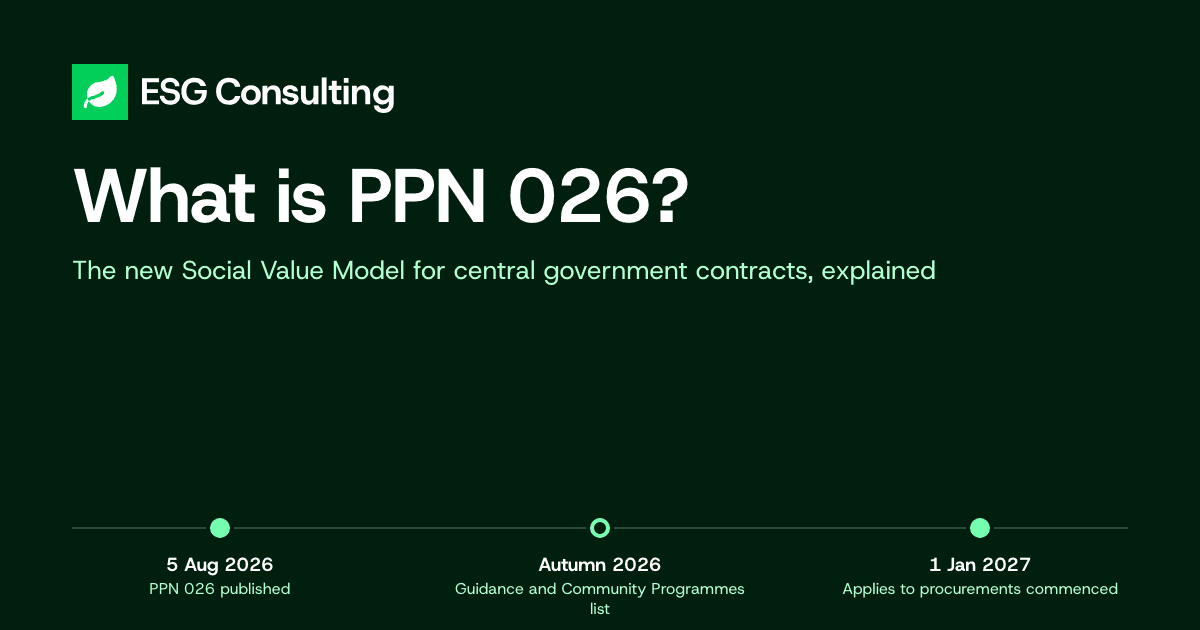
What is PPN 026? The new Social Value Model
PPN 026 replaces PPN 002 as the Social Value Model for central government contracts from 1 January 2027. Scope, the 10% and 20% weightings and the six criteria.
Read article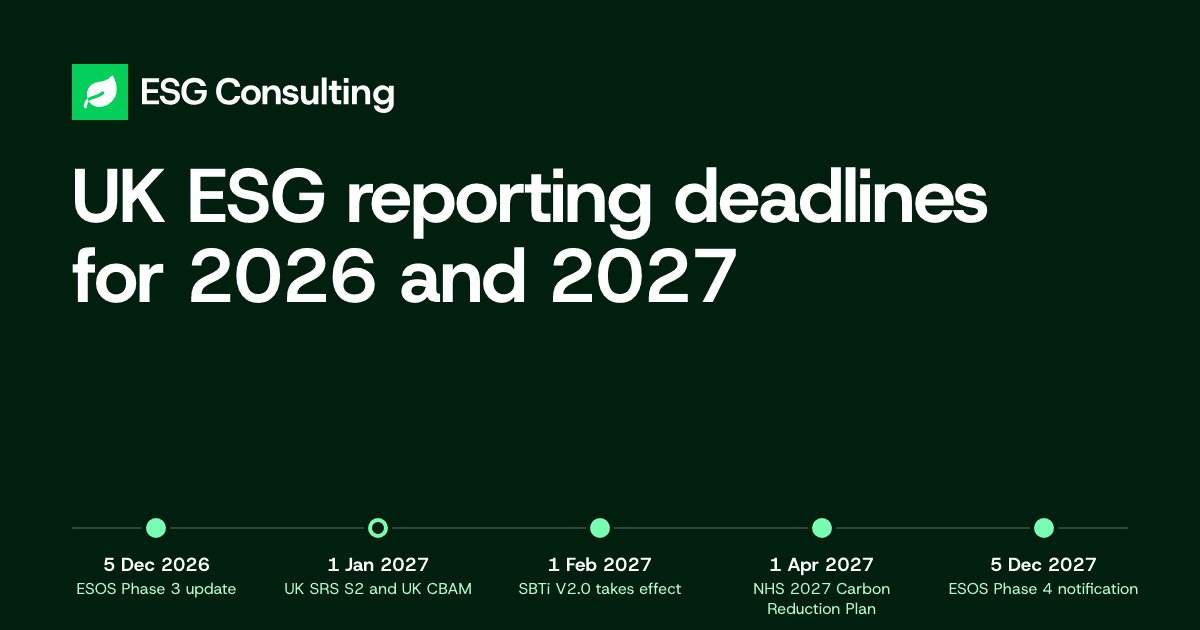
· 14 min read · Regulation
UK ESG reporting deadlines for 2026 and 2027
Every UK ESG reporting date to December 2027 - UK SRS, ESOS, SECR, UK CBAM, CSRD, SBTi, PPN 026 and the NHS - each marked mandatory, proposed or voluntary.
Read article