esos phase 4, esos compliance, esos lead assessor, energy audit, uk sustainability
ESOS Phase 4: Your 2026 UK Compliance Guide
By ESG Consulting Team · · 15 min read
31 December 2026 is the ESOS Phase 4 qualification date, and 5 December 2027 is the deadline for submitting the notification of compliance. Organisations that qualify must use that window to establish their scope, complete the required assessment or ISO 50001 route, obtain sign-off and submit through MESOS.
That's the position a finance director needs to understand before the next sustainability meeting. ESOS Phase 4 is not a voluntary energy-efficiency project that can sit behind a broader net-zero programme. It's a legally timed obligation for qualifying large UK undertakings, and the evidence needed for compliance takes time to assemble.
Table of Contents
- Where ESOS Phase 4 Catches UK Organisations
- Qualifying as a Phase 4 Participant
- Calculating Total Energy Consumption and Hitting 95% Coverage
- Choosing Between an ESOS Energy Audit and ISO 50001
- Site Visits, Sampling and Lead Assessor Sign-Off
- Your Phase 4 Timeline From Now to December 2027
- Using Phase 4 to Feed Your Wider UK Reporting
Where ESOS Phase 4 Catches UK Organisations
A UK finance director opens a sustainability update in spring 2027 and finds an uncomfortable sentence: the group qualified for ESOS Phase 4 on the previous year's reference date. The group now needs to prove its energy coverage, arrange the correct assessment route, secure board approval and submit before the statutory deadline.
The problem isn't discovering the obligation. The problem is discovering it after key decisions have already been left to chance. Lead Assessors may have limited capacity, energy records may sit with landlords or fleet managers, and board minutes may not show who approved the compliance approach.
Read the rules against the legal timeline. The Phase 4 compliance period runs from 6 December 2023 to 5 December 2027, with qualification determined by an organisation's status on 31 December 2026. The notification of compliance is due on 5 December 2027, and the subsequent action-plan deadline is 5 December 2028, as set out in the government's ESOS guidance.
The assumptions that cause avoidable failures
Start by rejecting three common assumptions:
- “ESOS only applies to manufacturers.” The assessment boundary can include buildings, industrial processes and transport. A services group, retailer, logistics business or property portfolio can have a complex obligation even without a factory.
- “Overseas subsidiaries are automatically excluded.” The relevant question is the UK participant and its qualifying corporate group. Group structure needs a deliberate review, not an assumption based on where the parent company is headquartered.
- “Our old compliance evidence will be enough.” Phase 4 removes Display Energy Certificates and Green Deal Assessments as alternative routes. A previous approach may not satisfy the current requirements.
The board should therefore treat ESOS as a controlled compliance project. Before the qualification date, confirm the group perimeter, identify the accountable executive, preserve energy records and begin discussions with a Lead Assessor. You can defer the final choice between audit and ISO 50001 if the evidence is not ready, but you can't defer understanding which entities and energy uses may be in scope.
Board instruction: Require a written qualification assessment, an energy-data ownership map and a route recommendation before the end of 2026.
The next decisions are practical. Does the organisation qualify? What energy belongs in total energy consumption? Which evidence will cover the required boundary? Those choices determine the work that follows.
Qualifying as a Phase 4 Participant
The qualification decision is fixed on 31 December 2026, not when the notification is filed. Any organisation that meets the ESOS definition of a large undertaking on that date must comply. The same applies where the obligation arises through a qualifying corporate group.
Treat the review as a documented legal assessment. Freeze the group structure at the qualification date, confirm employee and financial information for each relevant entity, and record the evidence supporting every inclusion or exclusion. Keep the analysis with the board papers or formal compliance file. A reviewer should be able to reconstruct the decision without relying on institutional memory.
A working group assessment
Consider a UK parent with two trading subsidiaries and one dormant entity. The parent and Trading subsidiary A meet the large-undertaking test on 31 December 2026. Trading subsidiary B falls below the test on its own. The dormant entity has no operating energy use.
That outcome does not permit the group to assess only the entities that appear to qualify individually. The UK group position still needs to be reviewed, including how ownership, entity status and energy use affect the participant group. Dormancy can change the practical energy boundary, but it does not remove the need for a documented group analysis.
The board pack should show the figures, conclusion and treatment clearly. The worked entries below use the available case figures and identify the evidence that must be attached for the subsidiaries.
| Entity | Employees | Turnover (£m) | Balance sheet (£m) | Phase 4 treatment |
|---|---|---|---|---|
| UK parent | 320 | 62 | 41 | In scope. Large-undertaking test met on 31 December 2026 |
| Trading subsidiary A | Meets the test | Group figures to be attached | Group figures to be attached | In scope where group rules require |
| Trading subsidiary B | Below the test on its own | Group figures to be attached | Group figures to be attached | Assess in the UK group context |
| Dormant entity | 0 | 0 | 0.1 | Excluded from the energy boundary, retained in group analysis |
For Trading subsidiaries A and B, attach the employee records and financial statements used by the working group. Do not leave “group figures to be attached” in the final compliance file. The board needs a completed evidence trail before the notification process begins.
Evidence that should survive review
Retain the legal-entity chart, ownership records, employee information, financial statements and written qualification conclusion. If the group reorganises, acquires an entity or changes its reporting structure near 31 December 2026, preserve the transaction documents and effective-date evidence.
The decision that locks at year-end 2026 is whether the organisation qualifies and which UK entities belong in the participant group. The notification deadline of 5 December 2027 is not a fresh opportunity to revisit that scope informally. A late scope decision will put pressure on energy-data collection, site selection, evidence preparation and director sign-off.
The board does not need every audit finding before qualification is settled. It does need a defensible scope conclusion, a named owner and a dated plan for resolving any remaining uncertainty before 5 December 2027.
Calculating Total Energy Consumption and Hitting 95% Coverage
The energy calculation is the control point for the entire assessment. If the total is wrong, the organisation can't demonstrate that its audit or ISO 50001 evidence reaches the required boundary.
For Phase 4, first define the participant group, then calculate total energy consumption, or TEC, using verifiable data. The review must cover buildings, industrial processes and transport. Include purchased energy and relevant fuel or energy datasets, then reconcile the total against invoices, meters, landlord information, fleet records and other supporting evidence.
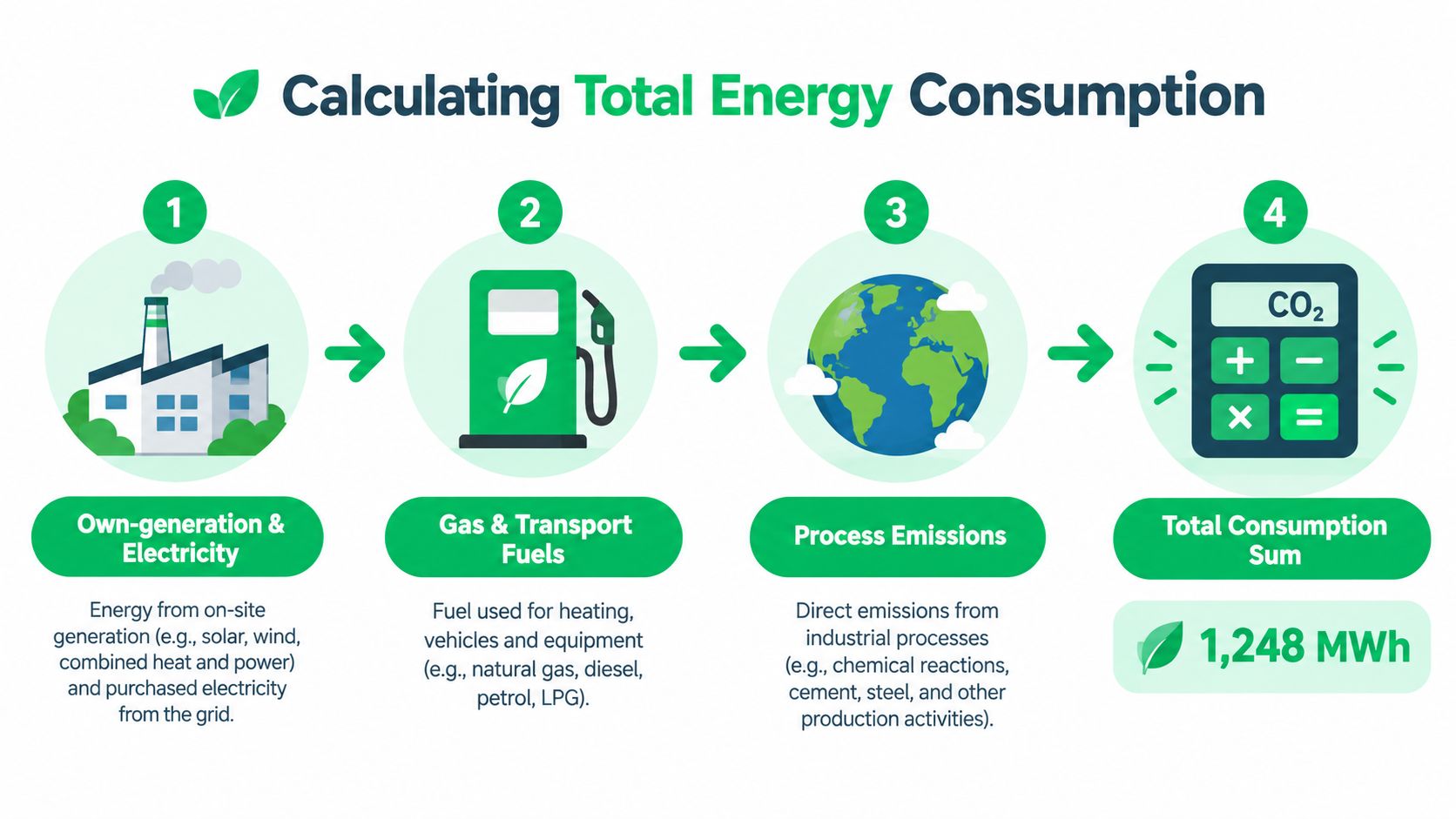
Build the boundary before choosing the audit
The required route must cover at least 95% of TEC, or all significant energy consumption where that applies. That isn't a rounding exercise. It's a coverage reconciliation that should show the total, the assessed elements, exclusions and the evidence supporting each exclusion. The government's Phase 4 compliance guidance sets out the need for verifiable consumption data and auditable coverage.
A compliant audit normally uses verifiable energy data covering a 12-month period beginning no earlier than 6 December 2022. Keep the chosen period consistent across the calculation and supporting assessment documents. For a multi-site estate, retain the number of sites, sites visited, consumption calculation, audit period and the justification that the selected sites are representative.
Common gaps include:
- Grey fleet activity: Business mileage may sit outside the facilities or finance dataset. Assign ownership to fleet, HR or finance and retain the underlying records.
- Landlord supplies: A tenant may receive electricity or heat through an arrangement that doesn't provide a clean meter trail. Obtain landlord statements and document the allocation method.
- Transport fuels: Petrol, diesel and other transport-energy records must be reconciled with the relevant operations, not treated as an optional appendix.
- Weak estimates: An estimate without a source, method and reconciliation won't support a complete coverage conclusion.
- Legacy routes: DECs and Green Deal Assessments are no longer alternative compliance routes for Phase 4. Don't leave them in the project plan as if they remain available.
The data model should be useful beyond ESOS. A well-controlled business carbon footprint process can provide a practical foundation, but the ESOS file must still demonstrate its own coverage and evidence requirements.
Practical rule: Don't ask whether the data is available in general. Ask who owns each dataset, what period it covers and what document proves the figure.
Choosing Between an ESOS Energy Audit and ISO 50001
This is a procurement decision, not a debate about which framework sounds more advanced. The board should select the route that gives the organisation the clearest evidence across the actual energy portfolio, with the least risk of a late coverage failure.
An ESOS energy audit is usually the more direct route for a newly qualifying group or a diversified portfolio. It uses the required consumption evidence, examines energy efficiency, identifies savings opportunities and includes site visits. The work is then reviewed and supported through the ESOS compliance process, including the necessary Lead Assessor involvement.
A qualifying ISO 50001 route can be efficient where the organisation already operates a properly certified energy management system covering the relevant energy consumption. The certificate must be checked for scope, sites, asset classes and boundaries. A certificate covering only a selected division won't solve a group-wide coverage problem.
Compare the evidence burden
| Dimension | ESOS energy audit route | ISO 50001 alternative route |
|---|---|---|
| Existing capability | Suitable where audit capability needs to be created for Phase 4 | Suitable where a certified system is already established |
| Site coverage | Requires a documented audit approach and representative site visits | Depends on the certified system's actual scope |
| Evidence burden | Energy data, audit findings, opportunities and site evidence | Certificate, scope and supporting system evidence |
| Portfolio fit | Strong option for varied buildings, processes and transport | Strong option where the system covers the full relevant portfolio |
| Main risk | Incomplete data or weak sampling can undermine the audit | Selective certification can leave uncovered energy outside the route |
| Board decision | Approve an audit scope and Lead Assessor engagement | Confirm that certification genuinely covers the required boundary |
The audit route generally wins for diversified estates, newly in-scope groups and portfolios where the coverage arithmetic is uncomfortable. It gives the organisation a structured way to investigate gaps rather than pretending an existing certificate covers them.
ISO 50001 wins where certification is real, current and broad enough to cover the organisation's relevant regions, operations and energy uses. Don't choose it because the certificate already exists. Choose it only after testing the certificate's scope against the TEC reconciliation.
The decision rule is simple: use ISO 50001 when it demonstrably covers the required consumption; use an ESOS audit when it doesn't or when the portfolio needs a fresh, defensible assessment. Cost matters, but a cheaper route that fails coverage is not a saving.
Site Visits, Sampling and Lead Assessor Sign-Off
A multi-site organisation doesn't necessarily need identical on-site work at every location, but it does need a sampling approach that a Lead Assessor can defend. The sample should be representative of the portfolio and weighted towards the sites and activities that matter most to total energy consumption.
Start with the energy map. Rank sites by consumption, then overlay operational risk. High-consumption plant should receive priority, as should buildings with multiple tenancies, unusual energy arrangements or unreliable records. A smaller site may also deserve attention if its data is weak or its process differs materially from the rest of the estate.
Make the sample defensible
Document why each site was selected and why others were not. The evidence pack should explain the relationship between the sample and the full portfolio, including the energy-weighted logic, operational similarities, differences between asset classes and any exclusions.
A credible sampling record answers four questions:
- Which sites consume the most energy?
- Which sites represent distinct buildings, processes or transport operations?
- Which sites have the weakest or most uncertain data?
- Why does the selected sample provide a reasonable basis for the wider conclusion?
The Lead Assessor's review is not limited to a polished report. They need to see the TEC calculation, coverage evidence, audit or ISO documentation, site-visit records, energy-saving measures and the compliance material submitted through MESOS. Recommendations should be sufficiently specific for the organisation to understand the expected energy effect, financial implications and implementation logic.
Prepare the sign-off file
The most common failures are mundane. A subsidiary is omitted from the group perimeter. Transport fuels aren't reconciled. A de minimis exclusion is mentioned without a documented rationale. The site sample is described as representative but no energy-weighted analysis supports it.
These weaknesses surface at notification. They can force rework, delay board approval and leave the Lead Assessor unable to support the submission confidently. The organisation should therefore create a sign-off pack before the final review, not assemble it while the notification deadline approaches.
The Lead Assessor should be engaged early enough to challenge the boundary, not merely sign a finished document.
Board approval also needs substance. The approving director should understand the participant group, the energy total, the coverage route, the material findings and the commitments that will flow into the action plan. A signature without an evidence trail is a weak control.
Your Phase 4 Timeline From Now to December 2027
The project should run backwards from 5 December 2027, while treating 31 December 2026 as the point at which qualification and group scope lock in. The organisation can refine delivery choices later, but it can't postpone the underlying evidence strategy indefinitely.
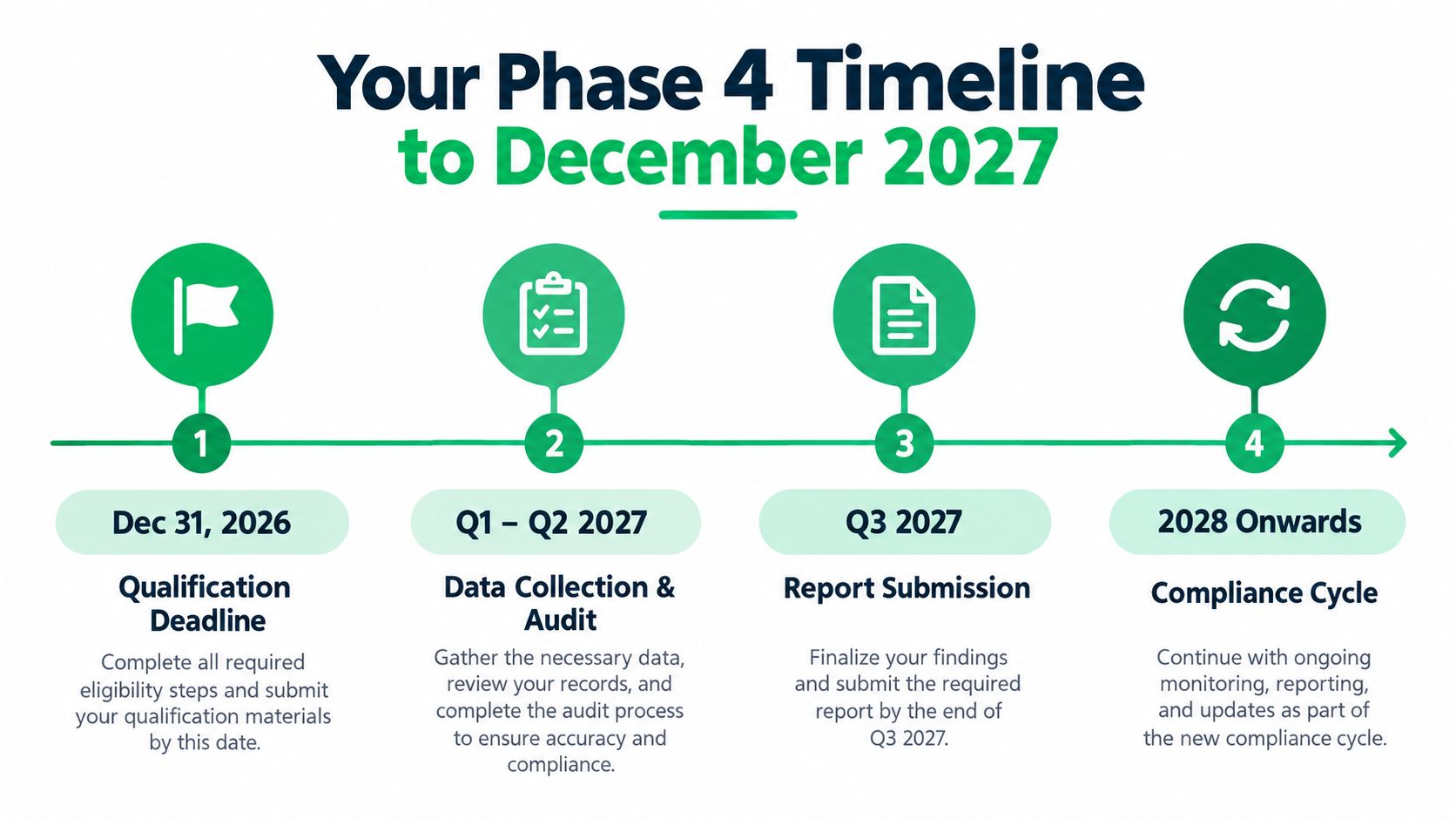
Before 31 December 2026
Confirm the legal-entity structure, UK subsidiaries, employee position and financial information relevant to the large-undertaking test. Establish the prior energy baseline and identify owners for buildings, processes and transport data.
Decision locked: whether the organisation qualifies and which entities form the participant group.
Early 2027
Appoint a Lead Assessor or confirm the suitability of the ISO 50001 route. Freeze the TEC methodology, issue data requests and identify sites requiring visits. Resolve landlord, fleet and missing-meter questions before they become audit exceptions.
Decision locked: the assessment route, evidence owners and initial site scope.
During the middle of 2027
Complete the energy audit work or assemble the ISO evidence. Carry out site visits, document sampling, reconcile energy datasets and test whether the chosen route reaches the required coverage. Record energy-saving opportunities in a format that the board can assess.
Decision locked: the coverage conclusion and the findings that support the compliance notification.
Before 5 December 2027
Give the Lead Assessor time to review the evidence, challenge exclusions and confirm the notification. Obtain board-level sign-off, complete the MESOS submission and retain the final evidence pack.
Decision locked: the organisation's formal notification of compliance.
The UK ESG reporting deadline planning resource can help place ESOS alongside the organisation's wider reporting calendar, but ESOS should have its own accountable project owner.
The work doesn't end at notification. The subsequent action-plan deadline is 5 December 2028. Use the period after submission to convert the assessed opportunities into owned actions, budgets and progress controls rather than treating the action plan as an administrative afterthought.
The board can defer fine detail such as the final wording of individual measures. It shouldn't defer scope, data ownership, assessor capacity or the route decision until late 2027.
Using Phase 4 to Feed Your Wider UK Reporting
ESOS evidence is too expensive to leave in a compliance folder. The energy data, asset register, site evidence and savings recommendations should be designed for controlled reuse across the organisation's reporting and procurement work.
The first reuse opportunity is Streamlined Energy and Carbon Reporting, where the same underlying consumption records may support the required energy narrative and calculations. Build one controlled dataset, retain its source documents and define the conversion and estimation rules once. The SECR reporting requirements guide provides a separate reference point for that reporting work.
The second is procurement. Where a customer or contracting authority asks for a carbon reduction plan, an ESOS audit can provide evidence of identified efficiency measures and management attention. It doesn't automatically satisfy every procurement requirement, but it can give the organisation a stronger factual base than a generic commitment statement.
The third is sustainability disclosure. For larger groups with relevant reporting obligations, the same energy baseline and decarbonisation actions may support climate-related reporting under ESRS E1. The organisation should check scope and applicability separately rather than assume that ESOS compliance equals reporting compliance.
| ESOS Phase 4 Output | SECR | PPN 006 | CSRD (ESRS E1) |
|---|---|---|---|
| Controlled TEC dataset | Supports energy consumption reporting | Provides evidence for organisational carbon information | Can support energy and climate data preparation |
| Asset and site register | Helps explain operational boundaries | Supports the description of operational measures | Supports climate data boundaries and controls |
| Audit recommendations | Provides context for efficiency actions | Can inform carbon reduction commitments | Can inform transition and energy-efficiency actions |
| Board sign-off and evidence trail | Strengthens internal governance | Supports credible procurement responses | Supports accountability and assurance readiness |
| Action plan and ownership | Helps connect data to management action | Provides a basis for implementation commitments | Helps structure targets, measures and progress tracking |
Assign one data owner across the ESOS, reporting and procurement workstreams. Store source invoices, meter information, fleet records, assumptions, site selections and approvals in a controlled evidence pack. That approach reduces duplicate requests and makes inconsistencies visible before they reach a regulator, customer or assurance provider.
The board should ask one final question: which ESOS outputs will be reused, by whom and under what control? If nobody owns that answer, the organisation will pay repeatedly for the same data exercise.
ESG Consulting supports UK organisations with ESOS Phase 4 scoping, energy data review, site audits, 95% coverage analysis, Lead Assessor sign-off and notification preparation. If your group needs a defensible route from the 31 December 2026 qualification date to the 5 December 2027 deadline, visit ESG Consulting to discuss the assessment and evidence plan.