SBTi, science based targets initiative, carbon targets, net zero, UK sustainability
Science Based Targets Initiative: A 2026 UK Guide
By ESG Consulting Team · · 14 min read
“Set the target, get it validated” is incomplete advice. It encourages boards to treat approval as the achievement, when the harder decisions concern investment, supplier contracts, operational change and evidence of actual emissions reductions.
The Science Based Targets initiative (SBTi) should sharpen those decisions, not replace them. For a UK board or audit committee, the test is whether management can connect the target to an accountable owner, an affordable delivery pathway and reporting that survives scrutiny. Approve the ambition, but challenge the implementation with the same discipline you'd apply to any material business programme.
Table of Contents
- Why the Science Based Targets Initiative Matters in 2026
- How the SBTi Framework Actually Works
- Choosing the Right Target-Setting Approach
- The Submission and Validation Process Explained
- Scope 3 as the Real Delivery Risk for UK Companies
- Navigating the Move to SBTi V2 in 2026
- Connecting SBTi to the UK Regulatory Calendar
- Turning an Approved Target into a Funded UK Delivery Plan
Why the Science Based Targets Initiative Matters in 2026
Joining the SBTi doesn't demonstrate decarbonisation. It signals an intention to develop targets, while validation establishes that a submitted target meets the applicable criteria. Neither should be presented as proof that the organisation has delivered its planned reductions.
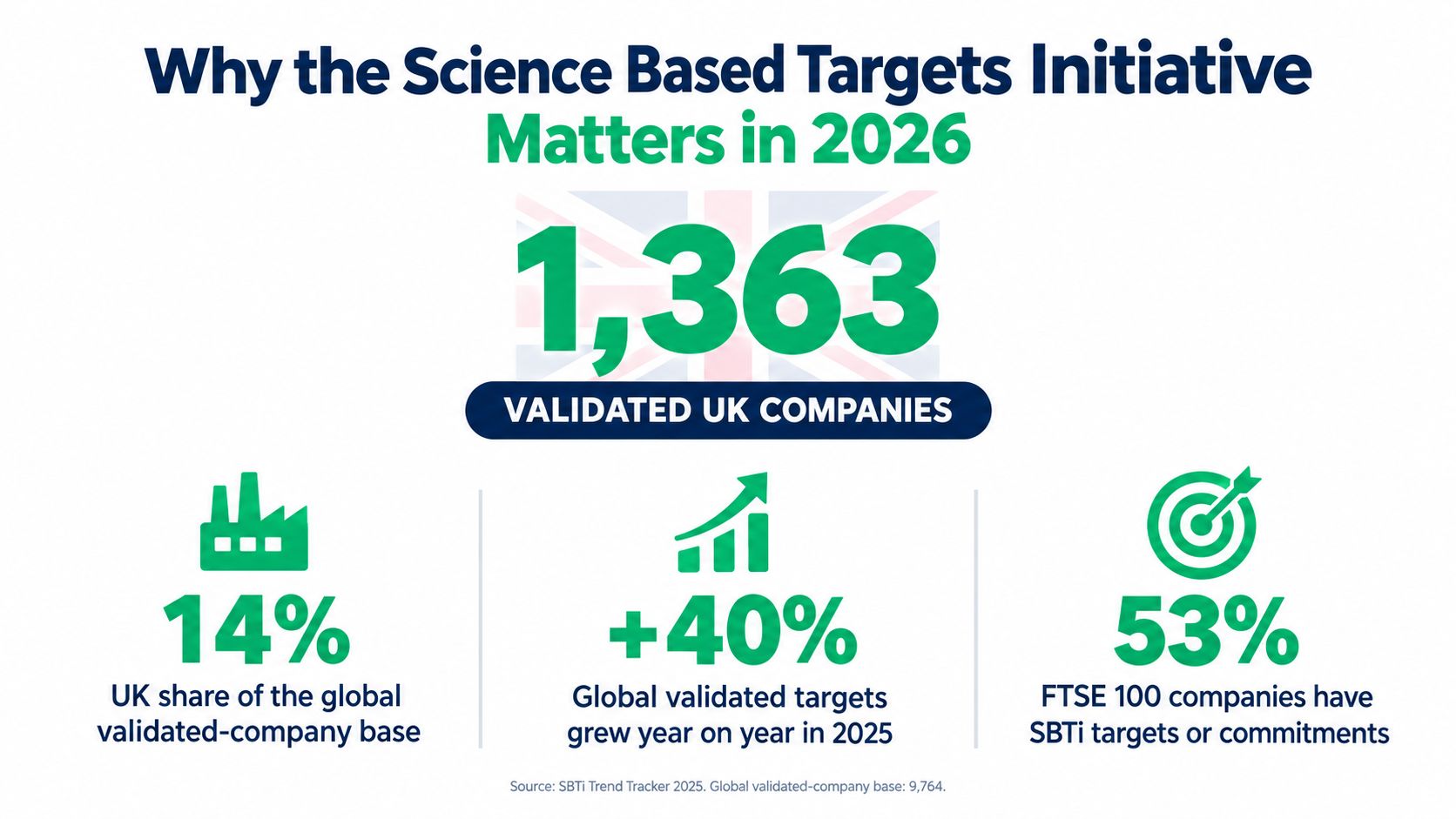
The UK's participation nevertheless makes this a serious management issue. By the end of 2025, the UK had 1,363 organisations with validated targets, representing 14% of the global total and ranking second behind Japan, according to the SBTi adoption figures and monitoring evidence. For boards, the relevant conclusion is not that participation guarantees performance, but that target-setting now belongs in mainstream corporate planning.
The headline UK adoption figure provides context, not a measure of emissions saved.
Participation extends beyond heavy industry
An earlier CDP briefing identified 524 UK-headquartered participants, including 220 with approved near-term targets, and named businesses including AstraZeneca, Schroders, Tesco, BT, Network Rail and Severn Trent in its review of corporate science-based target setting. That breadth matters: pharmaceuticals, financial services, retail, transport and utilities face different operational constraints, yet all feature in the initiative.
A supplier shouldn't dismiss SBTi because its own operations appear modest. The practical question is whether important customers expect compatible emissions information, supplier engagement or a credible reduction pathway.
Board test: Ask what participation changes in purchasing, investment and management accountability. If the answer concerns only communications, the programme is underdeveloped.
Management should distinguish commercial expectations from legal obligations. A customer's target-setting request isn't automatically a statutory requirement, but it can still influence a contract negotiation.
My recommendation is to assess SBTi alongside customer concentration, capital planning and investor communications. Do not join because peers have joined. Establish which business decisions the target must influence, then give the programme enough authority to influence them.
How the SBTi Framework Actually Works
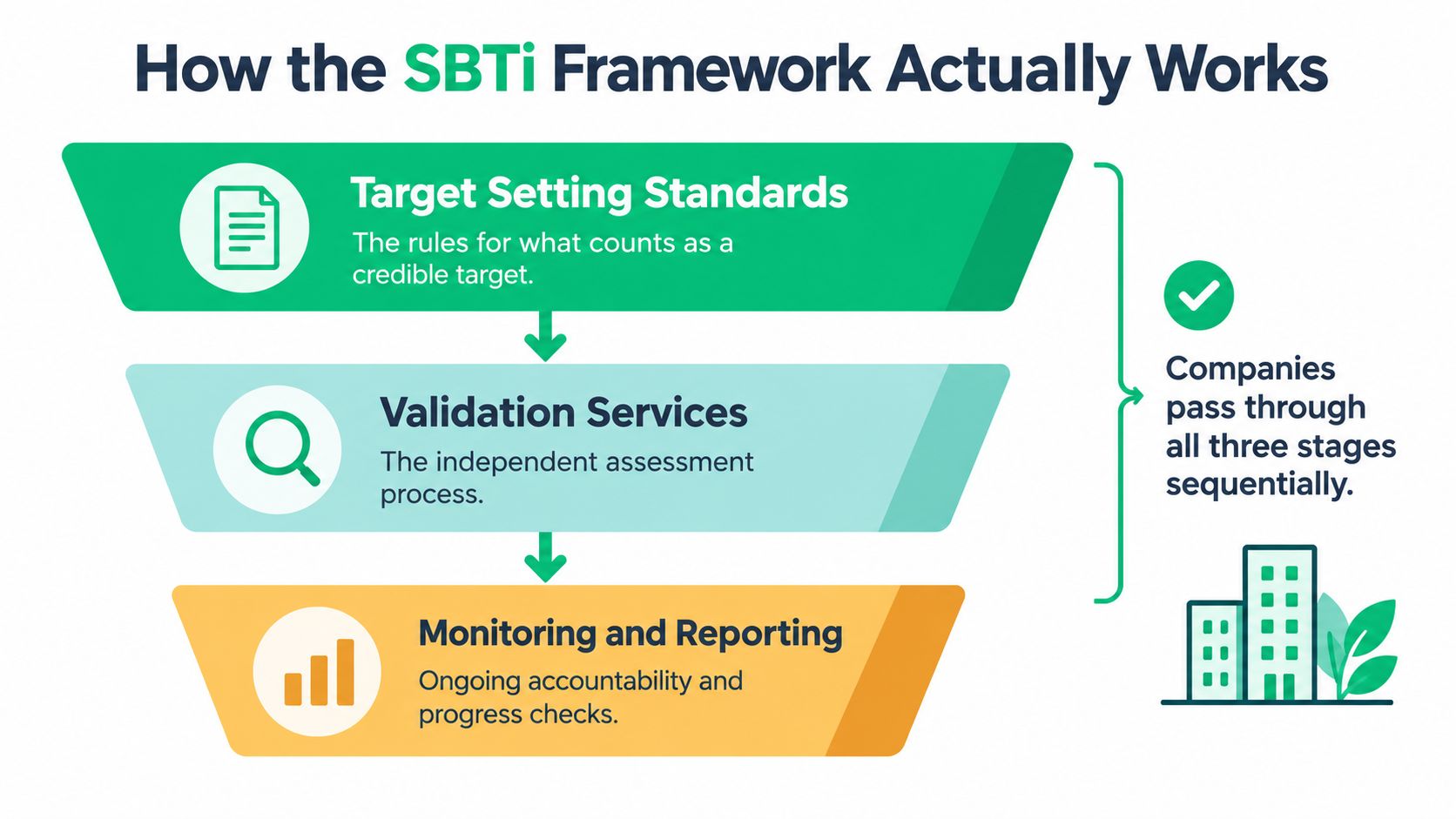
Think of SBTi as a filter for target credibility, rather than a complete operating manual for decarbonisation. Management develops the emissions inventory and proposed pathway, the target undergoes assessment, and the organisation remains responsible for delivery.
The distinction is important. A technically acceptable target doesn't select your heating technology, renegotiate supplier agreements or authorise capital expenditure. Those are management decisions, and they require a separate implementation process.
The framework is easier to understand when standards, validation and reporting are kept distinct.
Separate the pathway from the assessment
Near-term targets provide the nearer operational milestones. Long-term targets describe the deeper transformation required across the organisation and its value chain. Validation concerns the acceptability of those commitments, not an assurance opinion on every future management decision.
Read the target wording carefully. A statement about operational emissions is not interchangeable with a statement covering the value chain, and a near-term approval shouldn't be described as approval of every aspect of a net-zero strategy.
Use these distinctions when reviewing board papers:
- Committed status: Describe an intention to set targets, not an approved emissions pathway.
- Validated status: Specify exactly which targets have been approved and what they cover.
- Delivery status: Present actual performance separately, with supporting evidence and explanations of variance.
Keep climate action and accounting separate
For management purposes, distinguish reductions within the inventory from expenditure on climate projects elsewhere. Don't let a discussion about credits obscure decisions about fuel, electricity, materials or product design.
Likewise, don't describe validation as regulatory clearance. The board still needs to understand which legal, contractual and disclosure requirements apply to the organisation.
The most useful management pack separates target requirements, actual emissions performance and funded interventions. Combining them into a single green status indicator conceals the difference between an acceptable destination and a credible route to reach it.
Choosing the Right Target-Setting Approach
Choose the method after examining the footprint, not after opening a modelling template. Absolute contraction, intensity-based targets and the Sectoral Decarbonisation Approach (SDA) answer different questions. Treat them as options to assess against the applicable criteria, not interchangeable routes available to every organisation.
An absolute approach focuses on total emissions. An intensity approach relates emissions to a defined activity measure. A sectoral approach connects the proposed trajectory to an applicable sector pathway. Before selecting any of them, confirm eligibility under the relevant standard and guidance.
SBTi target-setting approaches at a glance
| Approach | Best suited to | Watch-out for |
|---|---|---|
| Absolute contraction | Organisations seeking a clear total-emissions trajectory | Growth assumptions and acquisitions can make delivery more demanding |
| Intensity-based | Activities with a meaningful, consistently measurable output denominator, where permitted | Improved intensity can coexist with rising total emissions |
| Sectoral Decarbonisation Approach | Activities covered by an applicable sector-specific pathway | Sector classification and activity data must genuinely fit the method |
A finance director should demand a business-as-usual forecast before approving the method. Test planned growth, changes in product mix and acquisitions against the proposed trajectory. A pathway that works only when the business stops growing isn't necessarily wrong, but the board must understand that assumption.
For a retail CFO, operational efficiency alone is an inadequate basis for method selection. Examine purchasing, product composition and the relationship between sales growth and the value-chain footprint. An economically convenient denominator can obscure physical emissions movement.
An NHS estates lead should start with responsibility and applicability. Establish which assets, services and organisational entities the proposed pathway covers before deciding whether a particular corporate target-setting route is suitable.
Defend the denominator
Intensity metrics require particular care. Revenue can change because of pricing, while physical output can change because of product mix. Neither movement automatically demonstrates better environmental performance.
Choose the method that explains the business honestly, not the method that produces the easiest-looking chart.
Keep a written method-selection memorandum. Record the alternatives considered, eligibility checks, growth assumptions, denominator choice and reasons for rejection. An auditor, investor or procurement reviewer should be able to understand the decision without reconstructing the consultant's spreadsheet.
The Submission and Validation Process Explained
Prepare the submission as an evidence package, not a completed questionnaire. The working papers should explain how management moved from source records to the baseline, from the baseline to the target, and from the target to its proposed coverage.
Use the following evidence gates as an internal readiness review. They're a practical way to organise the submission, rather than a substitute for checking the applicable SBTi criteria.
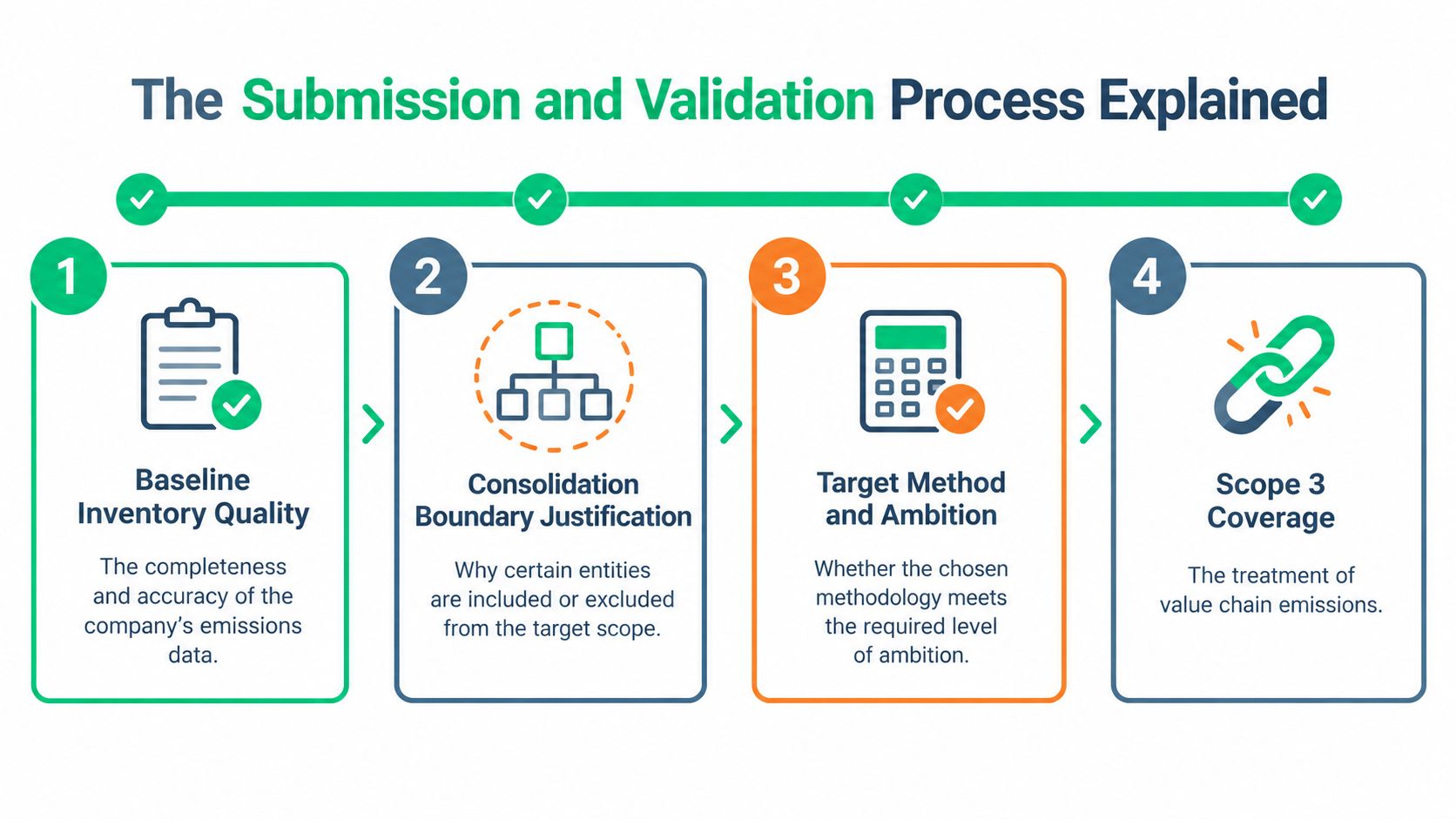
Build a submission that another reviewer can reproduce
Baseline inventory quality comes first. Retain activity records, calculation files, emission-factor references, assumptions and evidence of internal review. Where estimates are necessary, identify them explicitly rather than allowing them to look like measured data.
For consolidation boundary justification, prepare an entity map and explain the consolidation approach. Parent-level submissions must include subsidiaries within the chosen emissions-consolidation boundary; long-term targets must include relevant Scope 3 categories, and annual public target disclosure is required under the SBTi Corporate Net-Zero Standard criteria.
The target method and ambition file should preserve the model version, inputs and approval record. A reviewer needs to see why the selected approach applies, not merely that a spreadsheet produced an answer.
Finally, prepare Scope 3 coverage documentation. Explain the category assessment, exclusions and data limitations in language that procurement and finance can challenge.
Manage the hand-off into reporting
Don't promise a validation date before checking current service arrangements and the completeness of the evidence. Build time into the project plan for clarification requests and internal decisions, rather than assuming submission ends the technical work.
Before approval is announced, agree:
- Exact claim wording: Identify the approved target without implying wider certification.
- Evidence ownership: Assign responsibility for preserving the model and responding to questions.
- Reporting hand-off: Connect the target record to the annual disclosure process.
- Change control: Record how acquisitions, disposals and methodological changes will be assessed.
The audit committee should receive unresolved judgements before submission, not after publication. Boundary disagreements and uncertain category coverage are governance matters when they affect the meaning of a public commitment.
Scope 3 as the Real Delivery Risk for UK Companies
For a retailer, a precise operational inventory can coexist with a heavily estimated overall footprint. A 2025 assessment of major UK retailers found that Scope 3 represented at least 90% of their carbon footprints, while extensive estimation and repeated baseline recalculations complicated progress tracking, as documented in the retail climate-commitment assessment.
The management problem is attribution. If an inventory uses procurement spend multiplied by average factors, a change in expenditure can alter the reported result without an equivalent change in physical emissions. Inflation, supplier coverage and revised methodology therefore need to be distinguished from operational decarbonisation.
Control uncertainty before celebrating progress
Start with a category register that ranks emissions contribution and data uncertainty separately. A category can be material even when management has little confidence in its estimate. That combination should determine the priority for improvement.
Build the controls into procurement and finance workflows:
- Document recalculation decisions: Explain when a baseline change is justified and who authorises it.
- Improve material estimates: Prioritise supplier activity data or verified product information where it can change decisions.
- Map supplier coverage: Connect engagement requests to the sources included in the target.
- Preserve comparability: Retain previous calculations so reviewers can distinguish a revised estimate from a genuine reduction.
A supplier questionnaire is only useful if someone checks the answers. Request the reporting boundary, reporting period, calculation method and treatment of missing data, rather than accepting a standalone carbon total.
Give procurement an operational role
Procurement teams should translate emissions priorities into category strategies and contract discussions. Sustainability specialists can assess methodology, but buyers control many of the commercial conversations required to improve supplier information.
For implementation detail, use a structured approach to Scope 3 emissions reporting that connects value-chain mapping with data ownership and supplier engagement. Don't launch a broad information request without deciding how responses will influence purchasing.
Audit committee challenge: Require management to distinguish reported reductions caused by better information from reductions caused by changed activity.
The board doesn't need to review every emission factor. It does need confidence that management can explain material movements, identify uncertainty and show which procurement decisions are changing the underlying footprint.
Navigating the Move to SBTi V2 in 2026
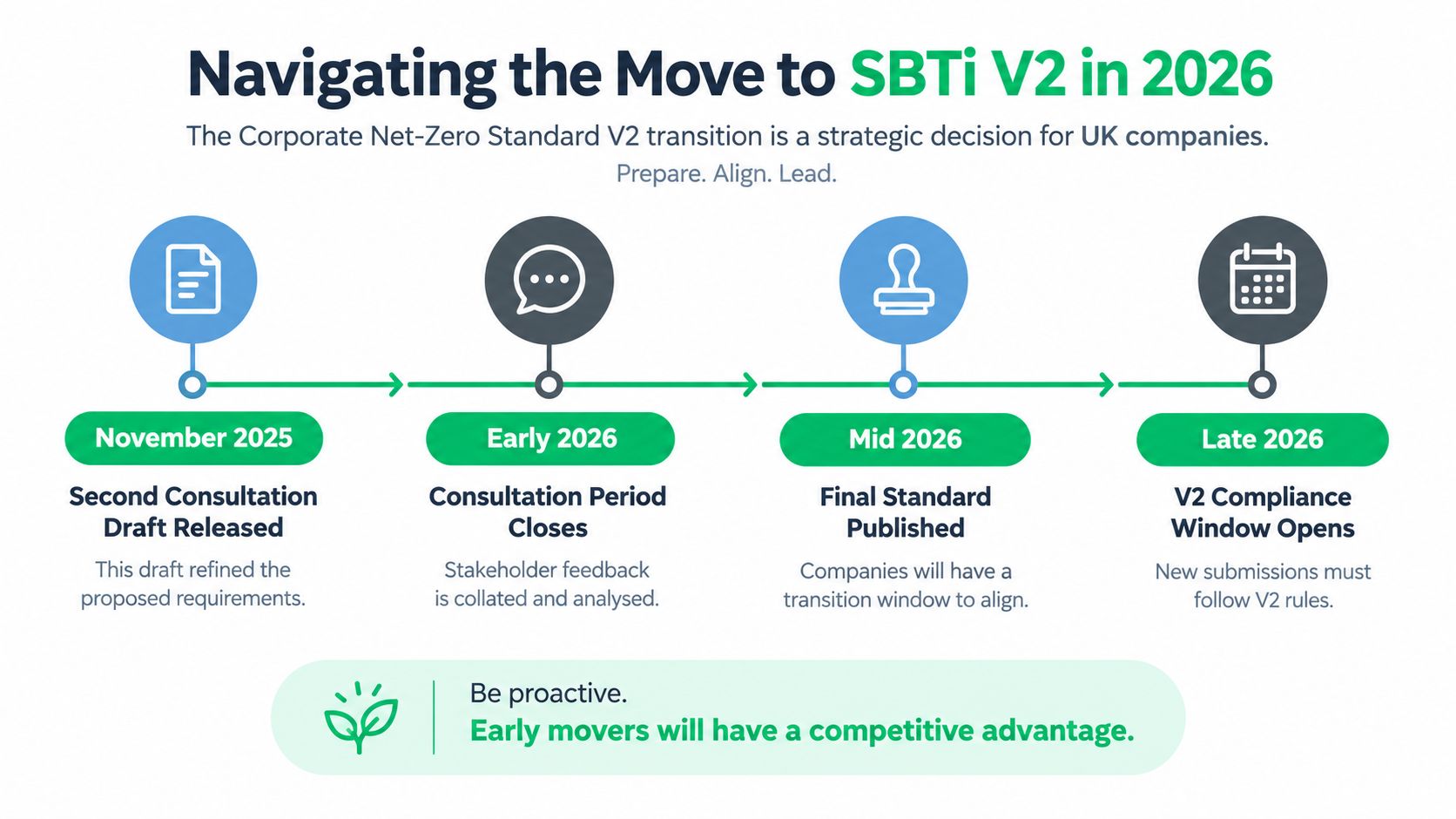
Treat the Corporate Net-Zero Standard V2 transition as a decision about timing, evidence and flexibility. Waiting for certainty can delay useful work, but rushing an immature inventory into submission can create avoidable rework.
SBTi released a second consultation draft in November 2025, with publication planned for 2026; its announced transition allows current-version target setting until 31 December 2027, with V2 expected to become mandatory for new targets from 1 January 2028, according to the SBTi V2 consultation announcement.
Use the announced transition dates above for planning. Illustrative milestones shouldn't be treated as confirmed publication or compliance deadlines.
Decide according to readiness and business need
| Decision | When it makes sense | Required safeguard |
|---|---|---|
| Submit under the current framework | The inventory is mature and a customer or strategic commitment makes timing important | Record the version used and assess transition implications |
| Defer submission | Material boundary or data decisions remain unresolved | Set a recovery plan rather than an indefinite pause |
| Build an adaptable inventory | Submission timing remains uncertain | Preserve category-level data, assumptions and model versions |
My recommendation is to continue inventory and governance work regardless of submission timing. Those foundations support either route and are more useful than speculative modelling of every draft provision.
Scenario-test changes to Scope 3 treatment, supplier engagement, recalculation and the distinction between reductions and removals. These are planning sensitivities, not a licence to describe consultation proposals as final requirements.
Protect board approvals and public claims
Give the board a version-controlled decision paper. It should distinguish current requirements, proposed changes and management assumptions, with a clear trigger for revisiting approval.
Use supporting discussion to inform the decision, not as authority for submission rules.
Don't assume that an existing target becomes invalid because a revised standard is published. Equally, don't promise that no changes will be needed. Check the applicable transition provisions before making statements to customers, investors or assurance providers.
Connecting SBTi to the UK Regulatory Calendar
Build a single reporting calendar, but don't pretend every framework asks the same question. SBTi concerns target-setting; statutory reporting, procurement requirements and investor questionnaires have their own applicability, boundaries and evidence needs.
The practical opportunity is to reuse controlled information without forcing artificial consistency. A difference between reporting boundaries may be legitimate. An unexplained difference is the problem.
Reuse evidence without merging obligations
| Reporting or stakeholder context | Recommended connection to SBTi work |
|---|---|
| SECR | Reconcile inventory boundaries, activity data and intensity measures |
| UK SRS readiness and TPT-aligned planning | Connect targets with governance, financial assumptions and transition actions |
| PPN 006 and NHS Evergreen preparation | Check that procurement statements match the underlying inventory and plan |
| CDP, PRI and SFDR responses where relevant | Reuse approved evidence while respecting entity, portfolio and questionnaire differences |
This is a coordination map, not a statement that every organisation must report under every framework. Ask legal, finance and procurement owners to confirm applicability before assigning work.
Use a maintained UK ESG reporting deadlines calendar to schedule data closure, technical review, board approval and publication. The deadline is the end of that workflow, not the date on which preparation should begin.
Establish a controlled reporting dataset
Maintain an inventory record with entity coverage, reporting periods, source references and documented adjustments. Where disclosures differ, prepare a reconciliation rather than asking separate teams to recreate the calculation.
Assign finance responsibility for links to budgets and financial assumptions, legal responsibility for applicability and claims review, and sustainability responsibility for technical consistency. Procurement should own supplier evidence requests and contractual follow-through.
The board should approve one coherent account of the organisation's direction. Different disclosures can use different formats, but they shouldn't imply incompatible baselines, investment plans or levels of progress.
Turning an Approved Target into a Funded UK Delivery Plan
The implementation gap is financial as well as technical. The BSI Net Zero Barometer 2025 reported that 36% of UK businesses said they had set a net-zero target, while 86% cited cost as a barrier and 53% of larger firms cited supply-chain complexity, according to BSI's UK business findings.
Those findings aren't a measure of SBTi performance. They are a reason to challenge whether the organisation has funded the changes its target implies.
Require an investable pathway
A credible net-zero strategy connects interventions with capital requests, operating costs, dependencies and decision dates. Don't accept a reduction curve that depends on unspecified future technology or supplier action that nobody has negotiated.
Take this checklist into the next management meeting:
- Accountability: Name the executive responsible for delivery and escalation.
- Investment: Separate approved expenditure from proposals still competing for funding.
- Sequencing: Identify procurement, infrastructure and operational dependencies.
- Supplier action: Allocate commercial ownership of value-chain interventions.
- Evidence: Preserve the records needed to demonstrate what changed and why.
Approval establishes the target. Management establishes whether the organisation can deliver it.
Require a clear explanation of the gap between the funded programme and the approved pathway. If management cannot close that gap immediately, the board should see the decisions, constraints and consequences explicitly.
The hardest question isn't whether the target will be approved. It's whether the organisation will make the purchasing, investment and operational decisions required to deliver it.
ESG Consulting offers SBTi target modelling and submission support, Scope 3 inventories, and costed decarbonisation pathways linked to UK reporting requirements. Visit ESG Consulting to scope a senior-consultant-led review of your baseline, V2 transition decisions and delivery funding before your next board approval.