scope 3 emissions reporting, GHG protocol, SBTi, value chain emissions, UK sustainability
Scope 3 Emissions Reporting: A UK Guide for 2026
By ESG Consulting Team · · 14 min read
A UK-listed group has just signed off its Streamlined Energy and Carbon Reporting figures. The directors' report is complete, the Scope 1 and Scope 2 calculations have been reviewed, and the compliance question appears closed. Then procurement asks for emissions from purchased goods, logistics and supplier operations. An investor requests value-chain data. A major customer adds a Scope 3 questionnaire to the next tender.
The organisation has met a formal reporting requirement, but it still can't answer a basic commercial question: what emissions arise across the activities that make its business possible?
That gap is now common. Scope 3 emissions reporting sits between legal disclosure, customer due diligence, transition planning and operational risk. A credible programme doesn't begin with a polished total. It begins with a documented boundary, a materiality decision, transparent estimates and evidence that another reviewer can follow.
Table of Contents
- Why Scope 3 Reporting Matters for UK Organisations Now
- What Scope 3 Actually Covers
- Standards and Frameworks That Shape Scope 3 Reporting
- Building a Defensible Value-Chain Inventory
- Choosing the Right Estimation Approach
- Engaging Suppliers Without Drowning in Data Requests
- Preparing for Assurance and External Scrutiny
- A Sequenced Plan and Common Pitfalls
Why Scope 3 Reporting Matters for UK Organisations Now
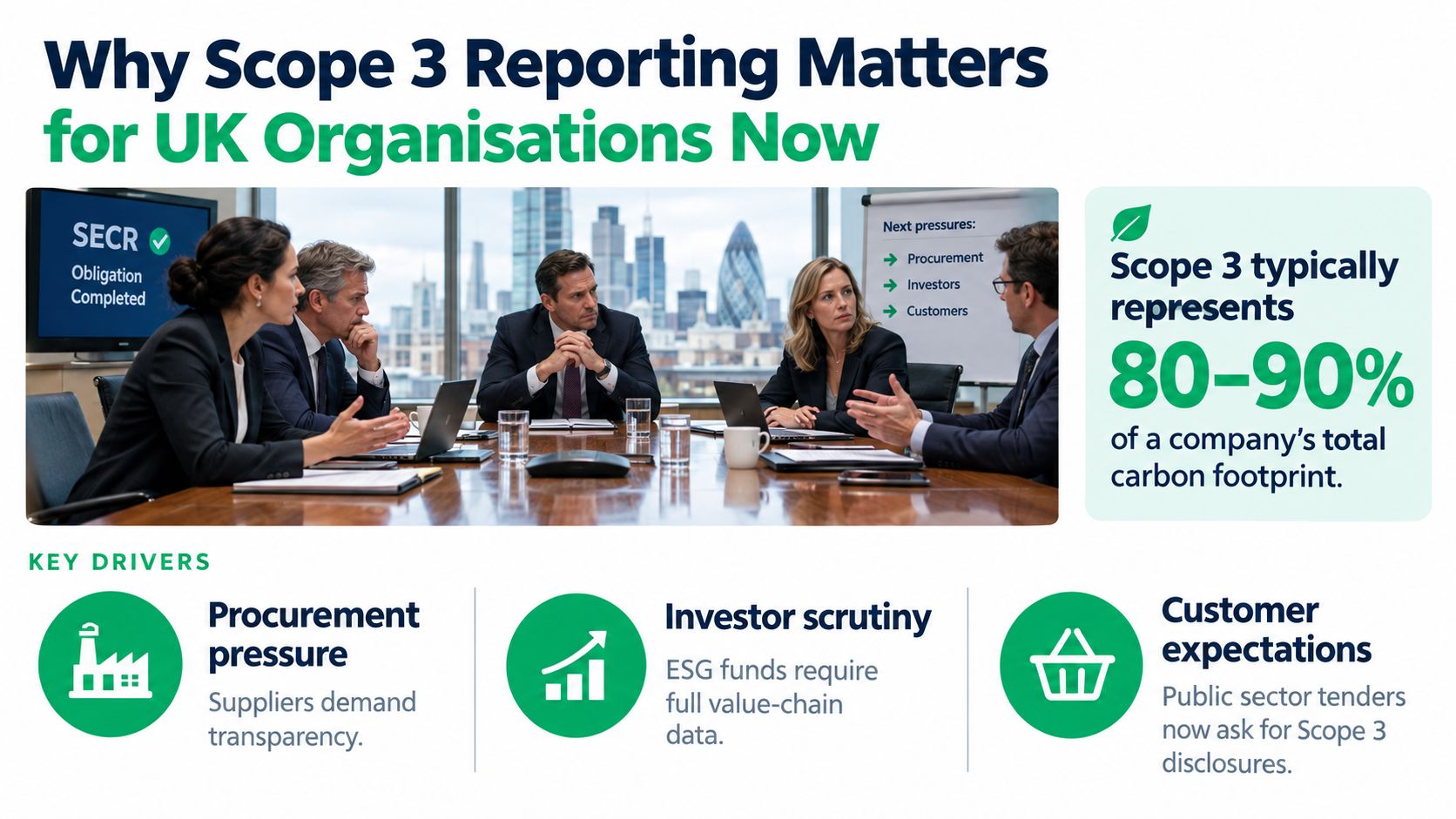
SECR creates an important distinction for UK organisations. Quoted companies must disclose specified global greenhouse-gas emissions, an emissions-intensity ratio, total global energy use, energy-efficiency actions and the methodology used in their directors' reports. The framework primarily mandates Scope 1 and Scope 2, while Scope 3 generally remains outside the minimum requirement, as the UK Government's reporting-landscape analysis explains.
That doesn't make value-chain emissions commercially irrelevant. Procurement teams may need supplier data for tender responses. Public-sector buyers can ask for carbon information through routes such as PPN 006. NHS suppliers may encounter expectations linked to NHS Evergreen. Customers and investors can also request Scope 3 information even when SECR doesn't require it.
Compliance is not the same as coverage
The UK Government's 19 October 2023 call for evidence identified Scope 3 as a major policy gap and sought views on whether, and how, reporting should expand. That signal matters even before any change in formal requirements. It tells boards that a limited SECR return shouldn't be presented as a complete carbon footprint.
A practical programme should therefore produce three things:
- A defensible inventory: clear boundaries, relevant categories, calculation methods and exclusions.
- A credible improvement plan: priorities for better activity data, supplier engagement and emissions reduction.
- An assurance-ready evidence file: source records, factor versions, approvals, assumptions and recalculation rules.
For a concise view of the wider UK compliance context, organisations can also review UK ESG rules and regulations. The central issue is straightforward. “Voluntary” under SECR doesn't mean low-stakes when customers, investors, procurement teams and transition plans depend on the answer.
What Scope 3 Actually Covers
The simplest way to understand the three-scope model is to follow responsibility through a business.
Scope 1 covers direct emissions from sources an organisation owns or controls, such as fuel burned in its sites or company vehicles. Scope 2 covers indirect emissions associated with purchased electricity, steam, heating and cooling. Scope 3 covers other indirect emissions across the organisation's value chain, both upstream and downstream.
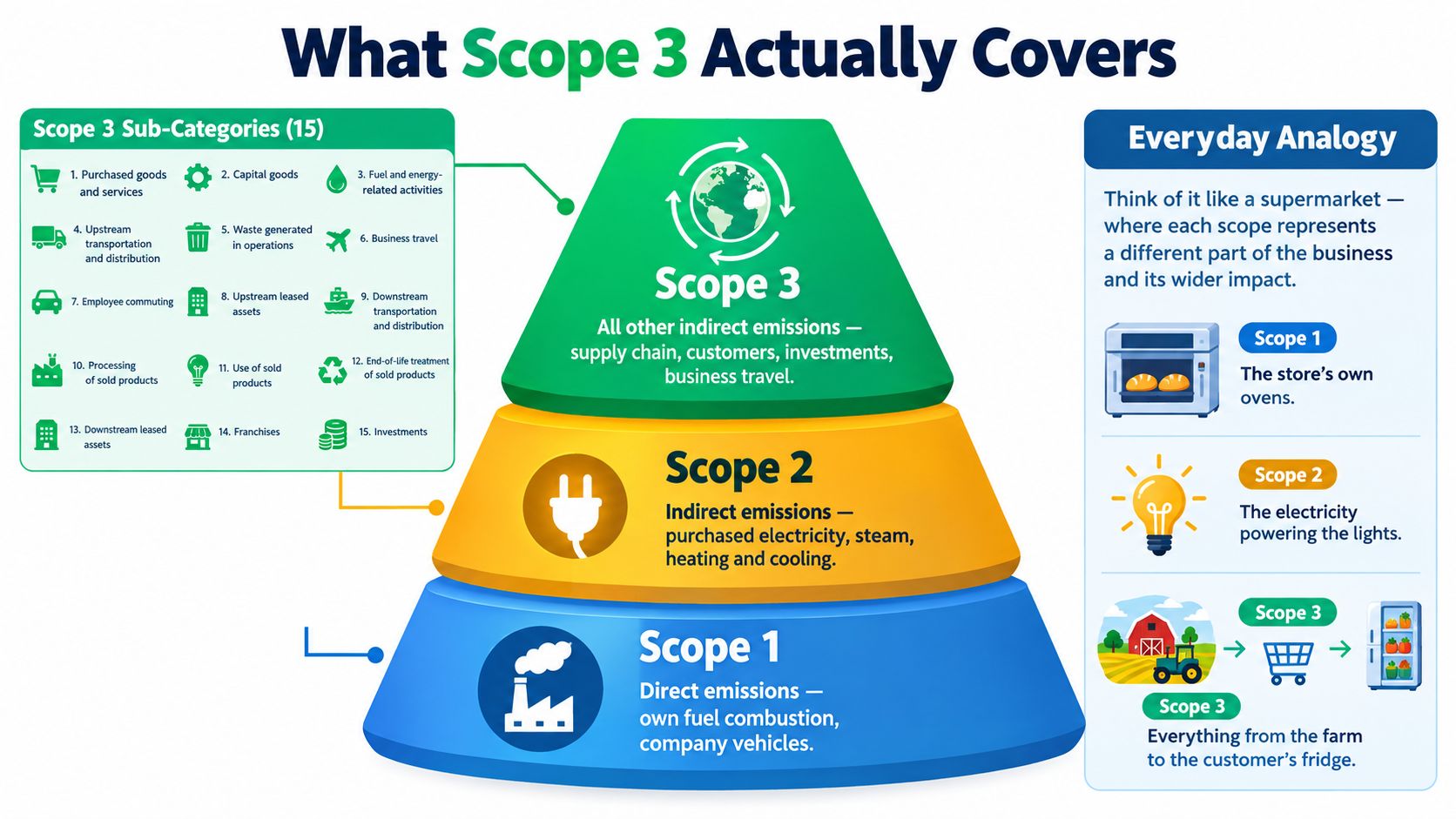
A supermarket analogy works well. Scope 1 is the store's own ovens and delivery vehicles. Scope 2 is the electricity used for lighting and refrigeration. Scope 3 includes farming, packaging, transport, employee commuting, customer use of sold products and disposal at the end of life.
The upstream map
The GHG Protocol organises Scope 3 into 15 categories. The upstream side generally includes:
- Purchased goods and services
- Capital goods
- Fuel- and energy-related activities not included in Scope 1 or Scope 2
- Upstream transportation and distribution
- Waste generated in operations
- Business travel
- Employee commuting
- Upstream leased assets
These categories often require collaboration between sustainability, finance, procurement, facilities, travel and human resources. Purchased goods may sit in accounts-payable data, while commuting may require a workforce survey or a structured assumption set.
The downstream map
The downstream categories follow products, services and assets after they leave the reporting organisation:
- Downstream transportation and distribution
- Processing of sold products
- Use of sold products
- End-of-life treatment of sold products
- Downstream leased assets
- Franchises
- Investments
Not every category applies to every organisation. A manufacturer may need to assess use of sold products and downstream transport. A bank may focus on investments. A property group may have significant leased-asset questions. The right inventory records which categories were considered, which apply and why any were excluded.
Practical rule: A Scope 3 total without category coverage, boundary notes and data-quality labels is a result, not yet a defensible inventory.
Standards and Frameworks That Shape Scope 3 Reporting
UK organisations rarely work against one framework in isolation. The GHG Protocol Corporate Value Chain Standard usually provides the accounting structure, including the value-chain boundary and category model. The inventory can then support target-setting, questionnaires and reporting, but each framework adds its own expectations.
| Standard | Scope 3 status | Boundary expectation | Assurance expectation |
|---|---|---|---|
| GHG Protocol Corporate Value Chain Standard | Methodological foundation for value-chain accounting | Assess relevant upstream and downstream categories across the value chain | The standard supports traceability, but the assurance level comes from the applicable reporting or assurance engagement |
| SBTi Corporate Net-Zero Standard v2.0 | Target-setting framework using Scope 3 information where relevant to the target boundary | Define a consistent base year, target boundary and emissions sources covered by the target | Target validation and progress reporting require controlled inventory evidence |
| CDP questionnaire | Disclosure route for investor and customer-facing climate information | Explain organisational boundary, Scope 3 categories, exclusions, methods and data quality | Evidence expectations depend on the response and stakeholder scrutiny, so unsupported claims remain risky |
| UK SRS S1 and S2, with CSRD and ESRS interfaces where applicable | UK sustainability disclosure framework, with climate-related value-chain considerations | Apply the relevant materiality and reporting requirements, documenting unavailable information and methods | Assurance requirements depend on the applicable legal regime and reporting cycle |
The UK position is particularly important. Current guidance says organisations should consider Scope 3 and disclose it when material to primary users, rather than assume a universal minimum requirement. The UK Sustainability Reporting Guidance for 2025 to 2026 therefore points towards a documented materiality assessment, not automatic omission.
Build one controlled dataset
The efficient sequence is to create one core inventory with category-level evidence, then map its outputs to each framework. Don't build a separate spreadsheet for CDP, a separate calculation for SBTi and another set of numbers for UK SRS. That approach creates reconciliation risk.
A stronger reporting architecture keeps the following under version control:
- Organisational and operational boundaries
- Category applicability decisions
- Base year and recalculation policy
- Activity data and conversion factors
- Supplier-specific evidence
- Estimates and data-quality ratings
- Materiality conclusions and exclusions
- Approval history and disclosure wording
A practical explanation of how UK frameworks interact is available in this guide to sustainability reporting frameworks. The important discipline is to separate the accounting method, the target method and the disclosure format. They overlap, but they aren't interchangeable.
Building a Defensible Value-Chain Inventory
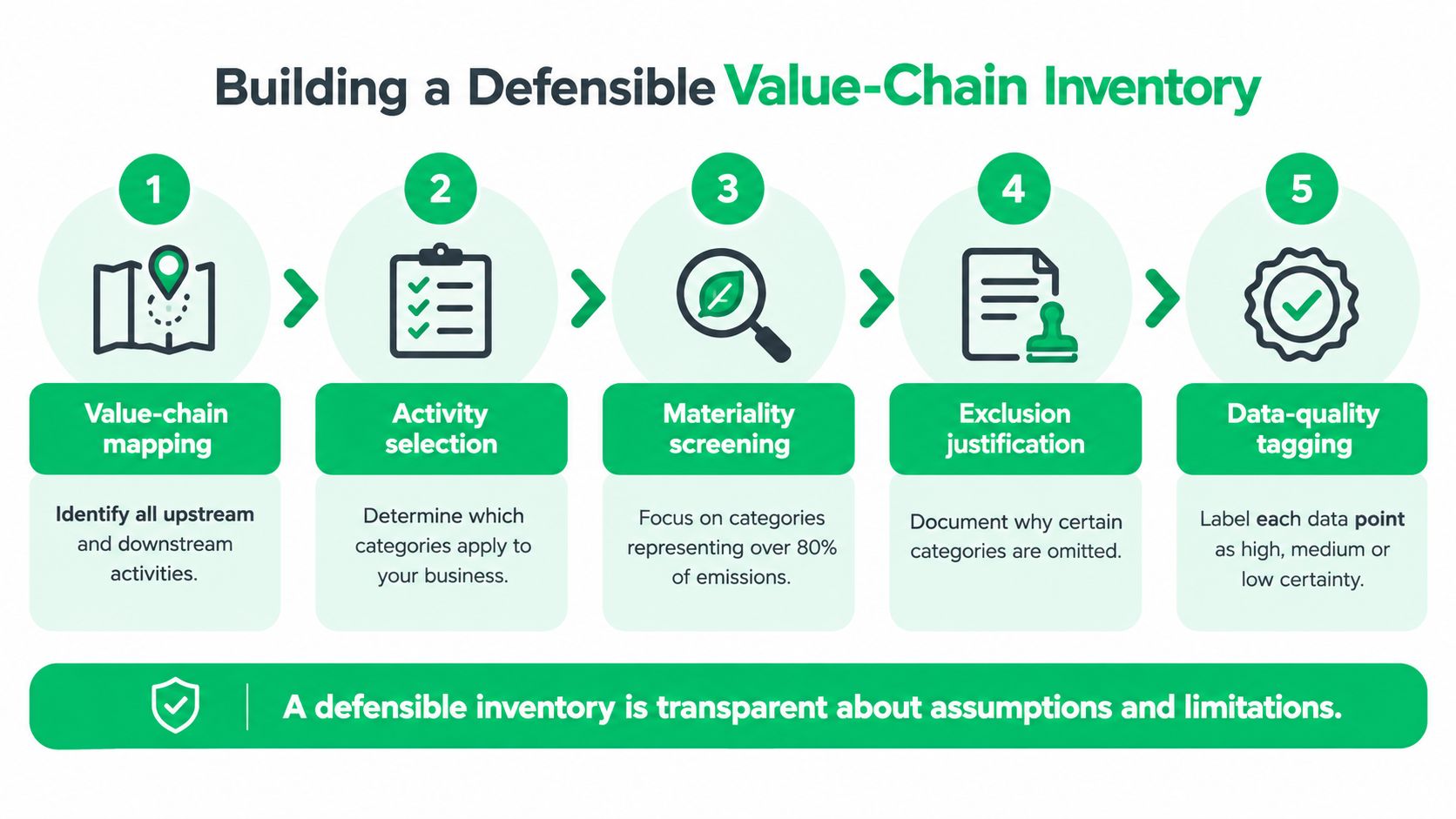
Start with the business model, not the data you happen to have. Map how the organisation buys, operates, sells, finances and disposes of products or services. Include legal entities, major sites, outsourced activities, logistics routes, leased assets, customer use and investment activities where relevant.
Use a written screening record
For every Scope 3 category, record whether it is applicable, material, screened, estimated, excluded or awaiting better evidence. A blank cell doesn't explain whether a category was forgotten, investigated and found immaterial, or blocked by missing data.
A useful screening record includes:
- Boundary: entities, geographies, products and activities covered.
- Activity source: procurement ledger, logistics records, travel system, supplier data or modelled estimate.
- Materiality basis: expected scale, stakeholder relevance, transition risk and decision usefulness.
- Exclusion rationale: why the category is not applicable, not material or unavailable.
- Data quality: primary, activity-based, spend-based or another documented method.
- Owner and approval: the person responsible for the conclusion and the reviewer who accepted it.
Consider a UK manufacturer preparing its first structured inventory. It may prioritise purchased materials, capital goods, inbound freight, operational waste, employee travel and product use because these categories connect directly to purchasing and product decisions. It may defer a low-relevance leased-asset category after screening it, provided the organisation records the basis for that conclusion and sets a review point.
That isn't a licence to ignore difficult categories. It is a controlled prioritisation decision.
Make estimation tiers visible
An assurance provider will want to know not only the final calculation but how the organisation moved from source data to emissions. Tagging every result by method makes the inventory easier to challenge and improve. It also prevents a modelled estimate from acquiring false precision because it appears in a consolidated total.
Assurance insight: Exclusions are easier to defend when the file shows that the category was assessed, the decision was proportionate and the conclusion will be revisited if the business changes.
Repeat the same process each reporting cycle. Update the value-chain map when acquisitions, outsourcing, products, suppliers or logistics arrangements change. A defensible inventory is a living control process, not a spreadsheet completed once for an annual report.
Choosing the Right Estimation Approach
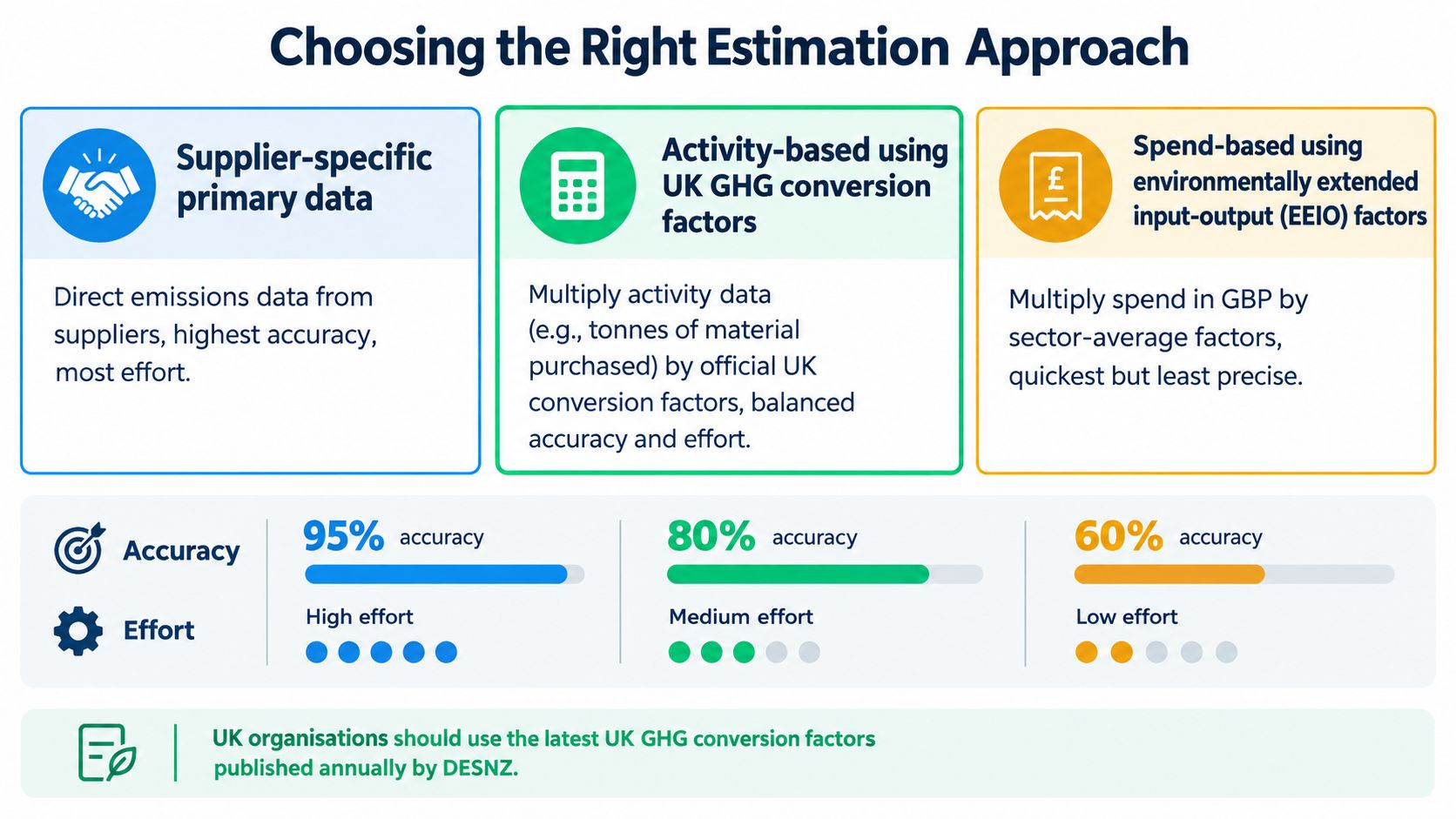
The best Scope 3 inventory usually mixes methods. Supplier-specific data is valuable for strategically important suppliers and categories where direct operational information can change a procurement or reduction decision. It isn't efficient to demand detailed primary data from every supplier before producing a usable first inventory.
The UK Government's conversion-factor approach is straightforward. Collect or estimate activity data, such as purchased quantities, fuel or electricity use, waste mass, travel distance or spend, then multiply it by the relevant factor. The 2025 UK GHG conversion-factor change document confirms that the factor set covers Scope 1, Scope 2 and Scope 3 calculations, including upstream and other indirect components.
Match the method to the decision
Supplier-specific primary data is the strongest option where the supplier has controlled measurements, a compatible boundary and sufficient evidence. It can support supplier engagement and procurement decisions, but it takes time to collect, validate and reconcile.
Activity-based estimates are often the practical centre of a UK programme. Physical quantities, distances, weights and energy data can be paired with the official UK factors. This method gives the organisation a clearer connection between operational activity and emissions than a general spend proxy.
Spend-based estimates are useful for screening and gap-filling. Environmentally extended input-output factors can help identify hotspots when physical data is unavailable, but inflation, product mix and sector averages can distort the result. A spend-based figure should not be presented as evidence of a specific supplier's performance.
The government's change-control document treats changes greater than 10% for most Scope 3 sources as major, compared with 5% for most Scope 1 and Scope 2 sources. Those thresholds make version control a practical requirement, not an administrative preference. Lock the factor version, source year, unit conversion, global-warming-potential basis and recalculation policy in the evidence file.
Use modelled results to rank categories and suppliers for attention. Then collect primary data where it could materially change a decision, rather than replacing every proxy immediately.
The right question isn't “Which method is perfect?” It is “Which method is proportionate to the decision, transparent about uncertainty and capable of improvement?”
Engaging Suppliers Without Drowning in Data Requests
Supplier engagement fails when the buyer sends a long questionnaire without explaining why the information matters or how a smaller supplier can respond. It also fails when procurement treats every supplier identically, regardless of emissions relevance, spend, strategic importance or ability to provide data.
A workable model uses escalating levels of effort.
| Engagement model | Best fit | What to request |
|---|---|---|
| Lightweight annual survey | Broad supplier population and early screening | Activity type, quantity, emissions information available and data gaps |
| CDP Supply Chain participation | Larger suppliers with established sustainability teams | Structured climate disclosure and relevant governance information |
| Bilateral data exchange | Strategic suppliers in material categories | Product, site, quantity, factor and assurance evidence |
| Funded joint decarbonisation | Critical suppliers with high influence and limited capacity | Shared baseline, improvement actions, technical support and progress controls |
Start with the categories that could alter the inventory or a procurement decision. Use modelled results to identify hotspots, but don't turn those estimates into accusations. A supplier shouldn't be labelled a poor performer because a sector-average factor produced a high result.
Make participation easy
Give smaller suppliers a short route to respond. Explain the boundary in plain language, specify the unit required, provide the relevant factor source and allow them to identify missing information without penalty. An honest “not available” is more useful than unsupported precision.
Procurement should track response quality separately from response rate. Useful fields include whether the supplier submitted primary data, whether the boundary matches the request, whether the source is documented and whether the result can be reconciled to purchases.
Supplier due diligence should also connect emissions to wider social and environmental risk. Organisations developing that process can use a structured ESG due diligence approach alongside the Scope 3 data request.
The commercial relationship matters. Buyers with influence can include data requirements in tenders and contract reviews. Buyers with limited influence may get better results through shared templates, supplier workshops and targeted support than through escalation alone.
Preparing for Assurance and External Scrutiny
An assurance provider won't only ask for the consolidated Scope 3 number. They'll test whether the organisation defined its boundary consistently, selected relevant categories, supported activity data, applied the right factors and explained exclusions.
Limited assurance generally provides a lower level of confidence than reasonable assurance and involves different procedures. Reasonable assurance requires more extensive evidence and a stronger basis for a positive conclusion. The exact requirement depends on the applicable reporting regime and engagement scope, but the preparation discipline is similar.
Assemble the evidence trail
For each material category, retain:
- Source records: procurement extracts, invoices, supplier submissions, travel data, logistics records and waste reports.
- Calculation logic: formulas, units, conversion steps, allocation methods and aggregation rules.
- Factor evidence: factor file, version, source year, unit basis and global-warming-potential reference.
- Estimate controls: assumptions, proxy selection, completeness checks and limitations.
- Governance records: reviewer comments, approval history, changes and final sign-off.
- Recalculation policy: the circumstances that would trigger a base-year or comparative restatement.
The UK reporting guidance expects organisations to deal openly with unavailable elements, methodological challenges and programmes intended to improve coverage and quality. That is better than hiding uncertainty. A clearly labelled estimate with a documented improvement plan is more credible than a precise-looking number with no provenance.
Prepare for the difficult question
“Why was this category excluded?” should produce a short, evidence-backed answer. The response might refer to the activity not being present, the category being screened as immaterial, a justified data limitation or a planned improvement action. It shouldn't be “we didn't have time”.
Assurance readiness also requires consistent disclosure language. If the inventory includes spend-based estimates, say so. If supplier data covers only part of a category, define the coverage. If a factor changed, explain whether the comparative figure was recalculated and why.
The inventory must survive review by someone who wasn't present when it was built. That is the standard to apply before sign-off.
A Sequenced Plan and Common Pitfalls
A practical programme can follow a clear sequence across the reporting cycle:
- Scope: confirm entities, activities, reporting period and intended uses of the inventory.
- Screen: assess all relevant GHG Protocol categories and document materiality decisions.
- Estimate: use supplier-specific, activity-based and spend-based methods in a controlled hierarchy.
- Engage suppliers: prioritise material categories and suppliers where better data could change decisions.
- Lock evidence: preserve source files, factor versions, assumptions, approvals and recalculation rules.
- Prepare for assurance: test completeness, traceability, exclusions and disclosure wording before publication.
The recurring errors are predictable. Organisations treat Scope 3 as one spreadsheet number, apply a single global average despite having a suitable UK factor, omit boundary documentation, present spend-based estimates as supplier performance or assume that voluntary reporting carries little consequence.
The UK context makes those shortcuts especially risky. SECR can be satisfied while material value-chain emissions remain outside the minimum disclosure. The government's call for evidence, customer requirements, procurement processes and investor scrutiny all point towards a higher expectation of transparency.
Take these questions to the first steering-group meeting:
- Which Scope 3 categories apply to our business model?
- What does our current SECR inventory leave outside the boundary?
- Which categories could be material to primary users?
- Which results are assurance-ready, and which are screening-grade?
- What supplier data would change a procurement or reduction decision?
- Who owns each gap, and when will the evidence be improved?
A strong answer won't be a single impressive total. It will be a controlled inventory that explains what the organisation knows, what it estimates, what it excludes and what it will improve next.
ESG Consulting helps UK organisations map value chains, build Scope 3 inventories, engage suppliers and prepare evidence for sustainability reporting and external scrutiny. Visit ESG Consulting to discuss a defensible Scope 3 workplan aligned with your reporting obligations and commercial priorities.