
sustainability audit, ESG assurance, UK SRS readiness, ESOS compliance, sustainability reporting
Sustainability Audit: A Practical UK Guide for 2026
By ESG Consulting Team · · 16 min read
The notification arrives between two meetings. Your ESOS Phase 4 assessment needs source documents, the external assessor wants evidence for figures that someone assembled in a spreadsheet, and the finance director needs matching energy and emissions numbers for the annual report. Everyone has the same question, but nobody is looking at the same controlled dataset.
That situation is now common. A sustainability audit isn't a year-end paperwork exercise. It's a structured examination of how non-financial data is collected, calculated, controlled and disclosed, with enough evidence for another person to reproduce the result. The organisations that cope best don't prepare three disconnected compliance packs. They build one auditable data model that can support ESOS, SECR and UK SRS without forcing the team to start again for each framework.
Table of Contents
- Why a Sustainability Audit Is No Longer a Box-Ticking Exercise
- Defining the Scope of Your Sustainability Audit
- Building an Evidence Trail That Withstands Assurance
- Running the Audit Across ESOS, SECR and UK SRS
- Common Findings That Derail Sustainability Audits
- Preparing Disclosures for the 2026 UK Assurance Regime
- Making the Sustainability Audit a Recurring Discipline
Why a Sustainability Audit Is No Longer a Box-Ticking Exercise
A sustainability audit used to be treated as the final stage of reporting. The ESG team gathered figures, management approved the narrative, and an auditor or verifier checked a selection of documents before the report went out. That approach breaks down when energy, workforce, supply-chain and climate data come from different owners, systems and reporting periods.
The pressure is visible in the UK energy regime. ESOS was introduced in 2014, with the first compliance deadline on 5 December 2015, and assessments are required at least once every four years. The scheme applies to large undertakings and is designed to identify cost-effective energy-saving opportunities across buildings, industrial processes and transport, rather than just record whether a company has completed a form. UK government analysis of ESOS estimated that strengthened requirements would deliver £1.12 billion in energy-bill savings and around 28 TWh of energy savings over 2023 to 2037, a projection that shows how an audit process can support national energy policy as well as corporate compliance.
The audit now tests the system behind the number
A reviewer wants to know where a figure came from, who changed it, which methodology produced it and whether the same source supports another disclosure. A reported electricity total is weak evidence if the company can't identify the meter population, billing period, conversion method, estimation policy and approval record.
The governance expectation has moved in the same direction. The Financial Reporting Council found that 83% of FTSE 100 companies obtained sustainability assurance in 2022, compared with 47% of FTSE 250 companies. It also reported that the proportion of FTSE 350 companies obtaining assurance rose by 19 percentage points between 2019 and 2022. The FRC's review of corporate reporting and assurance illustrates the shift from optional reporting support towards routine assurance over sustainability information.
Practical rule: if a figure matters to the board, a lender, a customer or a regulator, build its evidence trail before you write the disclosure.
The practical answer is a shared data model. It should hold the organisational boundary, activity data, emission factors, calculation versions, evidence references, controls, approvals and restatement history. ESOS can use the energy layer, SECR can use the annual energy and emissions outputs, and UK SRS can draw on the controlled climate and sustainability disclosures. The frameworks may still require different judgements, but the underlying evidence shouldn't be recreated three times.
Defining the Scope of Your Sustainability Audit
Start with boundaries, not documents. Before asking a site manager for utility bills or a procurement lead for supplier data, write down which entities, operations, activities and reporting periods are included. A sustainability audit becomes inefficient when the finance team uses a consolidated group boundary, operations uses an operational-control boundary, and the ESG team combines the two without coordination.
Set the organisational and reporting boundary
Record the parent company, subsidiaries, joint ventures, leased sites, outsourced operations and recently acquired businesses. Then distinguish the boundary used for financial reporting from the boundary used for an energy or emissions assessment. They may overlap, but they aren't automatically identical.
A useful boundary register includes:
- Entity status: legal entity, site, business unit or controlled operation.
- Control basis: financial control, operational control or another basis required by the reporting framework.
- Inclusion decision: included, excluded or awaiting evidence.
- Reason for the decision: ownership, control, materiality or data availability.
- Period covered: reporting start and end dates, including acquisition or disposal dates.
Choose assurance depth after deciding what the disclosure is meant to support. Limited assurance is usually proportionate for a first reporting cycle, a voluntary disclosure or a broad population of lower-risk indicators. Reasonable assurance is more demanding and is better reserved for KPIs the board has identified as material, where users need stronger confidence and the organisation can support deeper control testing.
| Factor | Limited Assurance | Reasonable Assurance |
|---|---|---|
| Primary purpose | Test whether the disclosure appears plausible and is free from material misstatement based on focused procedures | Obtain stronger evidence that the disclosure is materially correct through more extensive testing |
| Typical fit | First-cycle reporting, voluntary information and broad lower-risk datasets | Board-prioritised KPIs, critical climate metrics and disclosures with significant stakeholder reliance |
| Evidence burden | Process descriptions, analytical review, selected samples and clear source records | More extensive samples, control testing, reconciliations and potentially wider site or system testing |
| Management implication | Controls need to be documented and operating, but the scope is narrower | Controls must be consistently designed, evidenced and repeatable across the reporting population |
Decide what materiality means
Under UK SRS, document why a topic or KPI is material and how the judgement was reached. Separate the effect the organisation has on people and the environment from the way sustainability matters can affect enterprise value, financial position, performance or access to capital. Don't assume that one materiality lens answers both questions.
Double materiality isn't currently required by UK SRS, so don't import a more expansive assessment without explaining why you're using it. The important point is consistency. The materiality memo, data inventory and final disclosure should all tell the same story.
Consider a mid-cap manufacturer. The agreed scope might cover Scope 1 and Scope 2, Scope 3 Category 1 and Category 11, energy intensity and the gender pay ratio. The boundary register identifies the manufacturing group, the methodology records the relevant activity sources, and the assurance plan marks the two headline KPIs for deeper review. That decision gives management a defined population instead of an open-ended request for every ESG metric available.
Building an Evidence Trail That Withstands Assurance
An assurance provider doesn't start with the polished report. They open the working papers behind it. The strongest evidence trail lets the reviewer move from a disclosed figure to a calculation, from the calculation to source records, and from the source records to a named owner and approval.
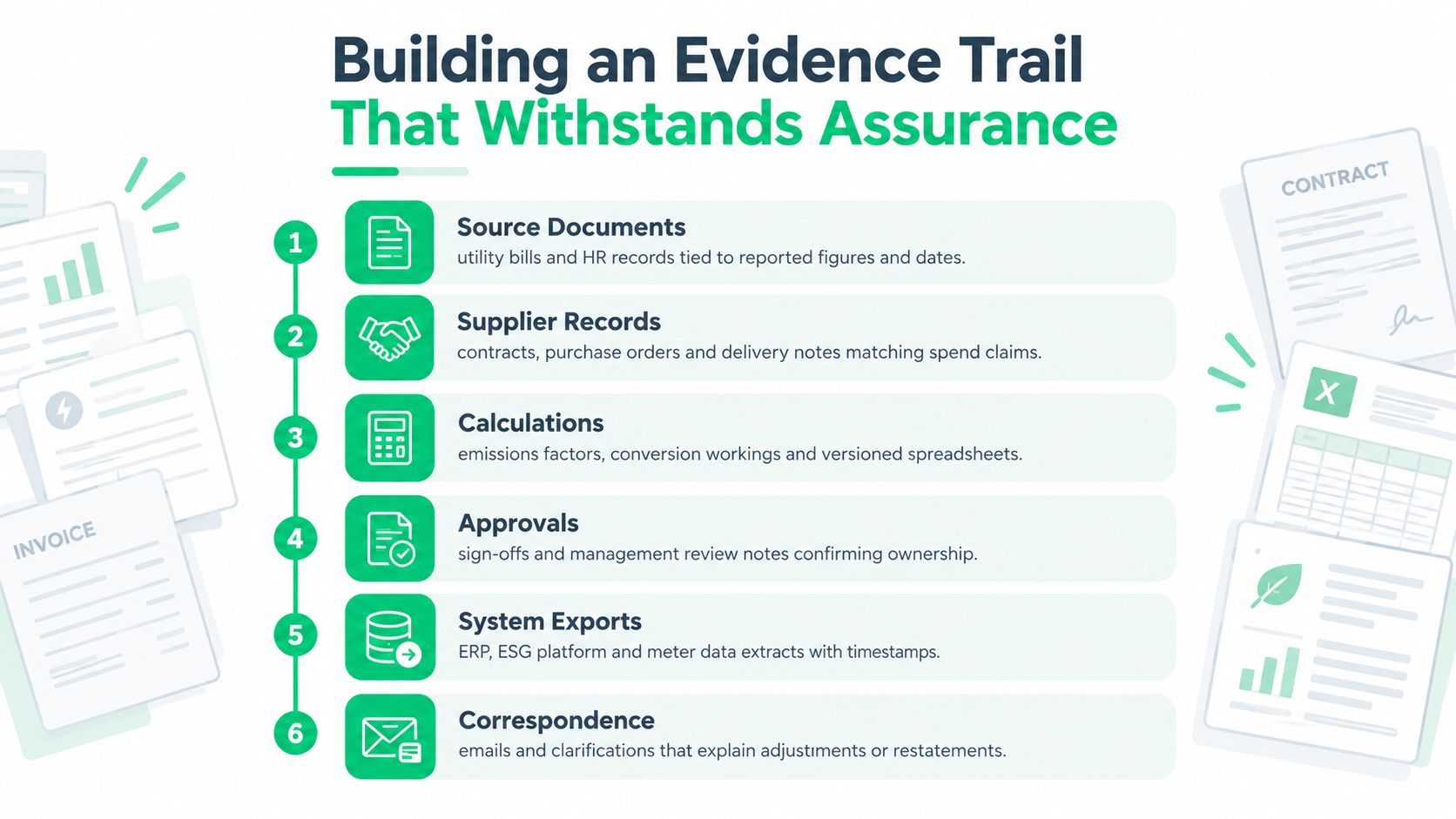
Six artefact groups matter
Source documents should identify the supplier, site, period and measured quantity. A kWh figure traced to an invoiced half-hourly meter pass-through is useful evidence. A single annual estimate labelled “Q4 placeholder” isn't, unless the organisation can show the meter issue, estimation method, later validation and approval.
Calculation methodology memos should state formulae, conversion factors, emission factors, unit conversions and spreadsheet versions. A reviewer shouldn't have to infer whether a factor was applied to kWh, spend or another activity measure.
System evidence includes screenshots, exports, timestamps and access logs. The aim isn't to collect screenshots for their own sake. It's to show which system produced the data and whether users could alter historical values without a controlled record.
Control descriptions map each KPI to a process owner, reviewer, frequency and exception route. “ESG team checks the file” is too vague. “Facilities manager reviews site meter completeness each month, then finance reconciles the invoice total at close” is testable.
Review sign-offs need a named approver independent of the preparer. Email approval can help, but a controlled workflow or dated sign-off is easier to retrieve and defend.
Reconciliations connect reported figures to general ledger postings, operational meters, headcount records or procurement systems. The reconciliation doesn't need to force every source into the same system. It does need to explain differences.
Label estimates instead of hiding them
The recurring weak spot is measured and estimated data sitting together without a clear label. If the landlord supplies consumption late, record the affected sites, the estimation method, the period, the proportion estimated and the confidence limits used internally. Otherwise, the reviewer may treat the entire KPI as unreliable rather than isolating the estimated component.
A living carbon management process should preserve the correspondence that explains adjustments, restatements and unusual movements. It also needs a locked copy of the calculation used for publication. A live spreadsheet that changes after sign-off is not an evidence trail. It's an unresolved control risk.
Running the Audit Across ESOS, SECR and UK SRS
Treat the three regimes as different outputs from a common evidence architecture. Start with an activity map that records electricity, gas, fuels, transport, refrigerants and other relevant energy uses by site, asset, business unit and period. Add the boundary register, factor library, data owner and evidence reference to each activity stream.
For ESOS, the dataset must be built from verifiable 12-month energy-consumption data, converted to kWh and split across buildings, transport, industrial processes and other uses. The compliance route must cover at least 95% of total energy consumption, include site visits to a representative sample and calculate energy intensity ratios for each end-use category. These requirements are set out in the UK government's ESOS Phase 4 compliance guidance.
SECR can draw from the same source records for annual energy consumption, Scope 1 and Scope 2 emissions and intensity ratios. UK SRS then adds the governance, strategy, risk and opportunity context needed for climate-related disclosures. The numbers may be shared, but the narrative, boundary explanation and materiality judgement still need their own review.
| Regime | Core data requirement | Boundary rule | Assurance level |
|---|---|---|---|
| ESOS | Verifiable energy consumption, converted to kWh, categorised by end use and supported by representative site evidence | Use the applicable ESOS assessment boundary and document excluded or estimated energy | Lead Assessor sign-off and evidence supporting compliance |
| SECR | Annual energy consumption, Scope 1 and Scope 2 emissions, intensity ratios and required narrative | Apply the reporting boundary and reconcile the reporting period to the annual report | Disclosure controls and any separately commissioned assurance |
| UK SRS | Material sustainability and climate-related information, including controlled metrics and supporting explanations | Apply the relevant reporting boundary and explain material omissions or differences | Assurance readiness should match the applicable oversight and engagement requirements |
Sequence the work around the reporting calendar
First, close the energy ledger and resolve missing meters. Next, freeze the factor library and calculate the ESOS outputs. Then reuse the reconciled energy dataset for SECR, documenting any period or boundary difference instead of silently changing the number. After that, map the controlled metrics and evidence to UK SRS disclosures.
This sequence prevents the common November-to-April failure mode, where the same electricity total is recalculated for each report by different people. The SECR reporting requirements should be treated as a reporting layer over controlled source data, not as a separate spreadsheet project.
Common Findings That Derail Sustainability Audits
Most findings aren't caused by a lack of commitment. They arise because the organisation has grown faster than its reporting controls. The same patterns appear across sectors, and each one is easier to resolve before the assurance provider has written it into a findings log.
Boundary decisions made in different rooms
A group may include a subsidiary in financial reporting but exclude its warehouse from the operational energy file. Another team may include a newly acquired plant in the current year without deciding whether the prior-year baseline needs restatement. The fix is a boundary register tied to legal-entity records, site lists and acquisition documentation. Management should approve the register before the calculations begin.
Estimates presented as measurements
Landlord-supplied consumption often arrives late, incomplete or in a different unit. The problem isn't always the estimate. The problem is an unexplained estimate sitting beside measured consumption as though both had equal evidential weight.
A defensible estimation policy identifies the driver, such as floor area, occupancy or historical meter behaviour, and records the period affected, the calculation and the subsequent validation. If confidence is weak, management should disclose the limitation and assess whether the KPI remains suitable for assurance.
Renewable claims without the instrument trail
A company may report renewable electricity while retaining only a supplier email and an unsigned verification statement. The reviewer needs contractual evidence, the relevant instrument or certificate record, the coverage period and confirmation that the claim relates to the reported consumption.
Ratios recalculated after an acquisition
Intensity ratios can change because of genuine operational performance, a denominator revision or an acquisition. Those causes shouldn't be blended together. Rebuild the denominator, document the inclusion date, restate the prior baseline where required by the chosen methodology, and add a plain-language restatement note to the working papers.
A finding is useful when it identifies a repeatable control weakness before that weakness becomes a qualification.
The right response isn't to patch the individual number and move on. Update the procedure, assign an owner and add the missing check to the next internal review. Findings are predictable signals from the audit process. They become expensive only when the organisation treats them as isolated surprises.
Preparing Disclosures for the 2026 UK Assurance Regime
The UK is moving towards more formal oversight of sustainability assurance. The government confirmed an interim, regulator-backed regime operated by the FRC, with an interim public register of practitioners planned by mid-2026. The same direction of travel is visible in FCA-linked reporting, where in-scope listed issuers are moving towards stating whether they obtained third-party assurance over UK SRS disclosures. Macfarlanes' analysis of the UK assurance regime explains why provider status and evidence readiness now belong in the reporting plan, not at the end of it.
Confirm scope and provider status
Start by confirming whether the entity falls within the first wave of applicable requirements. Don't assume that every UK SRS disclosure has the same assurance treatment, and don't select a provider solely because it already audits the financial statements.
Shortlist providers against the interim FRC register when it becomes available, then assess their experience with your sector, data systems, energy methodology and planned assurance level. The engagement letter should define the subject matter, reporting criteria, boundary, period, intended users, procedures, limitations, timetable and treatment of corrected or restated information.
Limited and reasonable assurance aren't interchangeable labels. Limited assurance generally involves focused procedures and analytical review. Reasonable assurance requires more extensive evidence and stronger control testing. The board should decide which metrics need the deeper approach before management finalises the disclosure.
Make the final six weeks evidence-led
Use the closing period to remove uncertainty, not to redesign the reporting system.
- Six weeks before publication: freeze the boundary register, materiality determination and disclosure inventory.
- Five weeks before publication: lock calculation workbooks, factor versions and source-document indexes.
- Four weeks before publication: obtain process-owner sign-offs and reconcile material metrics to operational or financial records.
- Three weeks before publication: run an internal sample review, including estimated data, manual adjustments and restatements.
- Two weeks before publication: clear open evidence requests and agree the wording for limitations or methodology changes.
- Final week: prevent uncontrolled edits, retain the approved disclosure pack and record the final management approval.
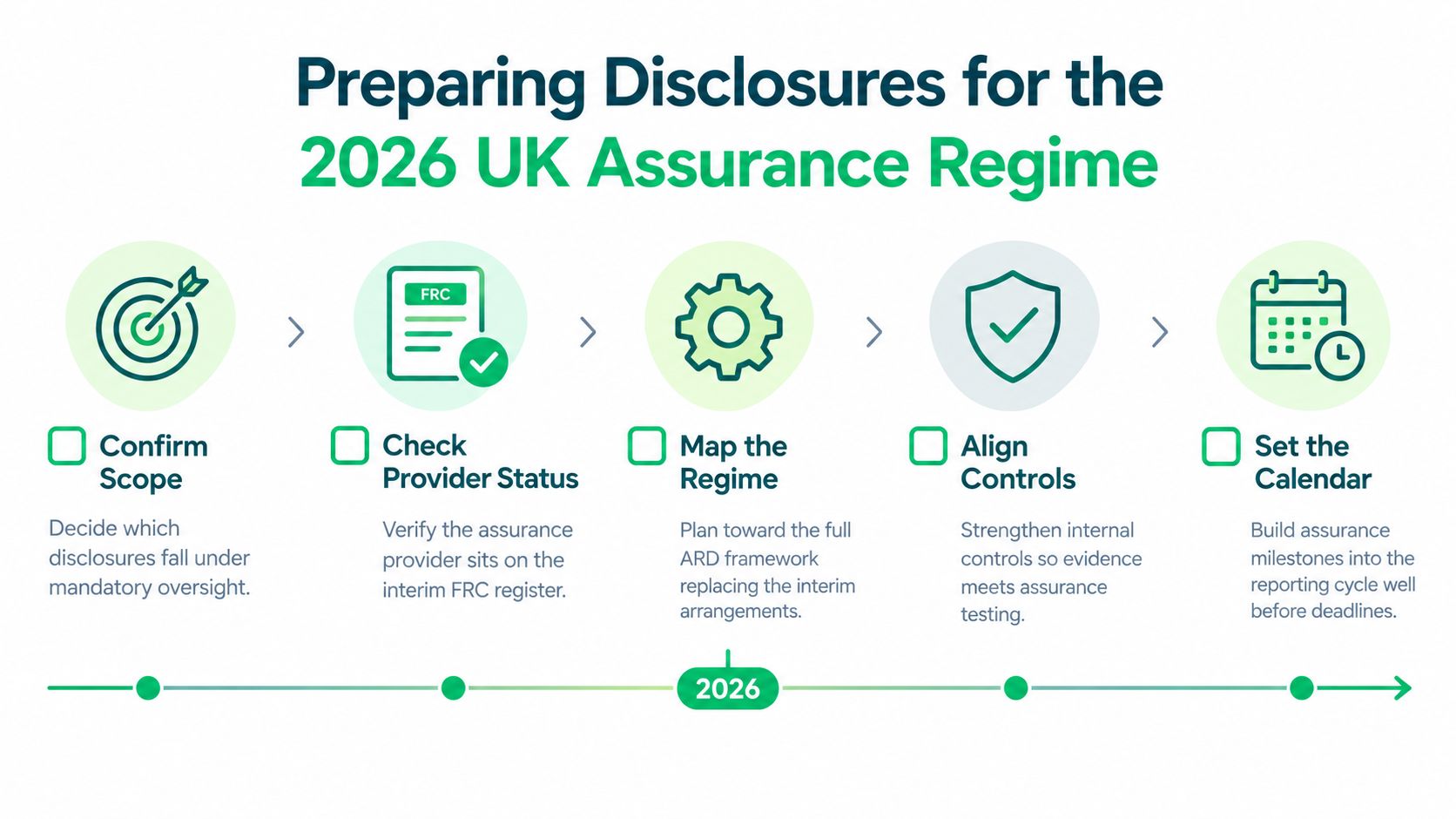
The useful question isn't only whether the report is complete. It's whether a reviewer can reproduce the material claims without relying on the memory of the person who prepared them. Guidance on ESG reporting controls should be translated into named owners, dated evidence and a controlled approval trail.
The following video provides a visual overview of the assurance preparation process:
Making the Sustainability Audit a Recurring Discipline
A sustainability audit becomes cheaper to manage when the organisation stops treating evidence collection as an annual rescue operation. The working papers should exist before the reporting deadline, with each data stream assigned to someone who understands both the source system and the disclosure it supports.
Keep the controls alive between reporting cycles
Facilities teams should maintain meter and landlord records as part of normal operations. Finance should reconcile relevant energy and spend data during the month-end close. HR should preserve the population, definitions and approval trail behind workforce metrics. Procurement should retain supplier responses and the rationale for estimates instead of asking the ESG team to reconstruct the value chain later.
A practical operating rhythm includes:
- Assign ownership: Name an accountable lead for every material data stream, including a deputy for absences.
- Maintain an evidence register: Add source documents, calculations, exceptions and correspondence as they arise.
- Standardise working papers: Reuse the same templates for boundary decisions, factor changes, reconciliations and approvals.
- Review quarterly: Test completeness, unusual movements and unresolved estimates on a fixed cadence.
- Run a dry review: Ask an internal reviewer to select samples and request evidence before the external provider does.
- Bank lessons: Convert findings into revised procedures, control checks and training for the next cycle.
The evidence register should also track requests that haven't yet been closed. A missing utility bill, an unsigned renewable certificate statement or an unexplained restatement is easier to resolve while the relevant person still remembers the transaction.
Measure the process, not just the emissions
Management often monitors energy consumption and emissions but doesn't monitor how long the audit takes, how many evidence requests remain open or which controls fail repeatedly. Those operational measures show where the reporting system is creating avoidable work.
The strongest teams hold a post-assurance debrief. They record which samples were difficult to retrieve, which definitions caused disagreement, which estimates required escalation and which disclosures needed late edits. They then assign owners and dates to the fixes, rather than filing the findings with the completed report.
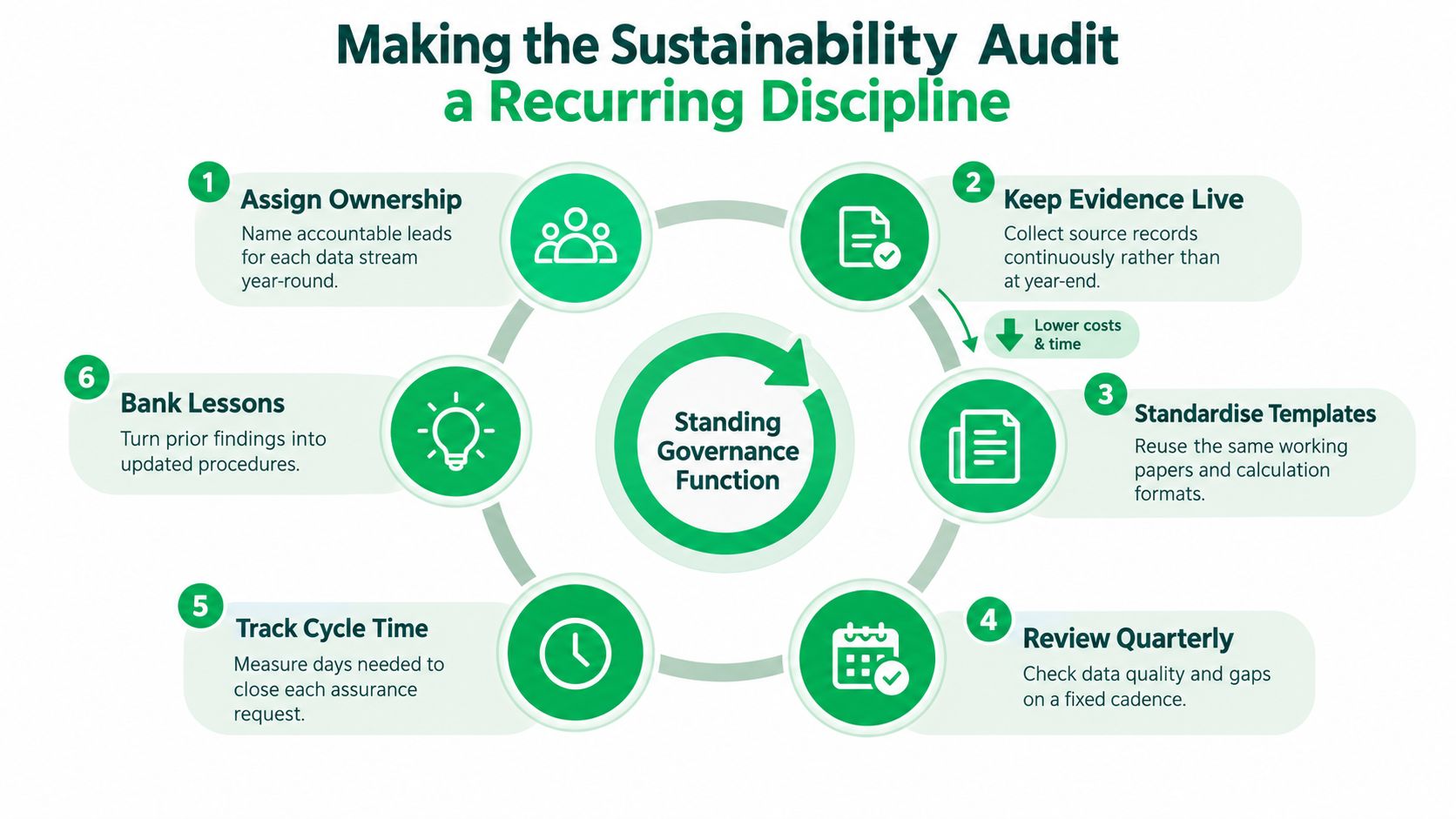
The end state is a standing governance function. One controlled activity map feeds the relevant outputs, one factor library records methodology changes, one boundary register explains scope, and one evidence trail supports review. That discipline won't remove judgement from sustainability reporting, but it makes judgement visible, repeatable and much easier to defend.
ESG Consulting helps UK organisations scope sustainability audits, build evidence-ready carbon and ESG data models, deliver ESOS and SECR work, and prepare UK SRS disclosures for assurance. If your team is managing overlapping obligations or rebuilding the same numbers each reporting cycle, visit ESG Consulting to discuss a practical route from source data to sign-off.
More from the blog
· 12 min read · Regulation
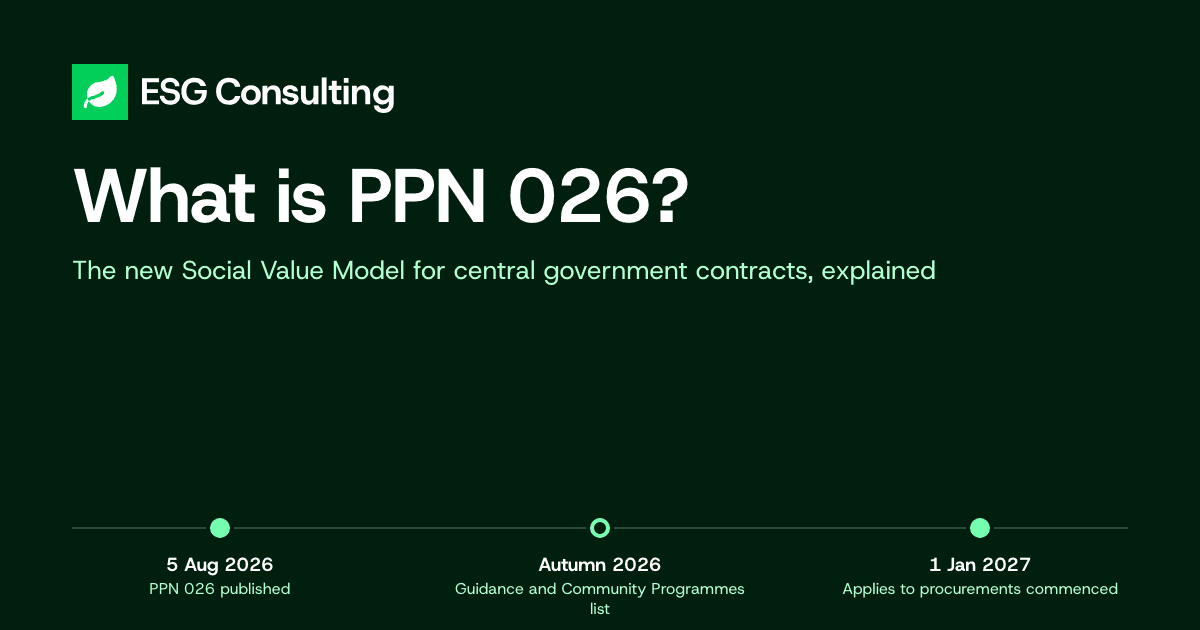
What is PPN 026? The new Social Value Model
PPN 026 replaces PPN 002 as the Social Value Model for central government contracts from 1 January 2027. Scope, the 10% and 20% weightings and the six criteria.
Read article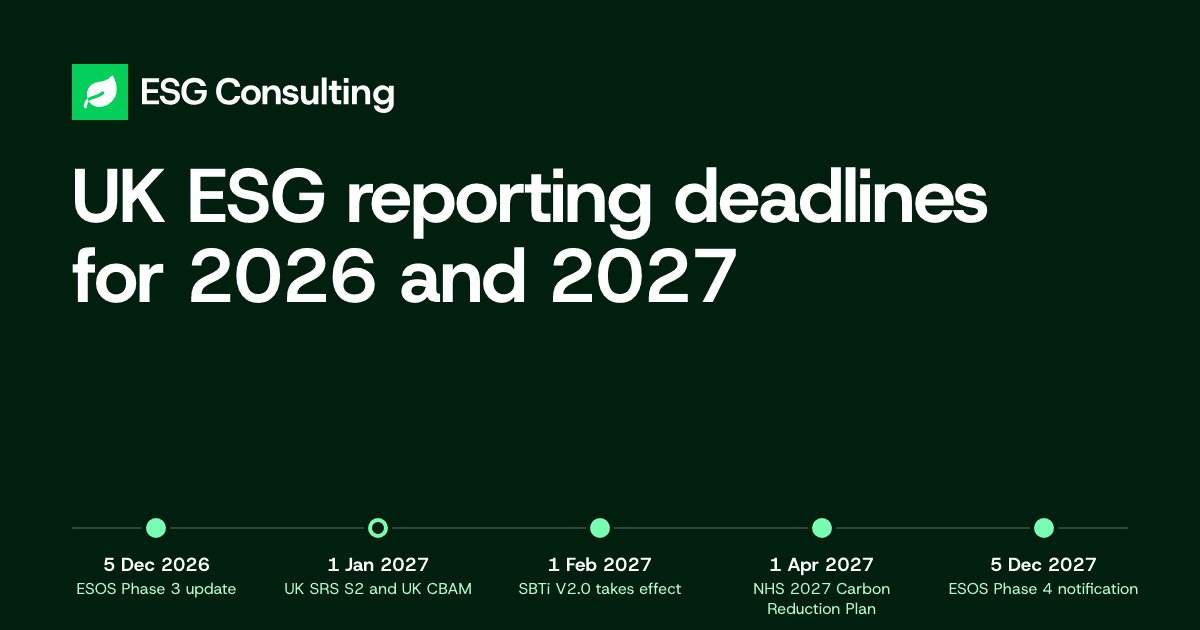
· 14 min read · Regulation
UK ESG reporting deadlines for 2026 and 2027
Every UK ESG reporting date to December 2027 - UK SRS, ESOS, SECR, UK CBAM, CSRD, SBTi, PPN 026 and the NHS - each marked mandatory, proposed or voluntary.
Read article