
sustainability consultancy uk, esg consulting, net zero strategy, carbon reporting, procurement
Sustainability Consultancy Uk
By ESG Consulting Team · · 14 min read
A finance director asks for a sustainability consultancy quote after a customer requests a carbon report and procurement adds a climate questionnaire. By Friday, a consultancy has proposed a £120,000 full ESG package, covering strategy, reporting, data collection and assurance preparation. Nobody has yet confirmed whether the company is in scope for SECR, ESOS, UK SRS, CSRD or PPN 006.
That is the wrong way round. Applicability comes before advice, and a defined deliverable comes before a fee. A smaller organisation may need a narrow SECR narrative, an ESOS assessment or a procurement-ready Carbon Reduction Plan. It may not need a multi-framework programme at all.
This guide sets out how to decide whether you need external support, how to procure it, and how to test whether the final work is sufficiently dependable for management, customers, regulators and an assurer.
Table of Contents
- Why the UK Sustainability Consultancy Market Looks Different in 2026
- Deciding Whether You Actually Need a Sustainability Consultancy
- Writing a Procurement Brief That Gets Comparable Quotes
- Fixed-Fee Versus Time-and-Materials Engagement Models
- What Good Deliverables Actually Look Like
- How a Senior-Led Engagement Should Run From Scoping to Sign-Off
- Red Flags and Final Checklist Before You Sign the Contract
Why the UK Sustainability Consultancy Market Looks Different in 2026
The UK market has matured beyond voluntary environmental advice. The environmental and sustainability consulting market was valued at £4.1 billion in 2024, grew 8.9% year on year, and the top 27 firms represented almost 78% of the market, according to Environment Analyst's UK market assessment. Sustainability and ESG strategy services had doubled their share since 2019 to 8% of total market revenue in 2024, while the sector employed 27,800 professionals, up 8.5% from the previous year.
That scale creates choice, but it also creates procurement noise. Buyers can now receive proposals built around strategy, software, reporting, training and assurance readiness, even when the underlying obligation is a single annual report narrative or an energy assessment. A larger package isn't automatically a better answer.
UK reporting also operates across different levels of obligation. SECR and ESOS are established compliance regimes. UK SRS S1 and S2 are available for voluntary use, while mandatory application remains under consultation, as outlined in this UK SRS briefing on the current reporting position. CSRD may matter where a UK organisation has relevant EU group or market connections, but the first task is a scope assessment, not an assumption that every UK business needs ESRS reporting.
| Framework | Who it applies to | Status in 2026 |
|---|---|---|
| SECR | Qualifying UK quoted companies, large unquoted companies and LLPs | Mandatory where the qualifying conditions are met |
| ESOS | Qualifying UK organisations within the scheme's thresholds | Mandatory where qualification conditions are met |
| UK SRS S1 and S2 | Organisations choosing to use the standards, with mandatory use under consideration | Voluntary unless another rule or requirement applies |
| CSRD | Organisations with the relevant EU reporting or group connection | Requires an entity-specific applicability assessment |
| PPN 006 | Suppliers responding to relevant UK public procurement requirements | A procurement requirement where included in the tender |
The UK environmental legislation overview is useful background, but it shouldn't replace a written applicability memo. Buyers now need sharper procurement, not automatically bigger budgets.
Deciding Whether You Actually Need a Sustainability Consultancy
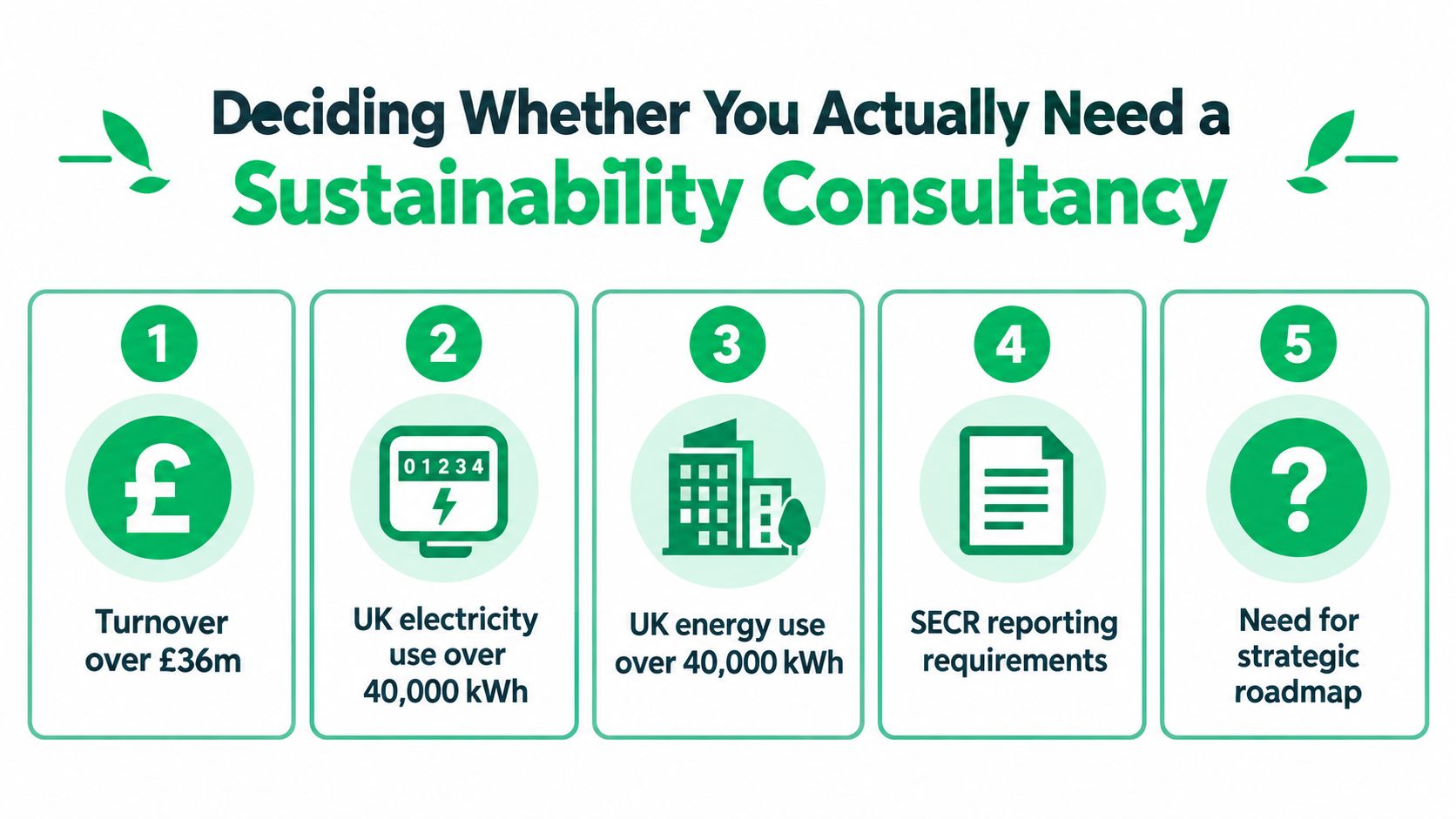
Before issuing a brief, answer five questions. Put the answers in writing and ask a finance, legal or company secretarial owner to confirm the corporate perimeter.
1. Which legal or procurement trigger applies?
Start with SECR. Check the group structure, reporting entity, annual report obligations, energy records and emissions boundary. Don't commission a complete ESG strategy if the immediate requirement is a compliant narrative supported by reliable Scope 1 and Scope 2 data.
Then test ESOS. Confirm whether the organisation qualifies for the relevant phase, which UK entities and sites sit inside the boundary, and whether an appropriately qualified Lead Assessor is required. The Environment Analyst UK regulatory overview summarises the compliance timetable, including the ESOS Phase 3 notification milestone and the later Phase 4 qualification and notification dates. The buyer should verify the current position with the responsible regulator before signing.
UK SRS S1 and S2 need a separate decision. The standards can support investor, lender or board reporting even where mandatory use isn't currently established. That doesn't make them an automatic requirement. Ask whether the board wants an ISSB-aligned reporting baseline, whether a customer or lender has requested it, and whether the organisation has the data and governance needed to make the exercise worthwhile.
CSRD requires an EU connection assessment. Review the group chart, EU subsidiaries, EU listings, customer requests and reporting responsibilities. PPN 006 is different again. If you're bidding for public contracts, read the tender documents and identify the required Carbon Reduction Plan content, sign-off and update obligations.
2. Can your team deliver the work?
A capable in-house finance, facilities or sustainability team may be able to prepare a narrow report. External support becomes more valuable when the boundary crosses entities, sites, data systems or jurisdictions, or when an independent reviewer will test the evidence.
Use the practical options below:
- Narrow fixed-fee scope: Choose this for a SECR narrative, a regulatory applicability memo, a focused UK SRS gap analysis or a PPN 006 response.
- Full multi-framework engagement: Choose this when reporting, emissions data, transition planning and board governance need to work as one programme.
- Not in scope: Choose no consultancy when the requirement is clear, the data owner is capable, the calculation method is documented and internal reviewers can challenge the result.
Don't hire a consultant to provide reassurance where your team only needs a checklist. The explanation of ESG consulting can help distinguish advisory work from a specific compliance deliverable, but the buyer still needs to define the decision being made.
Practical rule: If you can't name the framework, reporting entity, data boundary and final approver, you're not ready to buy a full sustainability consultancy engagement.
Writing a Procurement Brief That Gets Comparable Quotes
Most weak tenders ask for “support with ESG reporting”. That phrase gives every bidder permission to interpret the work differently. One consultancy prices a report, another prices a data transformation project, and a third prices a strategic programme with software access.
Write the brief around outputs. Your document should include six elements.
Name the work, evidence and accountable people
State the frameworks in scope, the entities covered, the reporting period, the data sources available and the systems the consultant may access. If ESOS is involved, require the proposed Lead Assessor's name and registration details in the response. Don't accept “a qualified team will support the work”.
Specify the deliverable in a way that can be accepted or rejected. For example:
Deliverable: SECR narrative, approximately 1,800 words, including three prior-year comparatives, methodology statement and management review comments, signed off by the Chief Commercial Officer.
The word count itself isn't the point. The point is that the buyer has named the document, its contents, its reviewer and the approval route. Apply the same discipline to a UK Carbon Reduction Plan, an ESOS assessment or a UK SRS readiness report.
Make the commercial response comparable
Require a fixed fee in GBP with explicit inclusions and exclusions. Ask bidders to price optional work separately, such as additional sites, supplier engagement, missing invoices, workshops or revised reporting boundaries. Include the named lead consultant, supporting team, expected client inputs and milestone schedule.
Add acceptance criteria linked to assurance readiness. The consultant should explain what evidence will be retained, how assumptions will be recorded and how a reviewer can trace each material figure to its source.
A strong brief also separates two buying decisions:
- Defined project: A fixed scope with a final deliverable, review rounds and handover pack.
- Ongoing support: A retainer or time-and-materials arrangement for changing questions, board advice or recurring questionnaires.
Mixing both in one tender distorts the price. The consultancy has to assume the most difficult version of the work, then protect itself against unknown data and scope changes. Ask for the project price first. Request ongoing support as a separately priced option.
Fixed-Fee Versus Time-and-Materials Engagement Models
The commercial model should match the uncertainty in the work. Fixed fee protects the buyer when the output is known. Time and materials protects both parties when the work cannot yet be defined. A retainer is appropriate when the organisation needs continuing access to senior advice.
| Model | Best fit | Buyer risk | Scope-creep risk | Cost certainty |
|---|---|---|---|---|
| Fixed fee | SECR report, ESOS assessment, UK SRS gap analysis or defined inventory | Incomplete assumptions may create exclusions | High if the brief is vague | High when boundaries and outputs are clear |
| Time and materials | Materiality refresh, transition plan build-out or unresolved data investigation | Final cost can rise before the buyer sees the complete answer | High unless capped and governed | Low |
| Retainer | Board advice, recurring disclosures or quarterly questionnaire support | Unused capacity and unclear priorities | Medium to high | Medium |
A fixed fee isn't protection if “data cleansing” sits outside the scope, “additional sites” are charged by the day and every review round resets the clock. The contract should state what happens when the consultant identifies a problem in the data. Define the included remediation, the approval process for extra work and the maximum day rate for approved changes.
Time and materials has a legitimate place. If a group has never mapped its value chain, doesn't know which source systems hold energy data and wants a transition plan tied to capital allocation, the first phase may need discovery. Put a ceiling on that discovery and require a written recommendation before commissioning the next phase.
Retainers should have a service catalogue. Specify meeting frequency, response times, named senior access, included reviews and unused-hours treatment. Never accept “flexible support as required” without a cap or an approval route.
What Good Deliverables Actually Look Like
A polished PDF isn't evidence of a good engagement. A useful deliverable lets a finance owner, board reviewer and external assurer follow the chain from source record to calculation to disclosure.
For SECR, expect an annual report narrative, emissions and energy calculations, intensity ratios, a methodology statement and explanations for material changes. The handover should identify data owners, conversion methods, reporting boundaries, prior-year restatements and unresolved limitations. If the consultant only supplies prose, the organisation still owns the difficult part, proving the numbers.
For ESOS, request the assessment, Lead Assessor sign-off, evidence pack, site and energy coverage rationale, audit findings and screening for an applicable ISO 50001 route. Ask where the supporting consumption records sit and who will respond to a regulator or internal challenge.
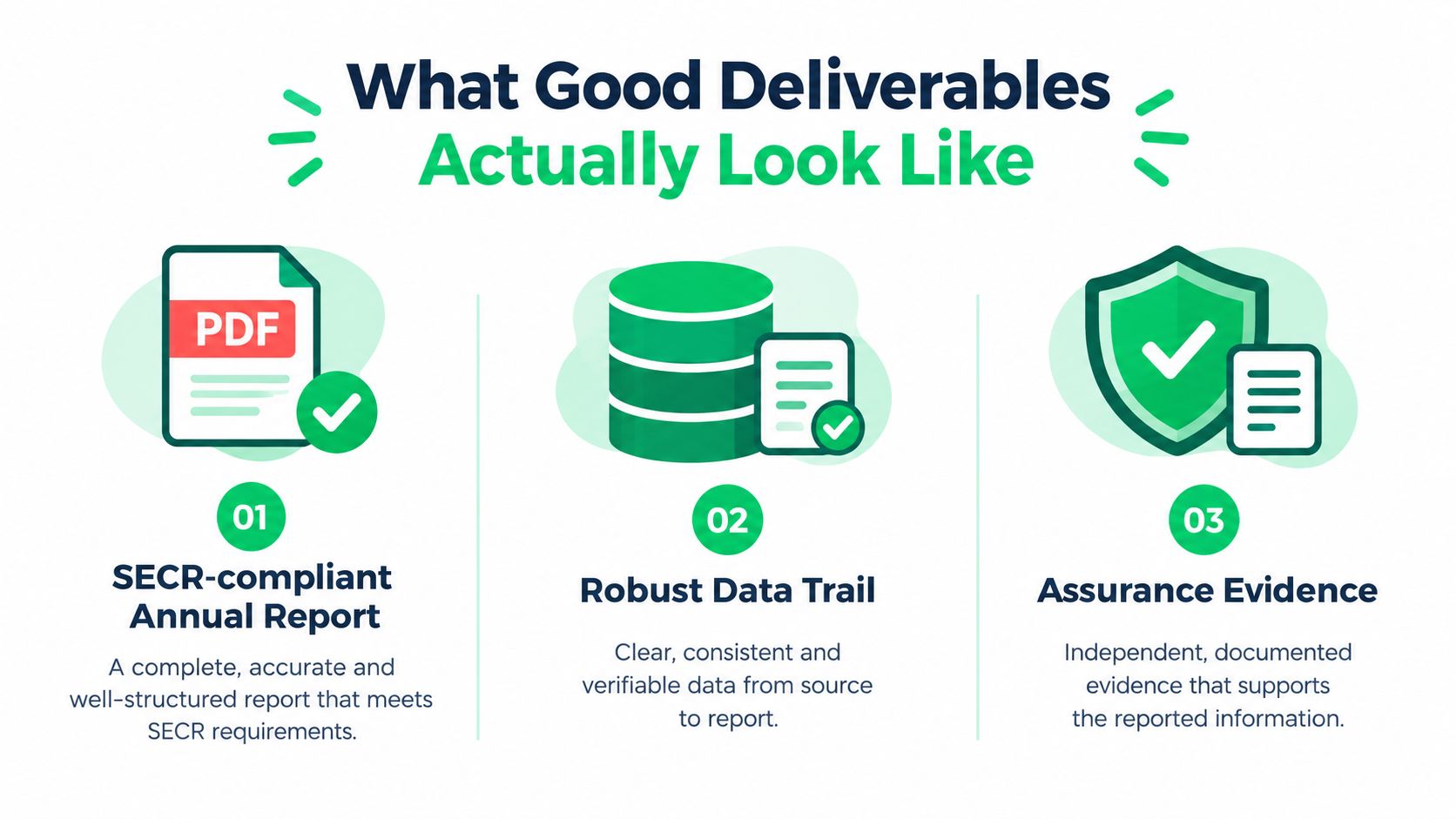
Test the evidence trail, not just the report
UK sustainability assurance is increasingly expected in practice. The Financial Reporting Council reported that 84% of FTSE 100 companies obtained some level of external assurance over sustainability reporting in 2022, compared with 68% in 2020, in its market study on sustainability assurance. That makes assurance readiness a design requirement, not a late formatting exercise.
Request these components for every material deliverable:
- Source-data register: System, owner, period, extraction date and supporting file.
- Methodology statement: Boundary, emission factors, conversion approach, estimation method and exclusions.
- Assumptions register: Each judgement, its rationale, approver and effect on the output.
- Versioning log: Draft history, changed figures, reviewer comments and final approval.
- Named preparer: The person responsible for each calculation and narrative section.
For a UK SRS-aligned report, expect a governance narrative, risk and opportunity process, value-chain mapping, materiality rationale and data lineage. A transition plan should connect targets to actions, investment decisions, responsibilities and progress monitoring. CDP, PRI and SFDR responses need reviewer notes and source evidence, not copied questionnaire language.
A GHG inventory should identify its standard and calculation protocol, with a source-data register that can support review. PwC found that only 30% of leading UK companies explained how climate-related risk was integrated into overall risk management, and reported that science-based target disclosure improved from 48% to 60%, while performance disclosure rose from 31% to 50%, in its review of UK sustainability reporting. The lesson is direct. Targets and polished narrative don't compensate for weak governance, reconciliation and management information.
How a Senior-Led Engagement Should Run From Scoping to Sign-Off
A credible fixed-scope project has visible control points. The senior consultant shouldn't disappear after the sales call and reappear for the final presentation.
The first meeting confirms the applicable frameworks, legal entities, sites, reporting period, data owners and approval route. Within five working days, the project team should issue a data request list with named templates, source-system instructions and a clear distinction between required evidence and helpful background.
The kick-off workshop then locks the boundary, base year and methodology choices. That decision record matters. If the team changes the organisational boundary halfway through the inventory, the effect on comparatives, targets and narrative needs to be visible.
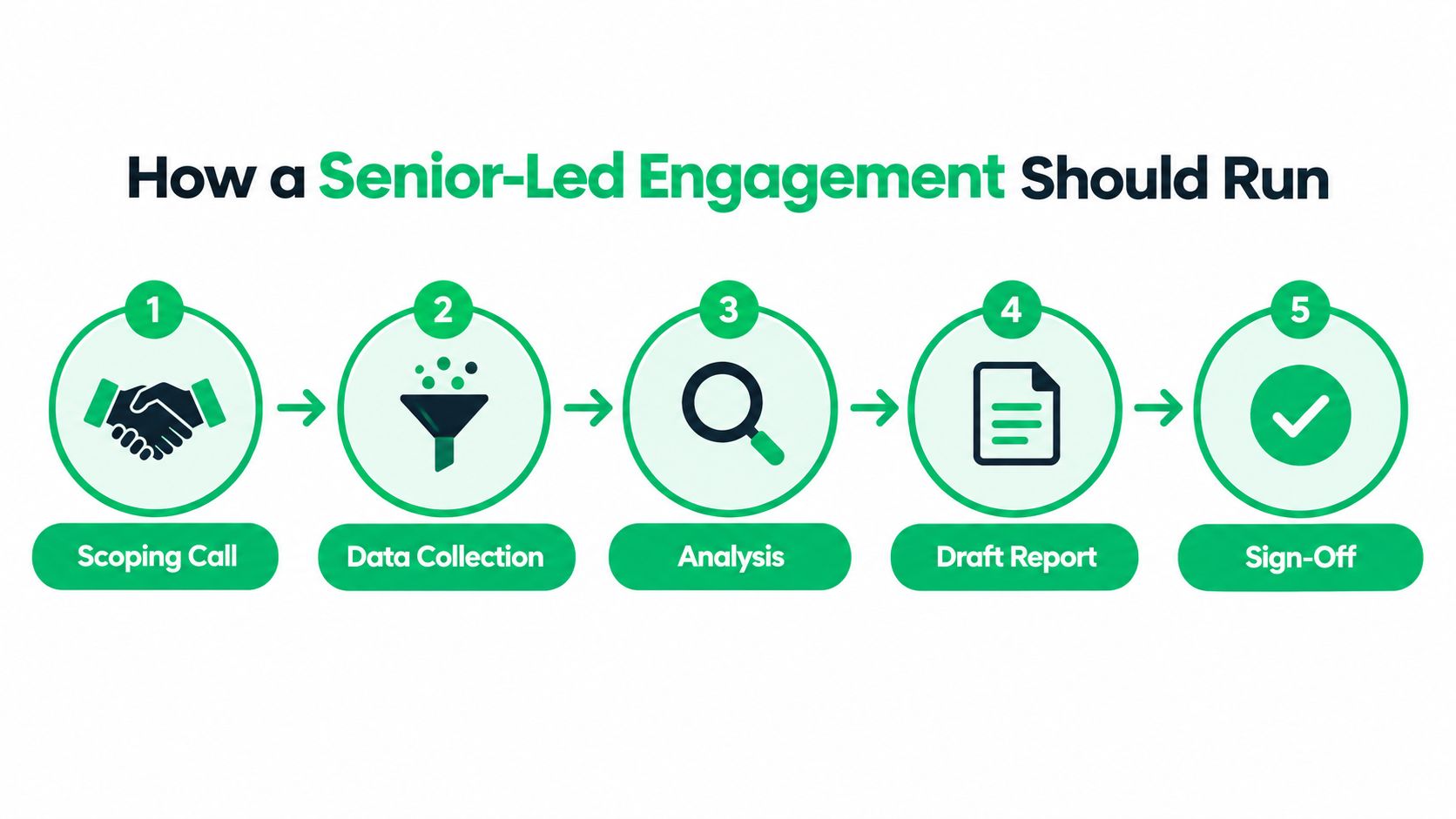
The control points buyers should see
A representative workflow looks like this:
- Scoping call: Confirm applicability, deliverables, people, systems and exclusions.
- Data collection: Issue requests, track owners and challenge missing or inconsistent records.
- Analysis: Reconcile consumption, calculate emissions, document assumptions and test outliers.
- Draft report: Provide a working draft, red-line review and evidence index.
- Sign-off: Deliver the final report, assumptions log, version history and assurer-ready folder.
The mid-project checkpoint is where experienced teams earn their fee. It should expose missing consumption records, inconsistent entity names, unexplained movements and unavailable supplier data before the draft is written. Waiting until final review turns a manageable data issue into a deadline problem.
The most common failures are operational:
- A stakeholder is unavailable until the reporting deadline.
- Additional entities or sites are added without a change order.
- A junior consultant replaces the person who sold the work.
- The client assumes “review” includes unlimited redrafting.
- The final evidence pack is assembled after the report rather than during the calculation.
Require the named lead consultant on every project invoice and in the contract. Ask for notice and approval before substitution. The handover should include a short sign-off meeting, not just a file transfer.
A serious project also records what the consultant couldn't verify. An explicit limitation is more useful than an unsupported figure presented with false confidence.
Red Flags and Final Checklist Before You Sign the Contract
A proposal can sound advanced and still leave the buyer with an unauditable report. Test the working method before you test the branding.
| Warning sign | Question to ask | Document or clause to request |
|---|---|---|
| Vague methodology | Which standard, factor source, boundary rule and estimation protocol will you use? | Methodology schedule attached to the contract |
| No named lead | Who is accountable from scoping through sign-off, and who can replace them? | Named-person commitment and substitution approval |
| Flexible billing | Which tasks are fixed fee, and what triggers a chargeable change? | Change-control process, day-rate cap and approval threshold |
| No ESOS Lead Assessor | Who will sign the assessment where ESOS applies? | Lead Assessor identity and sign-off responsibility |
| Generic template | Which client systems, entities and evidence will you interrogate? | Sample evidence index and client-specific data request |
| Inflated readiness claim | What does “CSRD” or “IFRS S1/S2 ready” mean in this proposal? | Framework-by-framework scope matrix and limitation statement |
Be particularly wary of readiness language. A gap analysis isn't compliance, a workshop isn't a transition plan and a report mapped to headings isn't evidence that the organisation can support assurance. Ask the bidder to show one anonymised example of the evidence index, assumptions register and review log they expect to provide.
Before signing, check these ten points:
- Scope: The entities, sites, periods and frameworks are named.
- Lead: One accountable senior consultant is identified.
- Fee: The fixed fee, inclusions, exclusions and tax treatment are clear.
- Acceptance: The contract defines review rounds and approval criteria.
- Evidence: The handover includes source records, calculations and an evidence index.
- Assurance: The work is designed for the intended level of external review.
- Method: Boundaries, factors, estimation and restatement rules are documented.
- Data: Confidentiality, retention, access and deletion terms are suitable.
- References: The bidder can demonstrate relevant work for a comparable reporting problem.
- Exit: You can obtain working files, transfer ownership and end optional support without losing the deliverable.
For UK organisations, ESG Consulting offers defined support across SECR, ESOS, UK SRS, CSRD scope assessment, Carbon Reduction Plans, transition planning and assurance-ready emissions reporting. If you need a clear applicability decision or a senior-led fixed-fee brief rather than an oversized ESG package, visit ESG Consulting and ask for the scope, deliverables, evidence trail and exclusions to be set out before any proposal is accepted.
More from the blog
· 12 min read · Regulation
What is PPN 026? The new Social Value Model
PPN 026 replaces PPN 002 as the Social Value Model for central government contracts from 1 January 2027. Scope, the 10% and 20% weightings and the six criteria.
Read article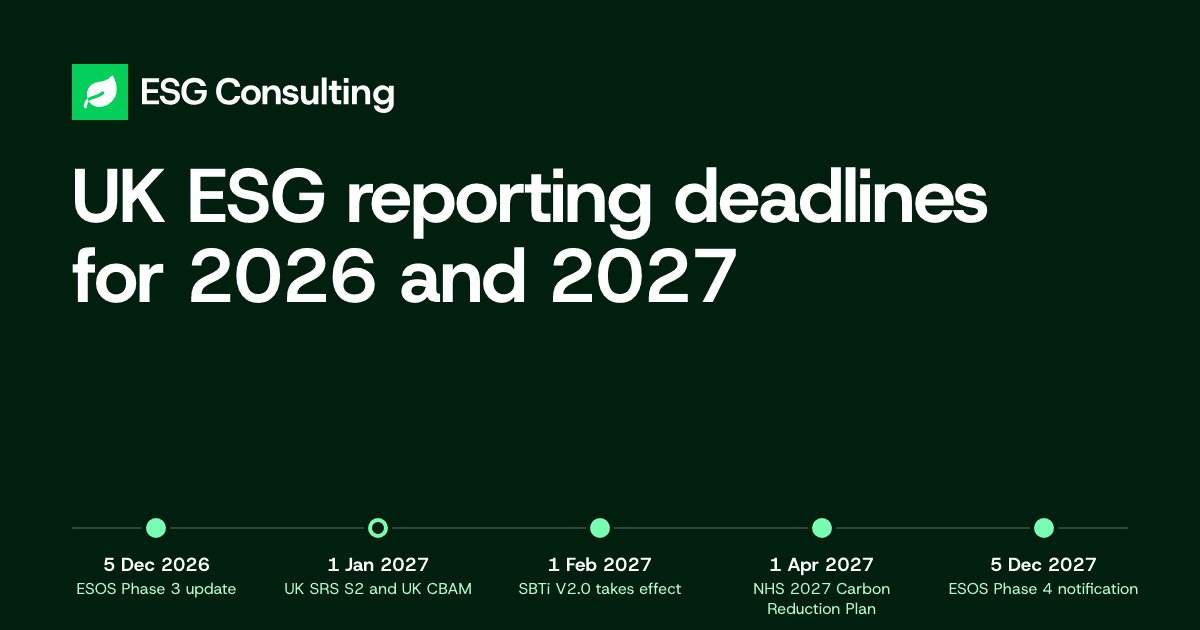
· 14 min read · Regulation
UK ESG reporting deadlines for 2026 and 2027
Every UK ESG reporting date to December 2027 - UK SRS, ESOS, SECR, UK CBAM, CSRD, SBTi, PPN 026 and the NHS - each marked mandatory, proposed or voluntary.
Read article