carbon consulting, ESG strategy, net zero UK, SECR compliance, scope 3 emissions
Carbon Consulting: A Complete Guide for 2026
By ESG Consulting Team · · 13 min read
What happens when a board thinks it has “done carbon” because it bought a spreadsheet, but the evidence collapses at assurance? That's the gap most organisations still miss. Carbon consulting is no longer about producing a neat emissions number, it's about building the records, controls and judgement calls that can survive regulatory scrutiny, buyer questionnaires and external review.
Table of Contents
- What Carbon Consulting Delivers
- Core Carbon Consulting Services in Practice
- Methodology Behind Reliable Carbon Inventories
- Choosing the Right Engagement Model
- Assessing Consultant Competency and Outputs
- Real-World Applications Across Organisation Types
- Turning Carbon Insights Into Measurable Outcomes
- Next Steps for Engaging Carbon Consulting Support
What Carbon Consulting Delivers
What does carbon consulting deliver when an assurance team starts asking for evidence, not intent? It gives organisations a controlled way to produce emissions information that can stand up to SECR, ESOS, wider sustainability reporting expectations, and procurement pressure from major buyers and lenders. ONS data indicates that UK net territorial greenhouse-gas emissions were about 385 million tonnes of carbon-dioxide equivalent in 2023, down 5% from 2022 and 53% below 1990 levels, with carbon dioxide representing about 79% of the total ONS greenhouse-gas emissions methodology. That matters because a defensible inventory has to be built from source records, not broad-brush statements.
Boundary discipline is the first test. Territorial emissions and consumption-based emissions are not the same, and ONS estimated 383.9 MtCO2e on a territorial basis versus 699.2 MtCO2e on a carbon-footprint basis in 2023 ONS greenhouse-gas emissions methodology. That gap surfaces when an assurance provider asks for the source invoice behind a Scope 2 figure, or when procurement, imported goods, and outsourced services sit outside the organisation's direct energy records. Scope 3 then becomes the pressure point, because the evidence trail is usually thinner and the judgement calls are harder to defend.
Practical rule: if the emissions discussion stops at utility bills, the organisation has a reporting exercise, not a decision-support system.
From disclosure to governance
The shift is structural. Current UK guidance makes SECR mandatory for quoted companies and for unquoted companies and LLPs that meet at least two thresholds, more than 250 employees, turnover above £36 million, or a balance sheet above £18 million UK sustainability reporting guidance 2025 to 26. Carbon data now sits inside annual-report processes, alongside finance sign-off, evidence controls, and the audit trail behind each figure.
Sector patterns shape the work. Manufacturing was the largest emitting industry in 2023 at 62 MtCO2e, or 16% of UK territorial emissions, followed by electricity, gas, steam and air-conditioning supply at 50 MtCO2e, or 13% ONS greenhouse-gas emissions methodology. In practice, that changes where I start, operations, supply chain, energy procurement, or capital planning, depending on where the records are strongest and where the biggest control gaps sit.
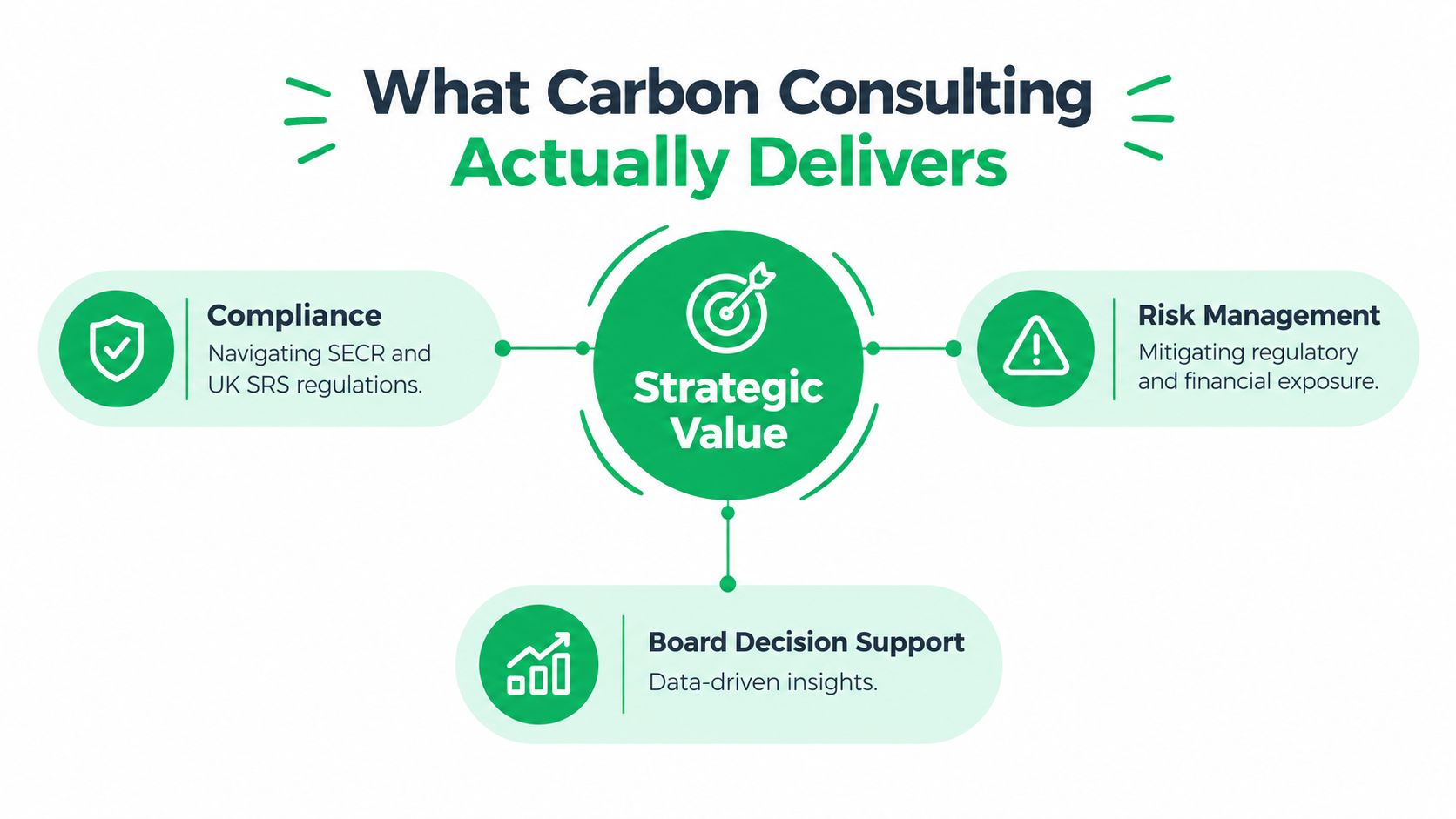
Carbon consulting done properly links compliance, risk management, and decarbonisation sequencing into one evidence-led operating model. The value is not the tonne figure on its own. It is the quality of the records behind it, and whether those records will still hold when they are tested.
Core Carbon Consulting Services in Practice
A credible engagement rarely begins with a grand strategy deck. It begins with scope mapping, data triage and a hard look at which obligations apply. Under SECR, organisations typically need domestic Scope 1 emissions, relevant electricity and energy consumption in kilowatt-hours, associated spend, at least one intensity ratio and a narrative on energy-efficiency action UK sustainability reporting guidance 2025 to 26.
The service stack that holds up in practice
The strongest consulting teams usually combine five functions:
- Inventory building. They define organisational and operational boundaries, then map source records to Scope 1, Scope 2 and relevant Scope 3 categories.
- Reporting control. They test whether the numbers can be traced back to invoices, meter reads, fuel cards or mileage logs.
- Compliance scoping. They confirm whether SECR, ESOS, public-sector reporting or customer requirements apply, and whether any exemptions or deferrals are available.
- Reduction planning. They turn the emissions profile into sequenced actions, usually starting where cost, control and abatement potential overlap.
- Assurance preparation. They build the evidence schedule, sign-off trail and narrative discipline that external reviewers will later probe.
That mix matters because the same client often needs several outputs from one dataset. A listed business may need annual-report text, a supplier questionnaire response and a board paper. An NHS trust may need estate-level prioritisation and a Green Plan that can survive fragmented site ownership. A government supplier may need a Carbon Reduction Plan aligned to procurement expectations.
ESOS raises the bar further. In Phase 3, at least 95% of total energy consumption must be covered by an energy audit, ISO 50001 certification, Display Energy Certificate or an equivalent route, with only up to 5% left as de minimis energy consumption ESOS Phase 3 guidance. That means the service is not just “do an audit”, it's reconcile the denominator first, then prove coverage.
For teams that want an external reference point on footprinting basics, the internal guide at carbon footprint business is a useful adjacent read.
Methodology Behind Reliable Carbon Inventories
Reliable carbon work is mostly recordkeeping with judgement layered on top. The calculation itself is easy to automate; the hard part is proving why a number changed, who approved the change and whether the change reflects operations or methodology. DESNZ publishes annual greenhouse-gas conversion factors in condensed, full and machine-readable formats, and those factors are meant to support Scope 1, Scope 2 and relevant Scope 3 calculations DESNZ greenhouse-gas reporting conversion factors 2025.
What a defensible inventory file contains
At minimum, I expect to see:
- The original source record. Meter, invoice, mileage log or fuel record.
- The activity unit. Kilowatt-hours, litres, kilometres or another auditable measure.
- The factor version. The exact DESNZ release used.
- The formula. How the activity converted into tCO2e.
- The approver. Who signed off estimates, exceptions and restatements.
A good inventory file should let a reviewer retrace the number without asking for a fresh explanation by email.
That discipline matters because recomputing prior years with a new factor set can create apparent emissions movement that has nothing to do with actual performance. The file should therefore separate genuine abatement from factor updates and document any restatement clearly DESNZ greenhouse-gas reporting conversion factors 2025.
Scope 3 needs a different control model from operational emissions. The weakness in many programmes is not that the estimate is crude, it's that nobody has defined when a crude estimate is good enough and when a primary-data chase is worth the time. Recent UK reporting behaviour shows why that matters, as more companies are restating sustainability metrics and Scope 3 figures are frequently among the changes Deloitte UK press room on sustainability adjustments in 2025. The lesson isn't “never improve data”, it's “improve it with a recalculation policy, or you'll break comparability”.
For organisations that need reporting to stand up under review, the service should include estimation approval rules, factor-version control and a clean split between measured data and management assumptions. A polished dashboard won't save weak traceability. The evidence trail will.
The other part of the methodology is organisational. When ownership of emissions data sits between finance, estates, procurement and sustainability, records drift. Carbon consulting is useful when it assigns ownership back to named data holders, then builds a monthly or annual reconciliation path that survives the reporting cycle.

Choosing the Right Engagement Model
The delivery model shapes the outcome as much as technical skill does. A fixed-fee, named-account-lead engagement behaves very differently from a generalist team on a rolling advisory retainer, and the difference shows up in who owns sign-off, who chases evidence and who answers when the auditor asks a follow-up question.
| Engagement model | Accountability structure | Scope certainty | Typical outcome focus |
|---|---|---|---|
| Named account lead, fixed scope | One consultant owns delivery from brief to sign-off | High | Assurance-ready outputs and clear governance |
| Generalist team, open advisory | Shared ownership across multiple consultants | Lower | Broad advice with variable continuity |
| Transactional compliance project | Narrow ownership, deadline-led | Medium | Filing deadlines and basic disclosures |
| Capacity-building programme | Client team gradually takes over | Medium to high | Internal capability and repeatable process |
A transactional project works when the priority is a filing deadline and the internal team already understands the data. A capacity-building model makes more sense when the organisation wants its finance or sustainability team to run the process after the consultant leaves. In practice, the best programmes mix both, one person accountable, one fixed boundary, and a documented handover.
What to look for in the scope
The scope should spell out sign-off gates, exclusion rules and how changes are handled mid-year. If the proposal doesn't say who approves data substitutions, or how factor revisions are managed, the organisation will end up with a deliverable that looks finished but behaves like a draft.
Practical rule: if nobody can explain the handover to finance, the engagement is too loose.
A firm such as ESG Consulting fits naturally into this role, because its delivery model is built around a named account lead and fixed scope, which is useful when the buyer needs clear ownership rather than a rotating advisory bench.
The right model also depends on what happens after the consultant exits. Strong engagements leave behind a control framework, not just a PDF. Weak ones leave a report that nobody wants to update because the underlying evidence process was never designed for reuse.
Assessing Consultant Competency and Outputs
Technical confidence matters less than assurance-readiness. A consultant can speak fluently about emissions factors and still deliver an archive that falls apart when someone asks for the source invoice or the reason a prior year changed. The better test is whether they can show how data is owned, reconciled and defended before external review begins.
Questions that expose capability quickly
Ask these questions and listen for specifics:
- Who owns the data after finance sign-off? If the answer is vague, the control model is weak.
- What evidence will you retain for each disclosure? Strong teams can describe the schedule without improvising.
- How do you decide when an estimate becomes primary data? If they can't explain the trigger, Scope 3 will drift.
- How do you handle restatements? A real answer should cover rationale, version control and comparability.
- Which frameworks have you worked against recently? Applicability matters more than generic ESG experience.
The policy context matters too. SECR is not optional for in-scope entities, and organisations also need to know whether related obligations such as ESOS or public-sector carbon reporting affect the engagement UK sustainability reporting guidance 2025 to 26. A competent consultant won't just calculate emissions, they'll flag when an obligation doesn't apply, when a disclosure can be deferred, and when a buyer expectation exceeds the legal minimum.
If a provider promises “accuracy” but can't describe the control environment, that's a red flag. If they rely on spend-based estimates without explaining where they're acceptable, that's another one. The same applies to a team that produces attractive charts but no source schedule.
For organisations comparing providers, the broader service framing in sustainability reporting consultant can help separate reporting capability from assurance-ready delivery.
Real-World Applications Across Organisation Types
Listed companies usually feel the pressure first because external reporting sits close to investor scrutiny. In practice, that means SECR data has to reconcile with finance, while wider UK sustainability reporting expectations push teams towards better governance, boundary discipline and clearer board narratives. Where supply chains are complex, Scope 3 often becomes the deciding factor for whether the emissions story is credible or merely complete on paper.
NHS bodies face a different problem. The issue is rarely a single emissions hotspot, it's the fragmentation of estates, landlord arrangements, transport, procurement and site-level evidence. A Green Plan can look neat at corporate level and still fall apart when the underlying utility, occupancy and operational records aren't aligned.
Private companies and government suppliers usually come at the problem through procurement. Carbon Reduction Plans, customer questionnaires and supplier due diligence force teams to prove not only that they measure emissions, but that they can defend the number and show a path to reduction.
Three practical patterns
- Listed group: focus on data governance, board reporting and restatement control.
- NHS trust: focus on site evidence, landlord recharges and estate-level prioritisation.
- Private supplier: focus on buyer-ready narratives, contract compliance and repeatable reporting.
The same inventory rarely satisfies every stakeholder, because each audience asks a different question of the same data.
That's why generic benchmarks are rarely enough. A custom pathway based on the organisation's own data, ownership structure and procurement pressure usually produces more useful decisions than an off-the-shelf target set.
Turning Carbon Insights Into Measurable Outcomes
Carbon consulting creates value when the numbers change decisions, not just disclosures. The strongest programmes connect inventories to procurement choices, capital allocation and supplier engagement, so emissions data becomes part of operational management rather than a once-a-year reporting chore. When teams use the same evidence trail for board KPIs, customer responses and assurance, the process gets faster and less fragile.
The best outcome is not a bigger spreadsheet. It's a system where assumptions are documented, evidence is retained, estimates are approved and restatements are explained before anyone outside the business asks. That's what makes decarbonisation pathways defensible, because the organisation can show how each action links back to a source record and a governance decision.
Regulatory and assurance pressure will keep rising, but the organisations that cope best are the ones that treat carbon data like financial data. They define ownership, control versioning and decide early what must be measured, what can be estimated and what needs to be escalated.
For teams building a long-term operating model, carbon management is the natural next discipline, because it turns reporting into a repeatable management process.
Next Steps for Engaging Carbon Consulting Support
Start with scope, not slogans. Ask for a proposal that names the regulatory frameworks in play, the evidence schedule, the sign-off path and the person who will own delivery from briefing to final output. If the draft doesn't cover factor-version management, restatement policy and Scope 3 governance, it's not ready.
Then test whether the engagement builds internal capacity or just produces another external report. Good consultants leave a client team that knows where the records sit, who approves estimates and how the next cycle will run. Weak consultants leave a polished document and a long list of unresolved dependencies.
Before appointing anyone, request examples of their control documentation, not just report samples. You want to see how they handle source records, exclusions, recalculations and assurance questions. That tells you far more than a slide deck ever will.
ESG Consulting helps UK organisations build carbon reporting that stands up to scrutiny, from SECR and ESOS through to Scope 3 governance and board-ready disclosure. If you need evidence trails, clear ownership and a practical route to assurance-ready reporting, visit ESG Consulting to see how that support can be structured around your organisation.