carbon reporting uk, secr compliance, esos phase 4, uk srs readiness, sustainability disclosure
Carbon Reporting Requirements UK: A Practical Guide
By ESG Consulting Team · · 18 min read
The finance director has three deadlines competing for the same data. The annual report needs its SECR narrative. The energy team is updating an ESOS action plan. Procurement has opened a portal asking for a PPN 006 Carbon Reduction Plan, while the board wants to know whether the business is ready for UK Sustainability Reporting Standards.
That isn't one reporting task. It's a stack of obligations with overlapping inputs, different applicability tests and separate evidence requirements. The mistake is to give each regime its own spreadsheet and consultant workstream. The better approach is to build one controlled carbon data system, then map its outputs to each obligation.
Table of Contents
- Why UK Carbon Reporting Now Feels Like Several Jobs at Once
- SECR as the Foundational UK Carbon Reporting Layer
- ESOS Phase 3 and Phase 4 and What Energy Audits Now Have to Prove
- UK SRS S1 and S2 and the Road to First Reporting in 2028
- Climate-Related Financial Disclosures and the FCA Consistency Statement
- CSRD, ESRS and When UK Groups Still Get Pulled In
- PPNs, Social Value and NHS Green Plans as Procurement-Side Tests
- Building a Cross-Regime Control Map and Your 90-Day Readiness Plan
Why UK Carbon Reporting Now Feels Like Several Jobs at Once
A decade ago, many organisations treated carbon disclosure as a voluntary sustainability exercise. UK carbon reporting requirements now sit much closer to annual reporting, financial controls, procurement eligibility and board accountability. SECR links energy and emissions data to the annual report. ESOS tests whether large organisations have identified energy-saving opportunities and, increasingly, whether they acted on them. Climate-related financial disclosures place governance, risk and strategy in the strategic report.
The procurement calendar adds another layer. A government supplier may need a Carbon Reduction Plan under PPN 006, responses under the Social Value Model and preparation for further procurement expectations. NHS trusts and healthcare providers have their own Green Plan and supplier-readiness pressures. UK-listed groups must also consider the direction of travel under UK SRS S1 and S2, while groups with European operations may face CSRD and ESRS obligations.
The same data, different questions
These regimes reuse parts of the same evidence, but they don't ask the same question.
- SECR asks: What energy did the organisation use, what emissions resulted, what intensity ratio applies and what efficiency action was taken?
- ESOS asks: Has the organisation assessed its energy use properly, and can it evidence the savings delivered from its action plan?
- UK SRS asks: How do sustainability-related risks and opportunities affect enterprise value, governance, strategy and financial reporting?
- Climate-related financial disclosures ask: How does the board govern climate risks, assess resilience and monitor targets?
- CSRD asks: What are the organisation's material impacts, risks and opportunities under a broader European reporting framework?
- Procurement frameworks ask: Can the supplier demonstrate credible carbon management in a format that supports a buying decision?
Treating all of these as one checklist creates predictable failure. Teams calculate emissions twice, use inconsistent organisational boundaries, lose the evidence behind an intensity ratio, or publish a target that the operational team can't support.
Board-level rule: Decide applicability regime by regime, then reuse controlled data and governance wherever the requirements genuinely overlap.
The practical sequence is straightforward. First, confirm which entities and activities are in scope. Second, establish a single source for activity data, emissions factors, methodologies and approvals. Third, create a crosswalk showing which disclosures can reuse that evidence and which need additional work, such as scenario analysis, double materiality or ESOS savings verification.
The rest of the guide follows that sequence by obligation, not by department. That matters because the finance team owns the annual report, procurement owns tender responses and sustainability owns the inventory, but the underlying controls need to work across all three.
SECR as the Foundational UK Carbon Reporting Layer
SECR is the base layer for most UK carbon reporting programmes. It moved operational energy and emissions reporting from a largely voluntary practice into a recurring corporate-reporting obligation for a broad population of organisations. It applies through company-size tests, so a large private business can't assume the regime is only relevant to listed companies.
For many companies, the first practical question is whether the large-company test is met. A company generally falls within the relevant threshold where it meets at least two of the following tests: 250 employees, £36 million turnover or £18 million balance sheet total. The thresholds and disclosure mechanics should be checked against the organisation's legal structure and reporting status, not inferred from whether the business has a sustainability team. The SECR reporting requirements guide is a useful reference point for that initial assessment.
Start with the size test and reporting entity
Applicability must be assessed at the correct entity level. Large unquoted companies and large limited liability partnerships generally need to report UK energy use, associated greenhouse-gas emissions, an intensity ratio, energy-efficiency action and the methodology used. Groups also need to understand which entities are covered and whether data is being consolidated consistently.
SECR normally covers:
- Scope 1: Emissions from sources owned or controlled by the organisation, such as fuel combustion in boilers or company vehicles.
- Scope 2: Emissions associated with purchased electricity, heat, steam or cooling.
- Intensity: At least one ratio that relates emissions to an appropriate business measure.
- Efficiency action: Measures taken during the year to improve energy efficiency.
- Methodology: The emissions factors, boundaries, assumptions and calculation approach used.
The annual report should also explain permitted exclusions and provide comparative information where applicable. A finance team should be able to trace every material figure from the published narrative to invoices, meter data, fuel records, factor selections and calculation files.
Build an audit-ready annual report process
SECR isn't a glossy sustainability brochure. It sits within the Companies Act reporting framework and connects carbon data to directors' annual-report responsibilities. That means the control environment matters as much as the final prose.
| Test or item | Threshold or requirement |
|---|---|
| Large-company test | At least two of 250 employees, £36 million turnover or £18 million balance sheet total |
| Energy information | UK energy use and associated greenhouse-gas emissions |
| Emissions coverage | Normally Scope 1 and Scope 2 |
| Intensity metric | At least one intensity ratio |
| Efficiency narrative | Energy-efficiency actions taken during the year |
| Methodology | Relevant calculation methods, factors and assumptions |
| Exceptions | Explain permitted exclusions |
| Comparatives | Include comparative information where applicable |
The best control is a reporting calendar that begins before year-end. Assign owners to electricity, gas, transport fuel, refrigerants and landlord-provided energy. Record missing data and estimation decisions as they occur, rather than trying to reconstruct the rationale during annual-report drafting.
A credible SECR file should answer five questions without relying on one individual's memory:
- Which legal entities are included?
- Which sites and activities sit inside the boundary?
- Which activity data supports each emissions figure?
- Why were particular factors and intensity denominators selected?
- Who reviewed and approved the final numbers and narrative?
Practical rule: If the board could approve the annual report but nobody can reproduce the emissions calculation, the SECR control is incomplete.
SECR provides reusable infrastructure for later work, but it doesn't satisfy later regimes by itself. It gives the organisation a controlled Scope 1 and Scope 2 baseline. It doesn't automatically provide transition planning, scenario analysis, value-chain evidence or financial materiality assessments.
ESOS Phase 3 and Phase 4 and What Energy Audits Now Have to Prove
ESOS is often described as an energy audit obligation. That description is now too narrow. The framework increasingly asks large organisations to show what happened after the audit, not merely prove that an assessor inspected energy use.
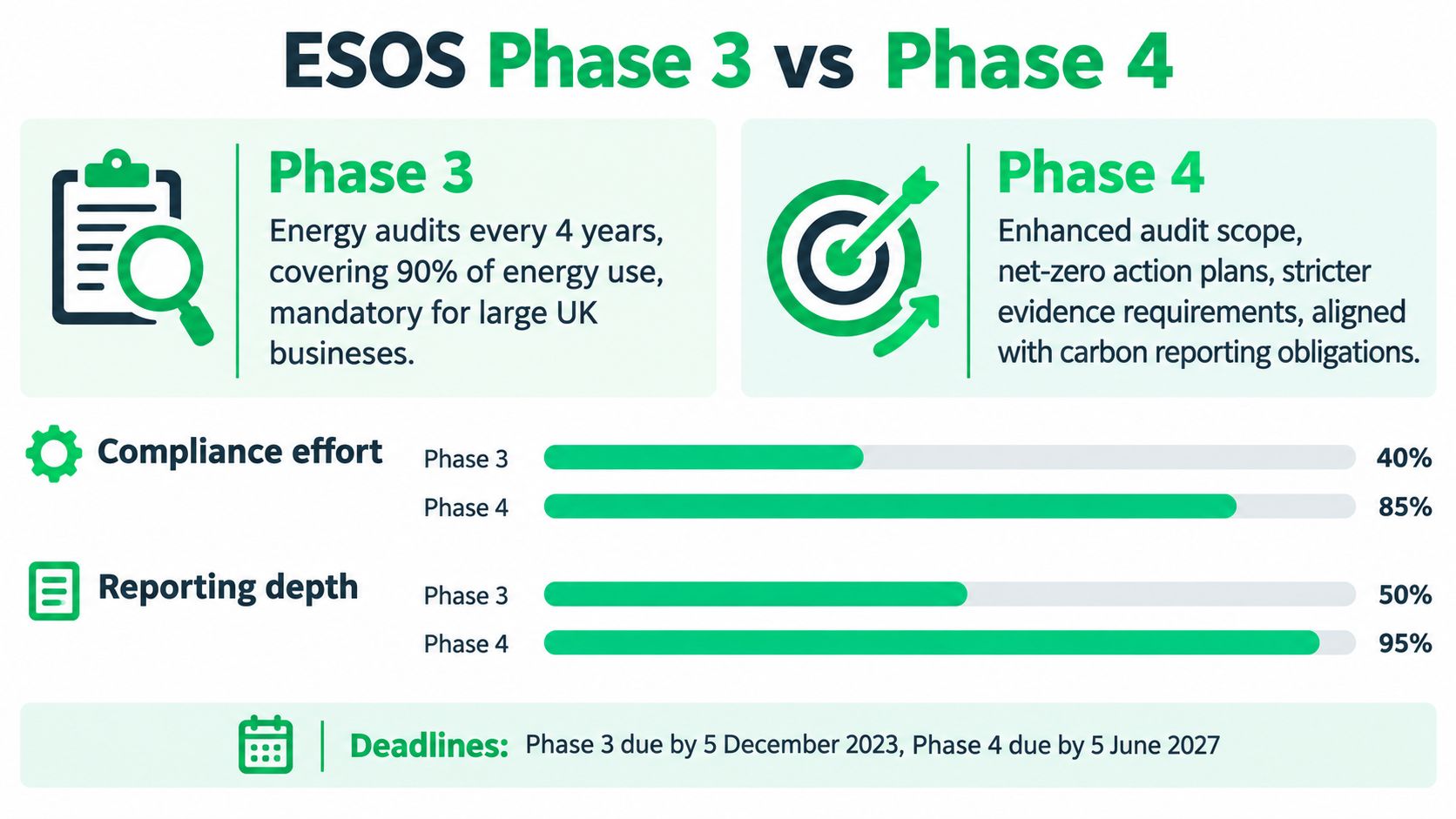
Phase 3 centred on identifying energy-saving opportunities and meeting the required audit and coverage process. Phase 4 adds a stronger implementation lens. The government's Phase 4 ESOS guidance requires participants to report progress against action-plan commitments, quantify energy savings achieved, describe the measures responsible and explain proposed measures that weren't implemented.
Phase 3 established the audit baseline
The ESOS process requires relevant participants to understand their energy use across the organisation, with audits and assessments supported by a registered Lead Assessor. Coverage must be sufficient, including the 95% energy coverage requirement for the relevant assessment process. A report that examines only the easiest buildings or most accessible meters isn't enough.
The Lead Assessor's role is important because the assessment needs professional review and sign-off. But sign-off doesn't turn an unimplemented recommendation into a decarbonisation result. Management still has to decide which measures receive funding, who owns delivery and how savings will be measured.
Phase 4 tests delivery evidence
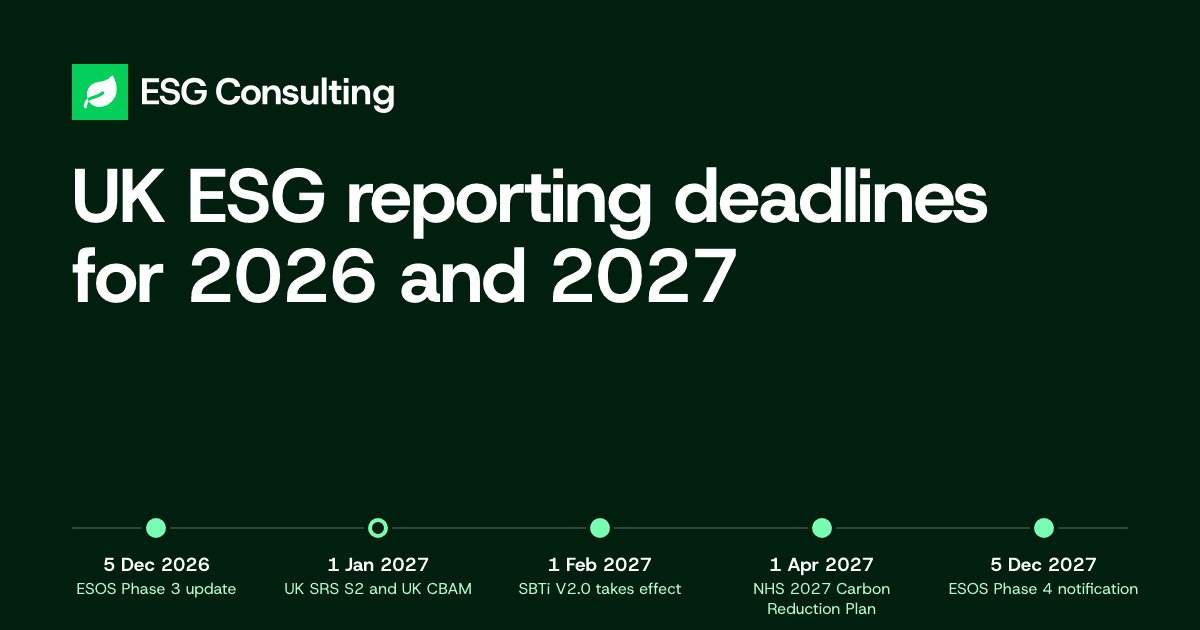
The practical change is the move from recommendation to evidence. For the progress period 6 December 2025 to 5 December 2026, the organisation needs to consider what actions were committed, what savings were achieved, which measures produced them and why other measures weren't implemented, as set out in the government guidance linked above.
That creates a useful distinction:
| Regime | Primary question |
|---|---|
| ESOS | Has the organisation assessed energy use and evidenced progress on action-plan measures? |
| SECR | Has the organisation disclosed energy, emissions, intensity and efficiency action in its annual report? |
ESOS savings are not automatically emissions reductions. A business may use less energy because of lower production, a site closure or a change in operating hours. Conversely, an efficiency project may reduce energy use while emissions factors or fuel mix change the reported carbon result.
Published ESOS information also has a limitation. It shows combined savings across measures rather than savings from each individual measure, partly to protect commercially sensitive information. Boards and procurement teams therefore won't always be able to distinguish individual project performance from the overall reported total.
Energy savings prove implementation only when the baseline, owner, measure and verification method are documented.
The control response should include a baseline, project register, implementation owner, approved capital decision, measurement-and-verification method and reconciliation to energy and emissions data. The ESOS Phase 4 service overview can help teams structure the assessment and evidence process, but the organisation still needs internal ownership after sign-off.
UK SRS S1 and S2 and the Road to First Reporting in 2028
UK SRS changes the question from “What did we emit?” to “Which sustainability-related risks and opportunities could affect the organisation, and how does management govern them?” That is a major expansion beyond SECR.
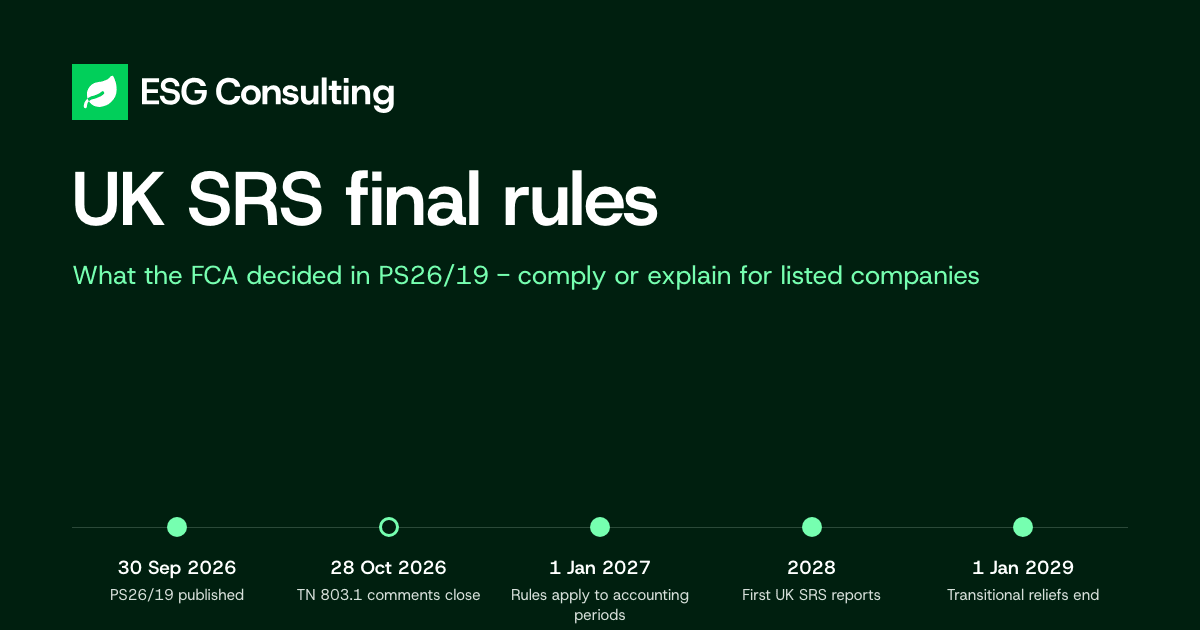
For FCA in-scope listed companies, the relevant reporting path is expected to operate on a comply or explain basis for accounting periods beginning on or after 1 January 2027, with first reporting in 2028, as described in the government's UK reporting framework materials. The practical implication is clear. A company that waits until the first reporting year to design its controls will be trying to build governance, financial connectivity, risk analysis and data architecture at the same time as it prepares the report.
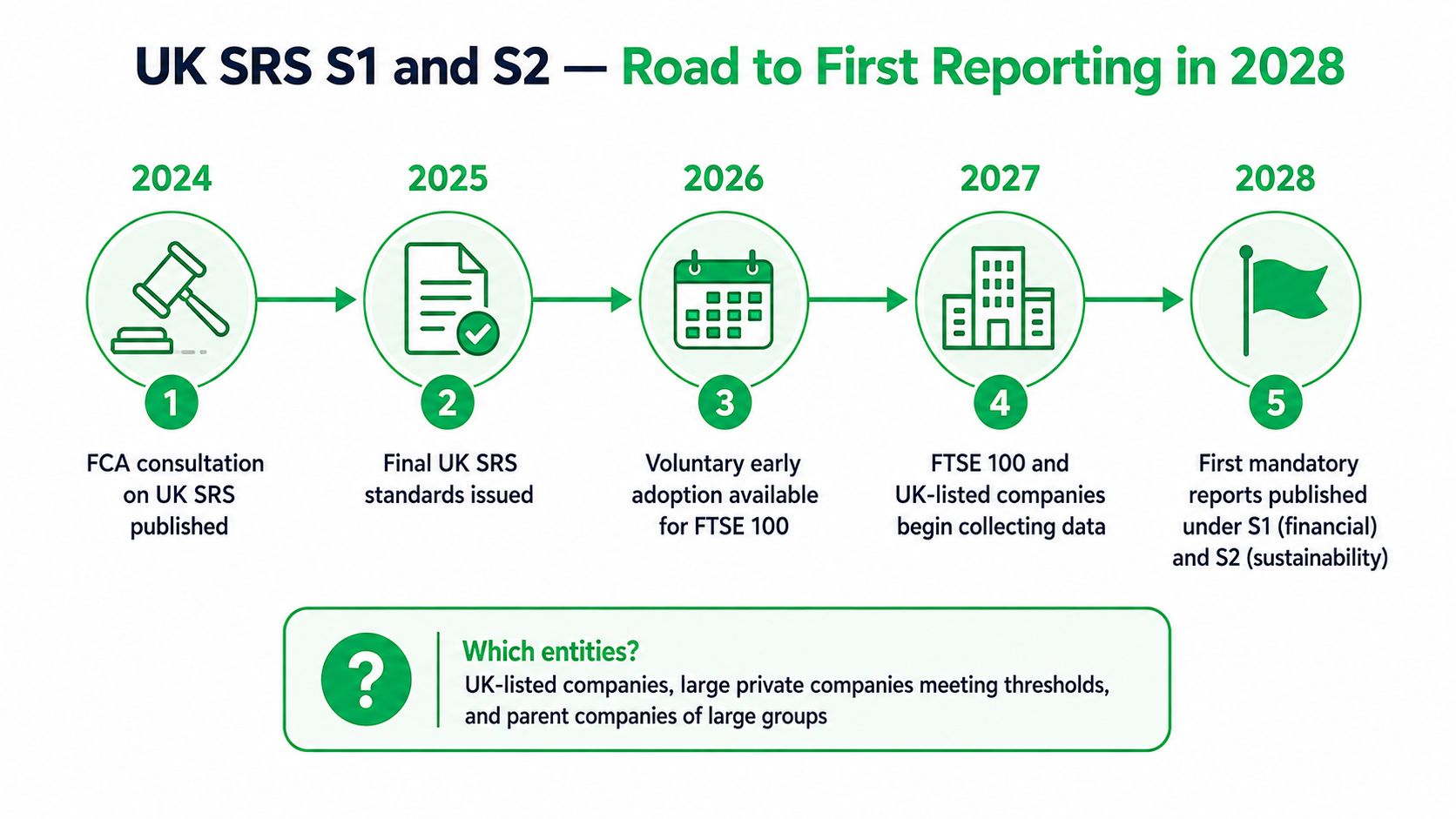
What S1 and S2 add to SECR
S1 addresses sustainability-related financial information more broadly. S2 focuses on climate-related risks and opportunities. Together, they require a connected view of:
- Governance: Who oversees sustainability risks and opportunities, and what information reaches the board?
- Strategy: How could climate and other sustainability matters affect the business model, capital allocation and resilience?
- Risk management: How are risks identified, assessed, prioritised and integrated into the wider risk process?
- Metrics and targets: Which indicators are used, how are targets monitored and how are methods documented?
SECR can supply useful Scope 1 and Scope 2 data, but it doesn't answer these questions. A company needs to link emissions and energy information to strategic decisions, financial planning, risk registers and target performance. It also needs a defensible approach to value-chain emissions.
Treat Scope 3 relief as a build period
Scope 3 receives a one-year transitional relief under the described reporting approach. That is a planning window, not a permanent exemption. The organisation should use it to map value-chain categories, identify material sources, establish supplier engagement and document estimation methods.
The right preparation sequence is:
- Map material climate risks and opportunities to business units and board committees.
- Connect those risks to financial planning, enterprise risk management and strategic decisions.
- Establish scenario analysis and resilience evidence.
- Build Scope 3 data pathways, including supplier, spend and activity-based sources.
- Test whether every metric and target can be traced to an owner, methodology and approval.
UK SRS is a formal reporting standard, not voluntary ISSB adoption or a refreshed TCFD narrative. Its value lies in connecting sustainability disclosures to general purpose financial reporting. Finance should therefore own the reporting architecture, while sustainability, risk, operations and procurement provide controlled inputs.
Climate-Related Financial Disclosures and the FCA Consistency Statement
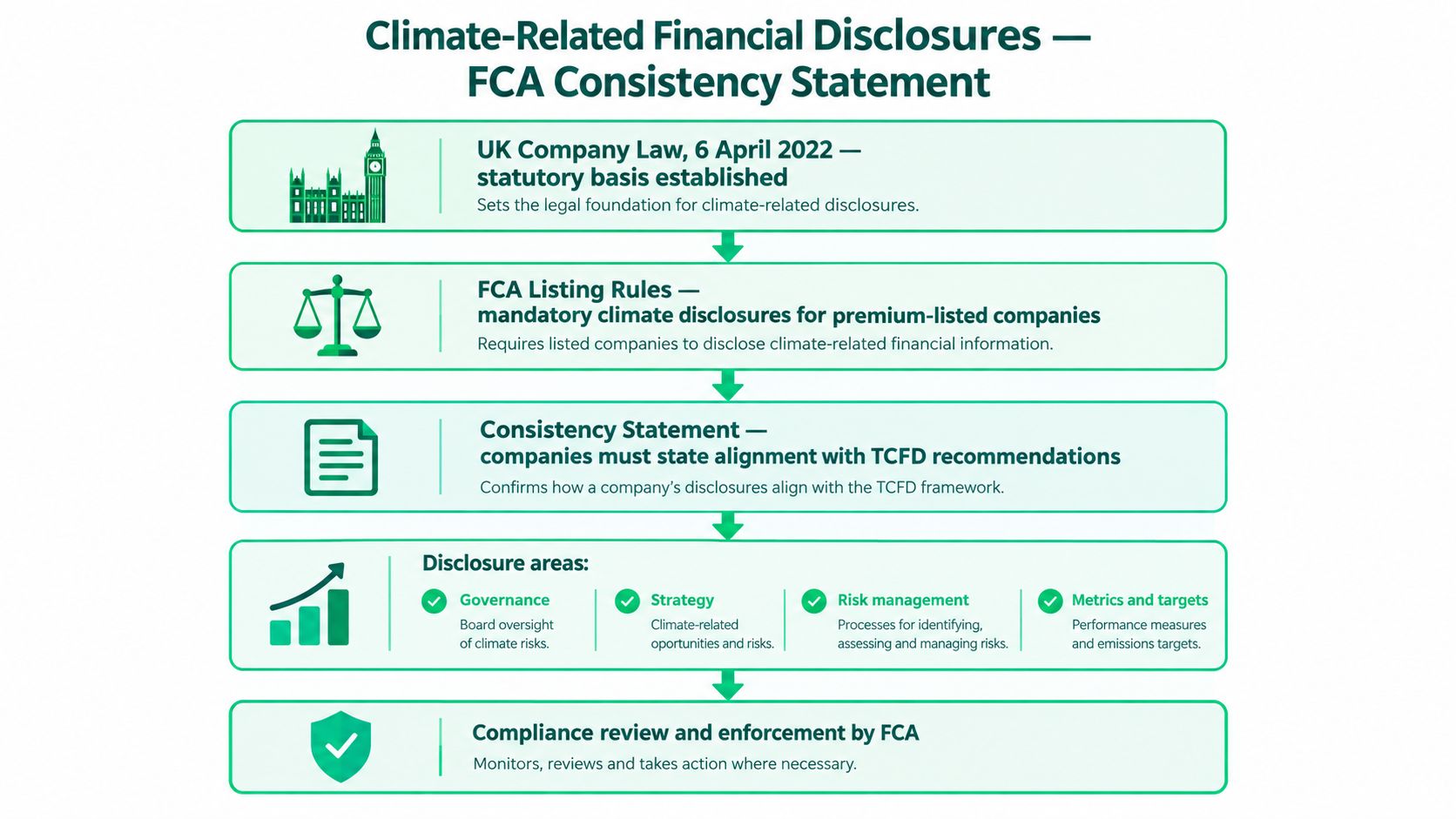
Climate-related financial disclosures are a statutory reporting regime, not an optional sustainability publication. The UK introduced mandatory climate-related financial disclosures for major companies and financial institutions from 6 April 2022, and the government estimated that the rules would affect more than 1,300 of the largest UK-registered companies and financial institutions. The government announcement on mandatory climate disclosures sets out the policy milestone and affected population.
Confirm whether the company is captured
The qualifying tests generally include more than 500 employees and, for a high-turnover company, turnover above £500 million. The rules also cover relevant companies with securities admitted to trading on the Alternative Investment Market. Applicability depends on the entity and reporting circumstances, so a group should document its assessment rather than rely on a broad label such as “large private company”.
The disclosure goes beyond a carbon total. The strategic report needs to address:
- Governance arrangements for climate-related risks and opportunities.
- The process for identifying, assessing and managing those risks.
- Principal risks and opportunities and relevant time horizons.
- Effects on the business model and strategy.
- Resilience under different climate scenarios.
- Climate targets and performance against them.
- Key performance indicators and calculation methods.
These requirements make climate reporting a board process. The audit trail should identify the committee or director responsible, the evidence reviewed, the methodology used and the location of supporting material in the annual report or another identified document.
Make the consistency statement a controlled sign-off
For UK-listed companies subject to FCA climate-disclosure rules, the annual financial report must state whether the disclosures are consistent with the TCFD recommendations. If they aren't complete, the company must explain which requirements weren't met, why, what steps are planned and the expected timeframe, as set out in the FCA review of TCFD-aligned disclosures.
That statement should have its own workflow. Finance should maintain a disclosure checklist, evidence index, review log and board approval record. Sustainability shouldn't be left to defend a missing risk disclosure after the report has gone to the printer.
Control test: Every TCFD pillar should have an accountable owner, approved evidence and a precise place in the published reporting package.
CSRD, ESRS and When UK Groups Still Get Pulled In
A UK headquarters doesn't keep a group outside CSRD. The relevant question is whether the group has an EU reporting connection through listed securities, EU-incorporated subsidiaries, significant EU operations or products and funds marketed into the European market.
UK groups should investigate at least four routes into scope:
- EU-listed securities: A UK group with securities admitted to an EU market may face European reporting requirements connected to that listing.
- EU subsidiaries: An EU-incorporated subsidiary can create a reporting obligation that affects group data collection and consolidation.
- EU operations: Significant activity in the EU may require information that UK management can't obtain from its UK reporting system alone.
- EU-marketed funds: Asset managers marketing Article 8 or Article 9 funds into the EU need to consider the sustainability information and product disclosures attached to those funds.
The reporting logic differs
UK SRS is primarily focused on financially material sustainability information and enterprise value. CSRD and ESRS use a broader double-materiality perspective, which considers both how sustainability matters affect the organisation and how the organisation affects people and the environment.
That difference changes the work. A SECR inventory may provide a useful emissions baseline, but an ESRS reporting package can require broader value-chain information, documented impacts and dependencies, stakeholder input, policy evidence and assurance-ready controls. The underlying activity data may be similar. The reporting shape isn't.

Use a simple decision rule before deciding CSRD is somebody else's problem:
- Check every EU listing and trading venue.
- List EU subsidiaries and assess their reporting characteristics.
- Map EU operations, customers and value-chain dependencies.
- Identify funds marketed into the EU, including Article 8 and Article 9 products.
- Confirm who owns the group-level data and assurance response.
Don't build separate emissions inventories for UK and EU reporting unless the boundaries differ. Build one controlled inventory, then create the UK and ESRS views from the same source. Keep the materiality assessment, evidence index and methodology decisions distinct where the frameworks ask different questions.
PPNs, Social Value and NHS Green Plans as Procurement-Side Tests
Procurement requirements often create the hardest operational deadline because a failed tender can remove revenue immediately. A late SECR narrative may be embarrassing. An incomplete Carbon Reduction Plan can make a supplier ineligible for a government opportunity.
PPN 006 requires relevant government suppliers to provide a Carbon Reduction Plan covering organisational emissions and a credible pathway towards net zero. The document needs to align with the buyer's required format and be supported by consistent emissions data, governance, targets and delivery evidence. It shouldn't be produced as a marketing document separate from the annual inventory.
The same source data can support several procurement outputs:
- PPN 006: Organisational footprint, reduction commitments, governance and delivery plan.
- Social Value Model: Environmental outcomes and the practical contribution proposed through the contract.
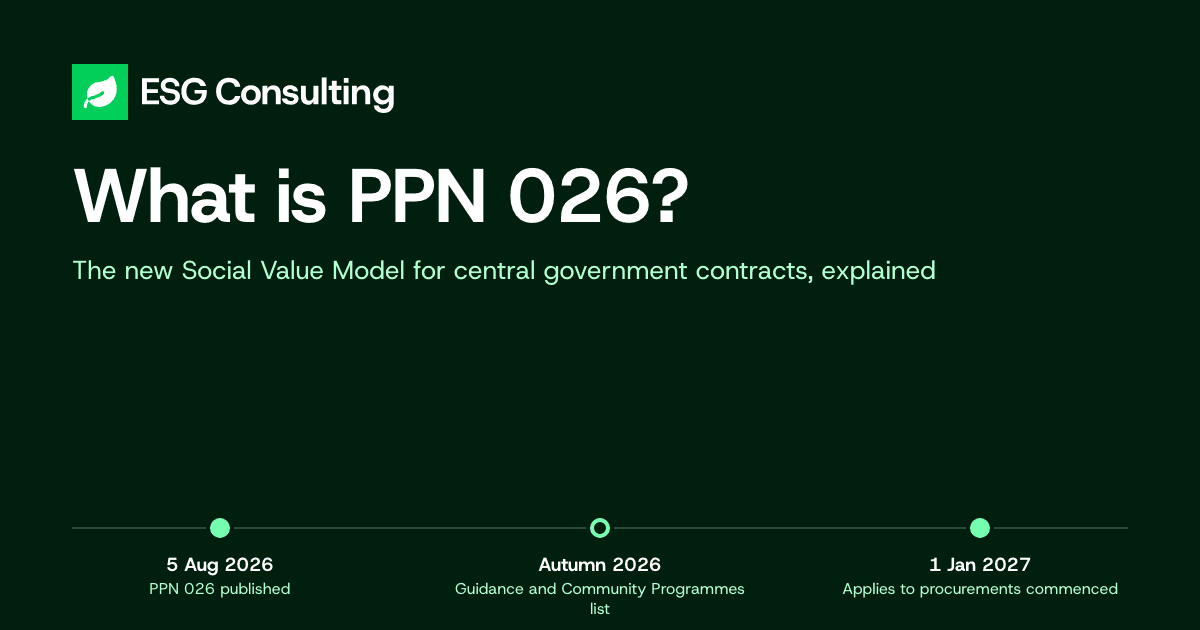
- PPN 026 preparation: Stronger readiness for evolving carbon and procurement expectations.
- NHS Green Plans: The trust's route to reducing emissions and embedding sustainability in operations and procurement.
- Evergreen assessment readiness: Evidence that a healthcare supplier understands climate, data and procurement expectations.
Procurement asks for proof of execution
A buyer doesn't only want to know whether a supplier has calculated Scope 1 and Scope 2. The buyer may test whether the target has an owner, whether measures are funded, whether suppliers are engaged and whether progress can be reported during the contract.
For NHS trusts and healthcare providers, the Green Plan should connect estates, travel, procurement, clinical operations and governance. Suppliers need to understand how their own Carbon Reduction Plan and emissions data will support the trust's procurement and contract-management requirements.
The Social Value Model guidance and UK context helps teams consider how environmental commitments interact with wider tender responses. The practical point is to avoid writing a carbon plan in isolation from the bid's social value methodology.
Commercial test: If the procurement team can't verify the number, the bid team shouldn't promise it.
Create a controlled bid library containing the latest inventory, methodology statement, target wording, action plan, evidence for completed measures and named approvers. Set an expiry and review trigger so an old Carbon Reduction Plan isn't reused after the organisational boundary, baseline or target has changed.
For large private companies and government suppliers, procurement readiness deserves board attention because it converts carbon reporting into a direct commercial condition. The same data architecture that supports SECR and ESOS can support bids, but the narrative must be adapted to the buyer's question.
Building a Cross-Regime Control Map and Your 90-Day Readiness Plan
The efficient model is a shared control base with regime-specific extensions.
| Shared control base | Separate capability still required |
|---|---|
| Organisational boundary and entity register | UK SRS scenario analysis and financial-materiality assessment |
| Scope 1 and Scope 2 activity data | CSRD double-materiality assessment |
| Emissions factors and methodology log | ESOS Phase 4 progress and savings evidence |
| Data owners, review controls and approval records | FCA TCFD consistency statement |
| Targets, action plans and delivery evidence | Procurement-specific Carbon Reduction Plan wording |
| Supplier and value-chain data routes | NHS and EU reporting formats |
Use the next 90 days in three phases:
- Applicability: Confirm which entities face SECR, ESOS, climate disclosures, UK SRS, CSRD or procurement requirements. Record where an obligation does not apply.
- Data and evidence: Stabilise boundaries, meters, factors, Scope 3 routes, action plans and approval trails. Remove uncontrolled spreadsheets from the final sign-off process.
- Board review: Run a gap assessment against the next report, tender or assessment. Escalate missing owners, unsupported estimates, uncosted actions and targets with no delivery evidence.
By the end, the board should be able to decide which obligations apply, which disclosures can be deferred, which ratings or voluntary frameworks aren't yet necessary, and which investments are required to protect reporting and procurement outcomes. That's the purpose of a control map. It turns overlapping carbon reporting requirements in the UK into a prioritised finance decision.
ESG Consulting helps UK organisations assess SECR, ESOS, UK SRS, climate-related financial disclosures, CSRD and procurement requirements against one controlled evidence base. Visit ESG Consulting to discuss applicability, audit-ready carbon data, board reporting and a practical readiness plan before your next reporting or tender deadline.