corporate sustainability reporting, UK SRS, SECR compliance, Scope 3 emissions, ESG data controls
Corporate Sustainability Reporting Explained
By ESG Consulting Team · · 16 min read
The most popular advice on corporate sustainability reporting is to choose a framework, gather the metrics and publish a polished narrative. That sequence is backwards. A framework can tell you what to disclose, but it can't make an emissions figure reliable, explain a prior-year restatement or prove that the board reviewed a material judgement.
For a UK organisation, the harder task is building a reporting system that connects operational records, financial consolidation, governance decisions and annual-report production. External assurance will test that connection. It will look for boundaries, source evidence, calculation methods, approvals and a consistent explanation of uncertainty. Treat sustainability reporting as a communications exercise and the weaknesses usually appear in the data, not the prose.
Table of Contents
- The Control Discipline Behind Sustainability Disclosures
- Mapping the UK Regulatory Requirements
- Executing Double Materiality and Boundary Setting
- Structuring Board Governance and Oversight
- Mastering Scope 3 Data and Restatement Policies
- Preparing for First-Cycle UK SRS Reporting
- Building an Assurance-Ready Reporting System
The Control Discipline Behind Sustainability Disclosures
A sustainability report may sit outside the financial statements, but its control requirements belong in the same discipline. Someone must define the reporting entity, approve the methodology, reconcile source records, review estimates and retain evidence for every material figure. The published narrative is only the visible result of that work.
SECR has already established this expectation for a broad population of UK businesses. It has applied since 1 April 2019 to every quoted company and to large unquoted companies and limited liability partnerships, subject to an applicable low-energy exemption. For unquoted companies and LLPs, the size test generally captures organisations meeting at least two of three thresholds: more than 250 employees, turnover above £36 million or a balance sheet total above £18 million. The UK sustainability reporting overview sets out these requirements.
The disclosure includes energy consumption, associated expenditure, greenhouse-gas emissions, at least one intensity ratio and principal energy-efficiency actions. Each item creates a control test. Can the organisation reproduce the figures from utility invoices, fuel records and approved emissions-factor calculations? Can it explain a boundary change and preserve the prior basis for comparison? Can another reviewer recalculate the intensity ratio without depending on a spreadsheet held by one person?
Practical rule: If a figure can't be traced from the annual report to a controlled source record, it isn't assurance-ready.
Why narrative alone fails
A commitment to reduce emissions does not define an inventory. A materiality statement does not replace evidence. The board needs to know which data is measured directly, which is estimated, who approved the assumptions and how an error found after publication will be corrected.
The January 2026 independent evaluation cited approximately 19,900 companies and LLPs in scope, compared with an original forecast of 11,300, around 76% more than anticipated. The scale matters because it shows that UK sustainability reporting extends beyond major listed issuers into the annual-report processes of large private businesses and partnerships. The evaluation is included in the UK sustainability reporting overview.
Ownership must follow the data. Sustainability teams may manage the methodology, while finance controls the timetable, consolidation logic and sign-off. Operations should own meter readings, fuel records and activity data. Procurement should challenge supplier evidence and document unresolved gaps. The board should understand the judgements affecting the reported result, including estimates, exclusions and restatements.
A credible disclosure therefore resembles a controlled reporting pack with a public narrative attached. Its quality depends less on the polish of the prose than on whether finance, sustainability and operations can reproduce the result, explain its limitations and support it through external assurance.
Mapping the UK Regulatory Requirements
UK reporting starts with applicability, not framework selection. Map the legal entities, listing status, size thresholds, reporting period and group consolidation before choosing additional standards or voluntary disclosures. This sequence identifies which requirements affect the annual report and which create a separate evidence burden.
SECR remains the established baseline. Quoted companies generally disclose global Scope 1 and Scope 2 emissions and energy. Large unquoted companies and LLPs generally report UK energy use and emissions, with a limited transport-fuel Scope 3 requirement. Because the disclosure sits in or alongside the annual report, its control owner should work to the financial reporting calendar rather than operate separately from it.
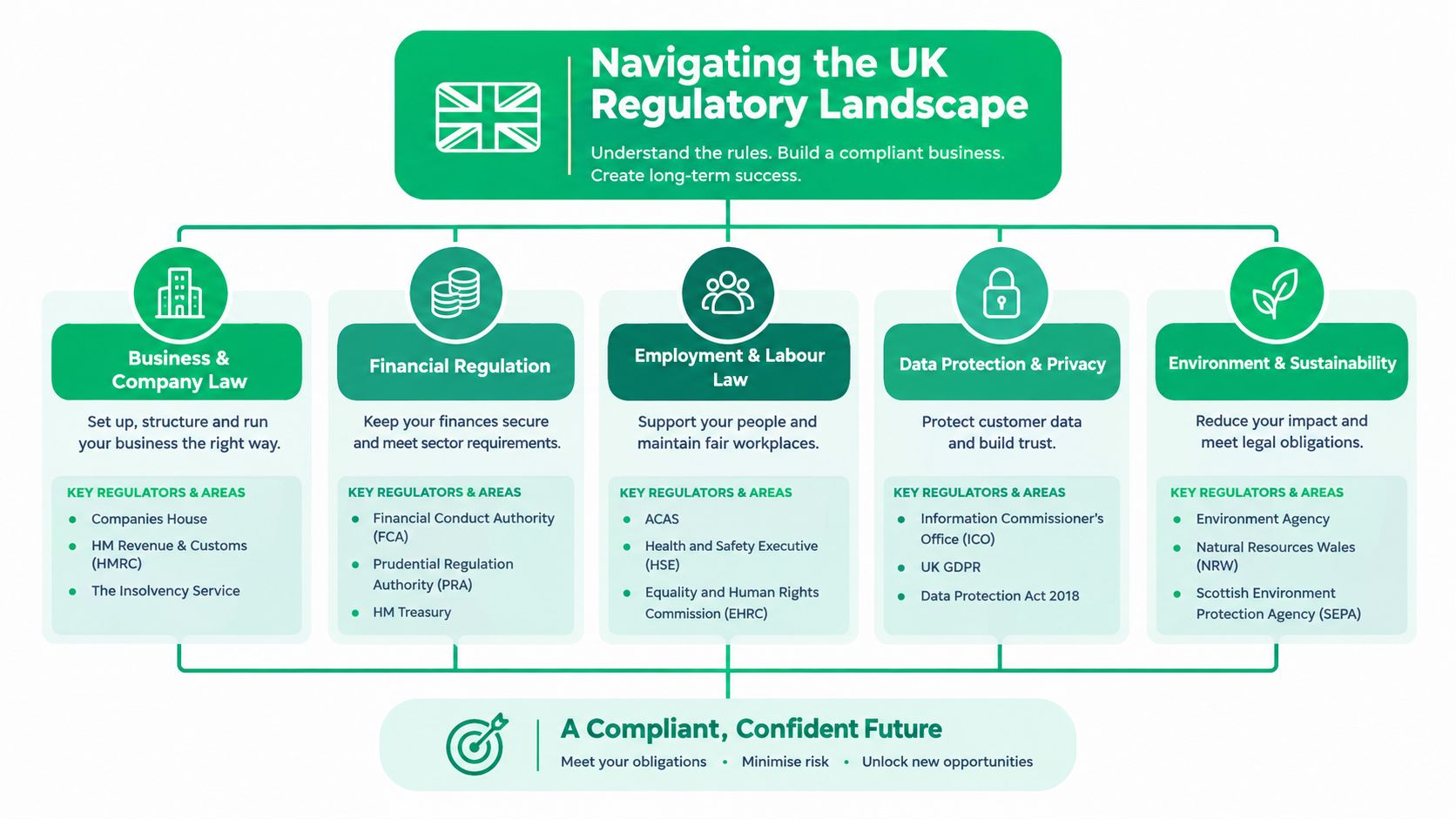
Separate the reporting layers
The FCA's TCFD-aligned Listing Rule moved climate communication from voluntary practice towards mandatory annual-report disclosure. It applied to accounting periods beginning on or after 1 January 2021 for premium-listed commercial companies. Companies had to state whether their disclosures were consistent with the TCFD recommendations, explain gaps, identify where relevant information appeared and describe steps towards fuller compliance.
In a review of 171 premium-listed commercial companies with December 2021 year ends, the FCA found that more than 90% self-reported consistency with the TCFD Governance and Risk Management pillars, while 81% reported consistency with all seven recommended disclosures (FCA review of TCFD-aligned disclosures). Performance was weaker for Strategy and Metrics and Targets. Governance wording is easier to produce than a defensible record of scenarios, metrics, targets and performance. Those areas require documented ownership, reconciled inputs and explanations that can withstand challenge.
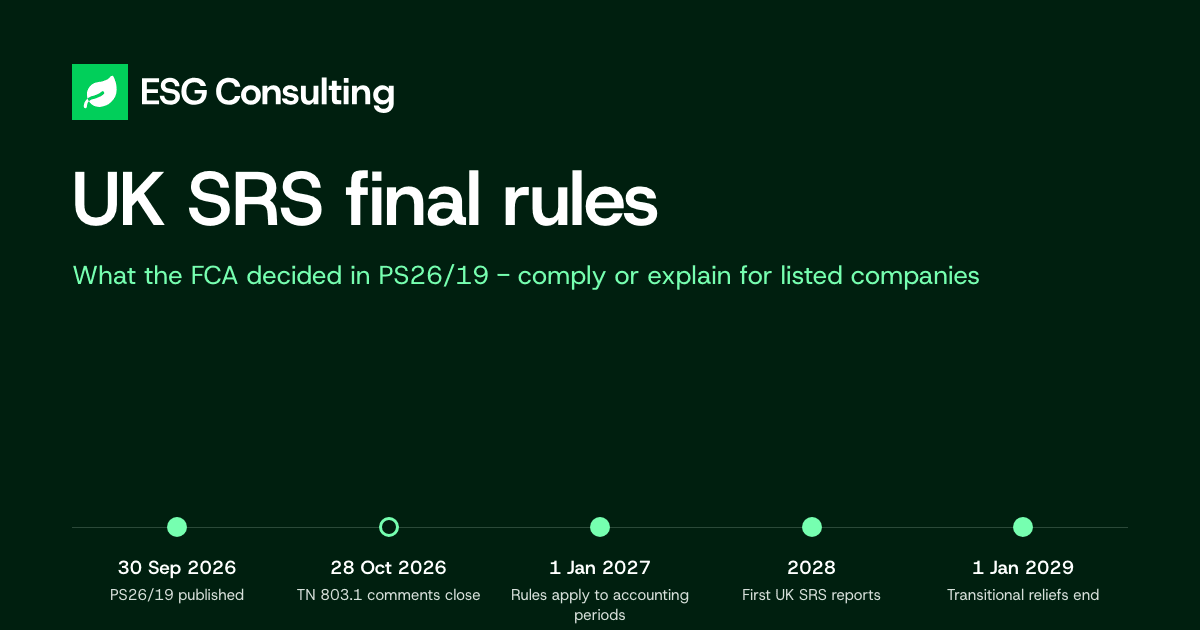
UK SRS S1 and S2 introduce a further implementation decision. The Government published the final standards in February 2026 for voluntary use. FCA rules are set to require listed companies to report against UK SRS on a comply-or-explain basis for accounting periods beginning on or after 1 January 2027, with first reporting expected in 2028 (UK SRS S1 and S2 publication). The FCA position includes no first-year delayed-reporting relief, so sustainability reporting should be coordinated with the related financial reporting timetable. Finance and sustainability teams also need an agreed treatment for late data, estimation changes and post-publication corrections.
Build an applicability matrix
A practical matrix should distinguish:
- Mandatory disclosures, including applicable SECR requirements and rules triggered by listing status.
- Comply-or-explain requirements, where the organisation must explain omissions and locate supporting evidence.
- Voluntary early adoption, which may meet investor or customer expectations while creating an internal evidence burden.
- Future applicability, including requirements dependent on accounting periods, corporate structure or regulatory implementation.
For organisations with EU exposure, CSRD and ESRS may create another reporting stream. UK SRS, TCFD and CSRD share concepts, but their scope tests, disclosures and assurance expectations can differ. Record the overlap, assign one source dataset where possible and document each regime-specific adjustment. Guidance on UK rules and regulations can support the initial mapping, but the group's legal applicability should be confirmed separately.
Executing Double Materiality and Boundary Setting
Materiality is not a popularity contest based on a stakeholder survey. It is a documented decision about which impacts, risks and opportunities are significant enough to influence disclosure, strategy or financial decisions. The assessment must show how the organisation reached its conclusion, not merely list topics that appeared during interviews.
For groups with EU exposure, double materiality requires two perspectives. Impact materiality considers how the organisation affects people and the environment. Financial materiality considers how sustainability matters affect the organisation's cash flows, access to finance, cost base, assets, liabilities or resilience. UK SRS has a financial materiality focus, so the same evidence may feed both processes without collapsing them into one conclusion.
Use a repeatable assessment
A defensible process usually follows this sequence:
- Define the population. List operations, products, services, suppliers, assets and affected stakeholders. Include activities that sit outside the central sustainability team's usual information flow.
- Identify impacts, risks and opportunities. Use business-unit workshops, incident records, procurement categories, risk registers and regulatory exposure. Record both actual and potential issues.
- Set assessment criteria. Document severity, likelihood, scale, scope and reversibility for impacts, then connect financial effects and time horizons to the enterprise risk process.
- Challenge the draft. Ask finance, legal, operations, procurement and the board committee to test omissions and disputed ratings. Keep the questions and responses.
- Approve and preserve the judgement. The final assessment should name owners, explain thresholds and record why topics were included or excluded.
Align the reporting boundary
The emissions boundary should reconcile to the financial reporting boundary wherever the relevant regime expects that relationship. Start with the consolidation schedule used for the annual accounts, then map each entity to operational control, leased assets, shared facilities and outsourced activities. Any mismatch needs a written rationale.
Many reports become fragile at this point. A newly acquired subsidiary may appear in the financial statements before its energy records are integrated. A disposal may remove operational data while comparative figures remain unchanged. A landlord may provide incomplete consumption information for a leased site. Each case requires an explicit treatment, an estimate where appropriate and a record of the limitation.
A boundary note should answer three questions: what was included, what was excluded and why the decision is consistent across reporting periods.
Keep an evidence register for exclusions and estimates. It should identify the source, responsible owner, date, calculation method, approval and expected remediation. A practical ESG materiality assessment approach can help structure the process, but the assessment only becomes useful when it connects to the ledger, risk register and reporting timetable.
Structuring Board Governance and Oversight
A board governance narrative earns credibility when it describes decisions, not meeting attendance. Investors and regulators need to understand who approves the sustainability strategy, who challenges the metrics, which committee receives risk information and how unresolved data limitations reach the board.
The FCA's TCFD experience demonstrates why this distinction matters. Governance and Risk Management disclosures performed more strongly than Strategy and Metrics and Targets in its review. A board can have a committee, a policy and regular agenda time while still lacking a reliable process for approving assumptions or tracking progress against targets.
Assign accountability down to the source
The governance model should show a clear chain:
- The board approves strategy, risk appetite, material judgements and significant targets.
- A board committee reviews the reporting pack, challenges performance and escalates unresolved control weaknesses.
- The finance function owns timetable integration, consolidation, reporting controls and consistency with the annual report.
- The sustainability function maintains methodologies, materiality records, emissions factors and disclosure interpretation.
- Operational owners approve activity data, such as energy, fleet fuel, waste or production volumes.
- Internal audit or a quality reviewer tests selected controls before external assurance begins.
That chain needs evidence. Keep committee papers, action logs, approval records, training records and documented responses to data exceptions. A sentence such as “the board oversees climate-related risks” is weak unless the report can point to the mechanism by which oversight occurred.
Link governance to the metrics
The governance narrative should connect directly to later disclosures. If the report includes an energy-intensity ratio, identify who reviews its denominator and what happens when the business model changes. If Scope 3 estimates rely on procurement data, identify the owner responsible for supplier engagement and the committee that accepts residual uncertainty. If a target has missed its pathway, show how management reports the variance and what corrective action follows.
A workable board pack contains more than final charts. Include the reporting boundary, methodology changes, data completeness, estimation exposure, prior-year comparison, open evidence requests and proposed wording for limitations. The board doesn't need to recalculate every figure, but it does need enough context to approve the judgement knowingly.
Board test: Could a non-executive director ask why a figure changed, who approved the change and whether the comparative data should also change?
That question turns oversight from a general commitment into an observable control. It also gives finance and sustainability teams a common language for escalating problems before publication.
Mastering Scope 3 Data and Restatement Policies
Scope 3 is where a neat reporting timetable meets an untidy value chain. Supplier-specific data can be relevant but incomplete. Industry averages are available but less representative. Spend-based estimates can provide coverage quickly, yet they may reflect price movements rather than physical activity. The right choice depends on the category, the decision the metric supports and the evidence an assurer can inspect.
Deloitte UK's analysis of FTSE 100 annual reports found that 69% of companies made prior-year adjustments to sustainability metrics in 2025, up from 46% the previous year. Greenhouse-gas emissions accounted for 65% of those restatements, and 75% of companies that restated GHG data made changes involving Scope 3 (Deloitte analysis of sustainability adjustments). These figures don't mean every restatement is a control failure. They do show why a company needs a policy before a revision occurs.
Choose the source according to the decision
| Data source type | Best use case | Assurance risk level |
|---|---|---|
| Supplier-specific activity and emissions data | Material suppliers with stable boundaries, verified methodology and clear evidence | Lower, if completeness and methodology are controlled |
| Supplier activity data combined with approved emissions factors | Categories where suppliers can provide physical quantities but not calculated emissions | Moderate, depending on factor selection and reconciliation |
| Industry-average or product-level factors | Early-stage category mapping, benchmarking and areas with limited supplier engagement | Moderate to high, particularly where products or geographies differ materially |
| Spend-based estimates | Initial coverage, procurement categories with no usable activity data or gap analysis | High, because inflation, price changes and classification can distort trends |
The hierarchy isn't absolute. A supposedly precise supplier figure can carry more risk than a transparent estimate if the boundary is unclear or the calculation method changes without notice. Record the reason for choosing each method, the period covered, the emissions factor, the data owner and the limitations.
Write the restatement policy first
A clear policy defines triggers rather than promising perfect stability. Consider restating when a boundary error affects a material category, when a methodology change breaks comparability, when a supplier correction changes the reported result materially, or when a previously excluded source is found to have been relevant. The policy should also explain how management assesses materiality and who approves the correction.
Keep the original figure, revised figure, reason, affected period, calculation file and approval record. Don't overwrite the old workbook and call the revised number an update. Publish a concise explanation where the change affects the reader's understanding, and distinguish a genuine correction from an improved estimate or a structural change in the business.
Make uncertainty visible
For every major Scope 3 category, maintain a lineage record from procurement or operational activity through to the reported emissions figure. It should link purchase data, supplier submissions, factor libraries, assumptions, calculation logic and review evidence. Where the data is estimated, label it as estimated and state the planned improvement, such as supplier engagement, category reclassification or a better activity-data feed.
Assurance doesn't require pretending that value-chain data is perfect. It requires showing that the organisation knows where uncertainty sits, controls the method and can explain changes without losing the history.
Preparing for First-Cycle UK SRS Reporting
The first UK SRS report will be won or lost before the reporting year begins. FCA rules are due to apply for accounting periods beginning on or after 1 January 2027, with first reporting expected in 2028. The FCA has stated that there is no first-year delayed-reporting relief, as noted earlier. The working deadline is therefore earlier than the date the annual report is published.
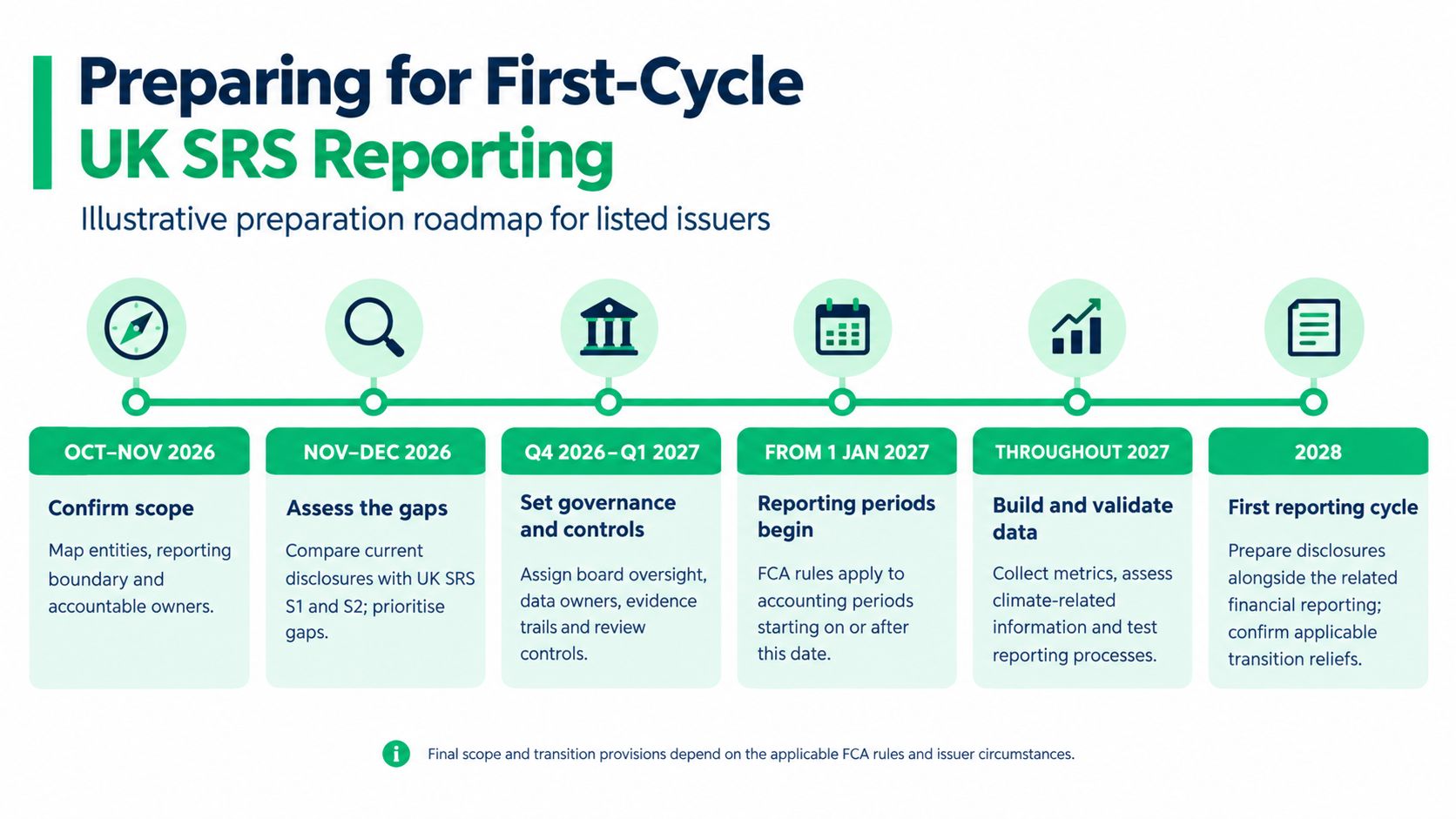
Phase one, establish applicability and ownership
Start with a gap assessment against UK SRS S1 and S2. Map every disclosure to an accountable owner, then confirm the reporting entity, value-chain coverage, climate-risk processes, metrics, targets and dependencies on financial reporting. The deliverable should be a signed applicability matrix that records decisions and evidence, not a collection of workshop notes.
Finance and sustainability should agree the reporting calendar at this point. Set data cut-off dates, consolidation deadlines, committee reviews, annual-report circulation, assurance testing and final board approval. Late sustainability data creates a direct control problem. Teams either delay publication or introduce adjustments after finance has closed the relevant records.
Phase two, build the controls
For each metric, document the source system, calculation owner and approval route. Use controlled factor libraries, versioned calculation files and an exception log for missing or inconsistent data. Reconcile emissions and energy records with the relevant operational and financial boundaries, then test the process before the first formal cycle.
The controls that matter most are practical:
- Data lineage: Trace each reported metric to its source record, transformation, calculation and approval.
- Change control: Record methodology, factor, boundary and system changes before they affect comparative information.
- Evidence retention: Store invoices, supplier submissions, meter records, assumptions and review notes in an organised repository.
- Disclosure controls: Tie narrative statements to the metrics, assumptions and risk records they describe.
The objective is not to create paperwork for its own sake. It is to ensure that finance, sustainability and assurance teams can reproduce a figure, explain a judgement and identify who approved the result.
Phase three, rehearse the annual report
Run a dry cycle against the actual reporting timetable. Ask an independent reviewer to test a sample of figures and challenge the governance narrative. Resolve whether each limitation belongs in the methodology, metric commentary, risk disclosure or more than one location.
UK SRS implementation requires coordinated work by the company secretary, finance director, risk owners, procurement leads, operations managers, internal audit and board committees. They should use one controlled timetable and a shared evidence standard. That coordination turns a comply-or-explain obligation into a report the organisation can defend under scrutiny.
Building an Assurance-Ready Reporting System
The strongest sustainability reporting function doesn't begin each year by asking what document to write. It maintains a system that collects evidence continuously, governs judgement consistently and produces disclosures as a controlled output. That system is valuable even when the final report is short.
SECR provides a useful operational benchmark. Post-implementation modelling indicates that the regime was associated with reductions in electricity and gas consumption among in-scope unquoted companies and LLPs of approximately 4.5% in 2020 and 6.2% in 2021 (SECR post-implementation review). The association supports a practical conclusion: measurement and board-level reporting can give managers the visibility needed to identify efficiency actions. Reporting doesn't create the saving by itself, but a controlled process can expose avoidable consumption and make accountability clearer.
What maturity looks like
A mature reporting system has several recognisable characteristics:
- Stable boundaries: Entity changes, leases, acquisitions and disposals are documented and reflected consistently.
- Controlled calculations: Emissions factors, formulas and assumptions have owners and version histories.
- Managed uncertainty: Estimates are labelled, challenged and improved through a defined plan.
- Clear restatements: Corrections preserve the original record and explain the effect on comparatives.
- Integrated governance: Board papers connect risks, targets, metrics, decisions and actions.
- Prepared evidence: Source records can be retrieved without reconstructing the process under assurance pressure.
An assurance-ready sustainability audit should test that system before the external assurer does. The review should prioritise high-risk metrics, Scope 3 categories, boundary changes, manual spreadsheets, late adjustments and narrative claims that lack a corresponding control.
The board doesn't need a flawless dataset. It needs a controlled one, with honest limitations and a credible route to improvement. Organisations that build that discipline will spend less time defending unexplained figures and more time using sustainability information to manage energy, risk, suppliers and capital decisions.
ESG Consulting helps UK organisations assess SECR, UK SRS, climate disclosure and CSRD requirements, build Scope 1, Scope 2 and Scope 3 evidence trails, and prepare first-cycle reporting that aligns finance, sustainability and board governance. Visit ESG Consulting to discuss a practical readiness assessment or assurance-focused reporting programme.