ESOS Phase 3, energy savings opportunity scheme phase 3, ESOS compliance, Lead Assessor, UK energy audit
Energy Savings Opportunity Scheme Phase 3: A Practical Guide
By ESG Consulting Team · · 15 min read
Finance sends a short email: has the ESOS Phase 3 notification been lodged? A director wants to know why this energy figure differs from the last mandatory report. Procurement asks whether the evidence aligns with PPN 006. Meanwhile, someone discovers that the compliance work didn't end when the notification went in.
That's the right starting point for Energy Savings Opportunity Scheme Phase 3. Treat it as a four-year governance cycle, not a one-off audit: establish who was in scope, prove the energy coverage, and keep the action plan and its progress updates connected to reliable data. The practical question isn't only whether the organisation submitted. It's whether it can explain and support what it reported.
Table of Contents
- What Has Just Landed on Your Desk
- Who Phase 3 Applied To and Why It Matters
- The Phase 3 Timeline You Cannot Afford to Miss
- Building a 95% Coverage Evidence Pack
- Choosing the Right Compliance Route
- Lead Assessor Sign-Off and Board-Level Approval
- Where Phase 3 Submissions Quietly Fail
- Where to Go From Here
What Has Just Landed on Your Desk
The finance lead may have the submission receipt but not the working papers behind it. The sustainability lead may have an audit report but no consolidated view of leased sites or fleet fuel. A director may be comparing figures that use different boundaries or reporting periods. Those are not separate problems. They point to the same issue: Phase 3 depends on a coherent account of the organisation, its energy use and its follow-through.
Procurement's PPN 006 question adds another layer. A Carbon Reduction Plan and an ESOS submission serve different requirements, but the underlying activity data may overlap. If teams have built separate spreadsheets with different entity lists and energy totals, the organisation risks creating conflicting versions of its own operations. Use one controlled evidence trail where possible, then make clear which framework each calculation and disclosure serves.
The immediate task is to establish what was submitted and what remains due. Participants that had to prepare an action plan must also report progress against it. Those reports need credible savings estimates, documented implementation status and senior sign-off. A notification receipt alone doesn't show that the wider governance process is under control.
Practical rule: If finance, facilities and sustainability can't trace the same energy figure to the same source data and organisational boundary, resolve that before making another compliance claim.
This briefing is designed to help a compliance lead answer the questions that have landed in their inbox: whether the group was in scope, what the deadlines meant, how to substantiate the 95% coverage test, and how to manage the action plan as an ongoing control. Start with scope. If the wrong entities are in the participant group, even a carefully prepared audit can be incomplete.
Who Phase 3 Applied To and Why It Matters
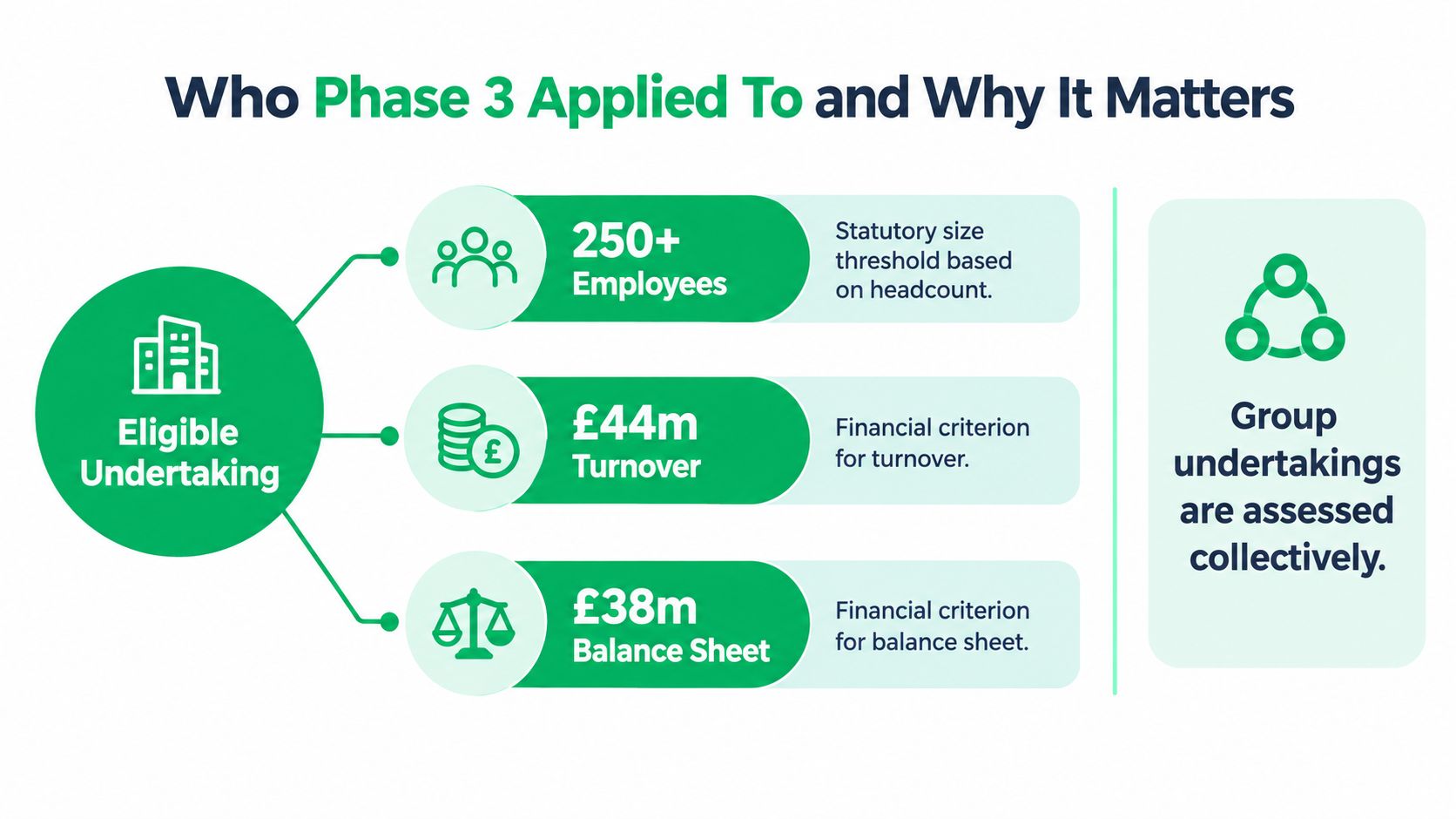
Phase 3 applied to qualifying large UK undertakings and their corporate groups. The government's Phase 3 compliance guidance sets out the scheme's size tests and the relevant dates. The obligation was not determined by whether an individual subsidiary appeared large when viewed on its own. The group structure and the qualifying undertaking mattered.
Check the size tests first
An organisation generally met the large-undertaking test if it had more than 250 employees, or if it exceeded both financial thresholds: £44 million in annual turnover and £38 million in annual balance sheet total. The employee test and financial test are alternatives. Under the financial test, both figures must be exceeded, not just one.
For a group, don't stop at the turnover of the company that received the email. Identify the relevant undertakings and check whether the group's structure brings entities within the participant. A holding company may coordinate compliance, but that doesn't mean the energy assessment can ignore the operations and consumption of relevant group members. Build the scope decision from the legal-entity structure, not from whichever facilities list is easiest to find.
The qualification date was 31 December 2022. That date is central to the Phase 3 scope test, so keep the records and group information used to make the decision. Where ownership changed, check the circumstances and the applicable rules rather than assuming that a later transaction automatically removes an entity from consideration.
Keep the period and the qualification date distinct
Phase 3 covered 6 December 2019 to 5 December 2023. That period defined the compliance cycle, while the qualification test looked at the organisation's status on 31 December 2022. Mixing the two dates can lead to an incorrect scope conclusion, particularly where a group has undergone an acquisition, disposal or restructuring.
Use a simple decision record: name the responsible undertaking, list the relevant group entities, document the information supporting the size test, and explain any boundary decisions. If your team is also consolidating wider reporting requirements, a guide to UK carbon reporting requirements can help distinguish related obligations without treating them as interchangeable.
A defensible answer to “do we, or don't we?” should be reproducible. If another person can't follow the group chart and qualification evidence to reach the same conclusion, the scope review isn't finished.
The Phase 3 Timeline You Cannot Afford to Miss
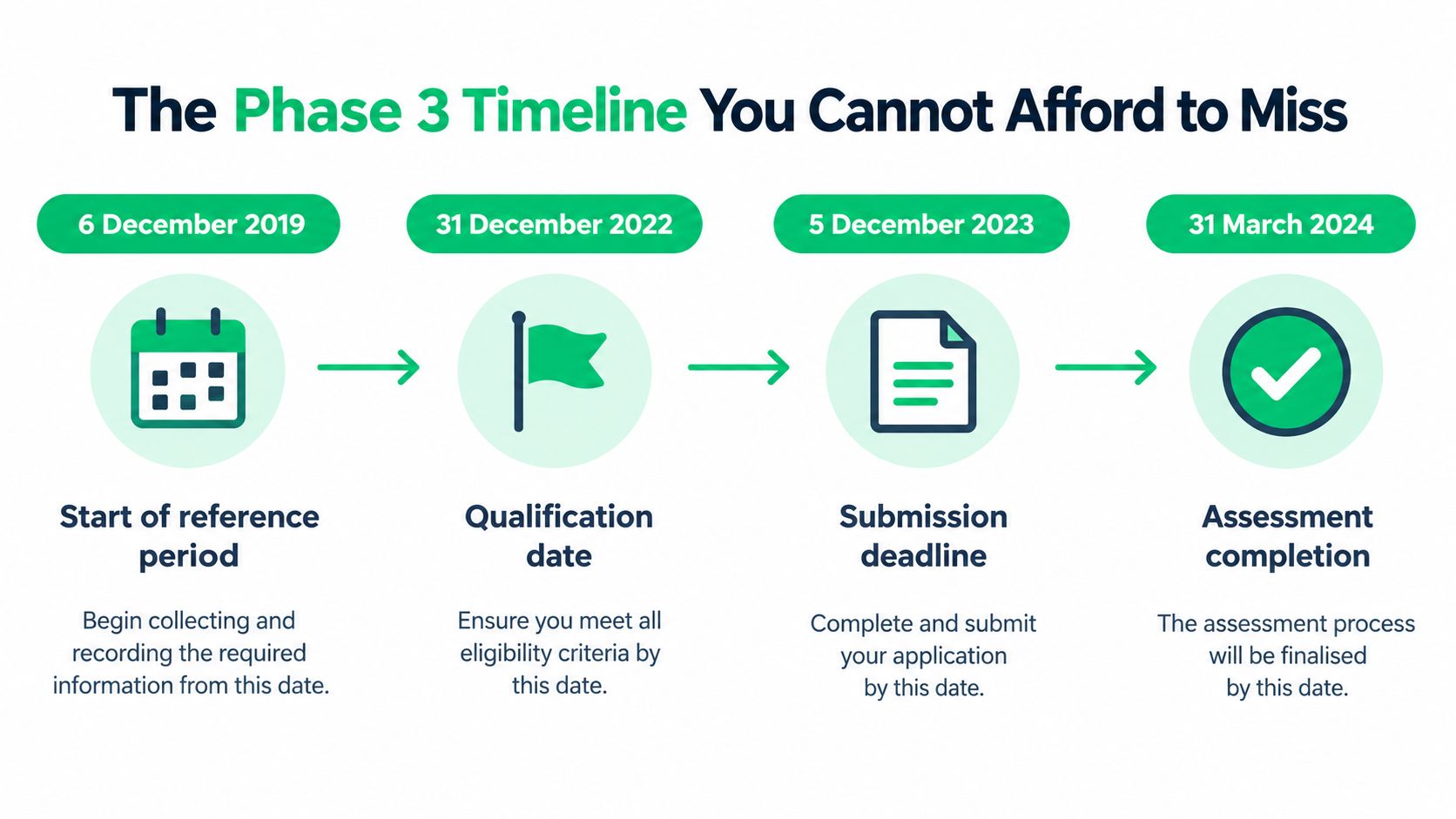
Phase 3 runs beyond the initial assessment and notification. Participants with action-plan reporting duties must track progress through the remaining updates, making this a four-year governance cycle rather than a one-off audit. The Environment Agency's guidance on complying with ESOS sets out the notification and follow-up requirements.
Reconstruct the dates in order
- 6 December 2019: Phase 3's compliance period began.
- 31 December 2022: The qualification date used to determine whether an organisation was in scope.
- 5 December 2023: The original statutory notification deadline.
- 5 June 2024: The government's extended practical compliance deadline.
- 5 December 2025: The first progress update deadline for participants required to report against an action plan.
- 5 December 2026: The second progress update deadline, still ahead for participants reporting against an action plan.
The assessment period and qualification date serve different purposes. The period beginning 6 December 2019 defines the cycle being assessed, while the qualification date determines the organisation's status for that cycle. Keep both dates clear in the compliance file so a reviewer can distinguish the assessment window from the scope test.
The original notification deadline was 5 December 2023, and the government extended the practical compliance deadline to 5 June 2024. Participants still had to complete the required assessment and obtain sign-off. They also had to submit their compliance notification through the online system, supported by the relevant ESOS work and approvals.
Treat the updates as live obligations
Participants required to prepare an action plan should manage its reporting dates as continuing governance obligations. The plan covers 6 December 2023 to 5 December 2027, and each proposed measure needs an estimate of the energy reasonably expected to be saved over that period. Progress updates were due on the dates above, with each reporting progress and receiving board-level or equivalent director sign-off.
The first update has passed; the second deadline remains ahead. Reconcile reported progress against the plan, retain the basis for savings estimates, and record measures already implemented. That record gives reviewers a clear trail from each recommendation to the action taken and the progress reported.
Building a 95% Coverage Evidence Pack
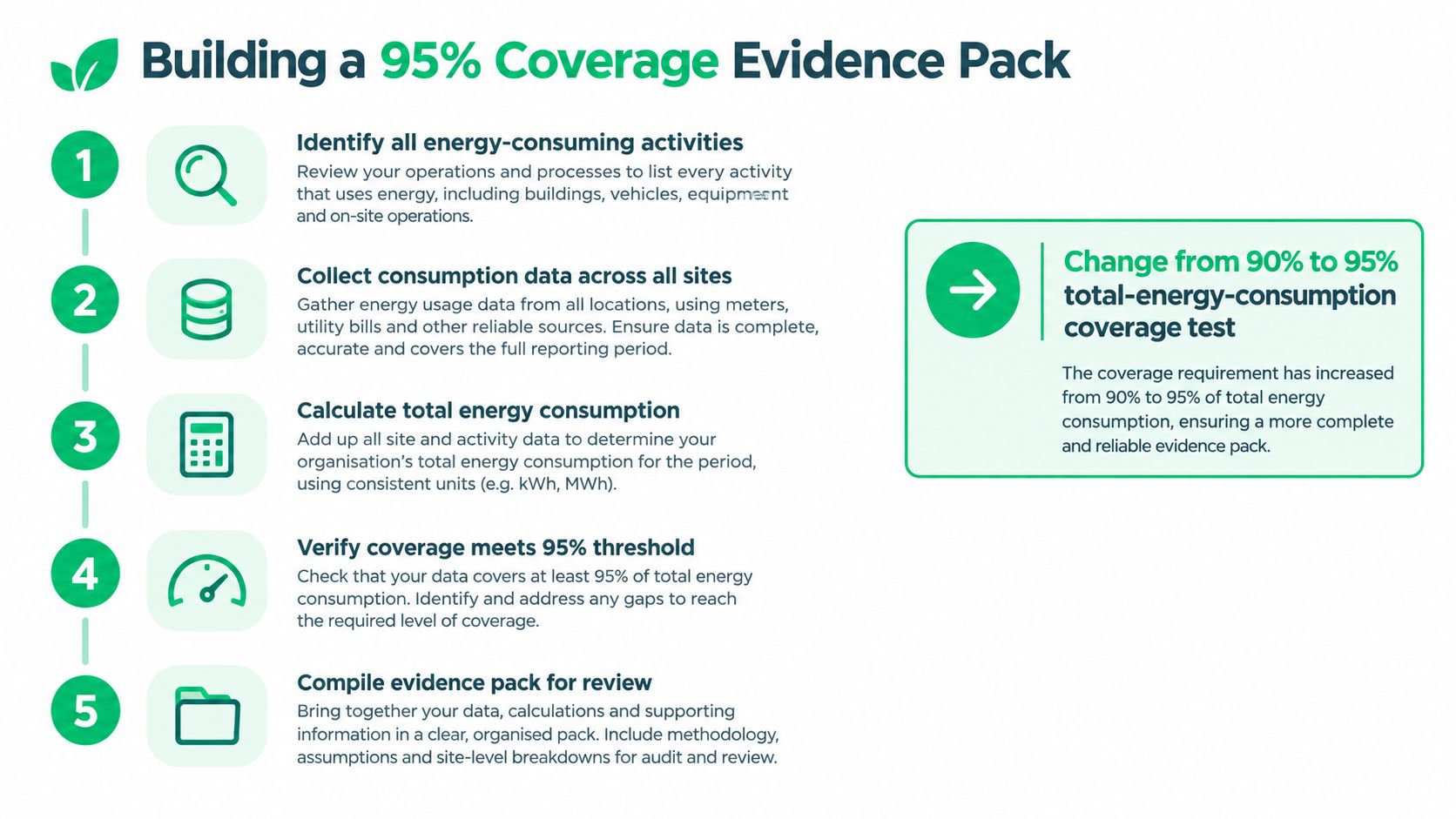
The shift from a 90% significant-energy-consumption threshold in Phase 2 to at least 95% coverage of total energy consumption in Phase 3 changes how you should build the evidence. It's not a sampling exercise where a few large sites stand in for the rest of the group. It's a data-control test: establish the total energy denominator, map consumption to an accepted compliance route, and show your working.
Start with a complete inventory of energy-consuming buildings, industrial processes and transport activities. Gather consumption in kWh where possible, and record the original units and conversion method where you need to convert. Include the less convenient sources as well as the major sites: leased premises, dispersed offices, fleet fuel and relevant energy use associated with smaller subsidiaries. A stream that looks immaterial in isolation can become material when combined with other omissions.
The Environment Agency's ESOS guidance describes the 95% coverage requirement and accepted compliance routes. Use it to check the route against the relevant consumption, but don't mistake the formal percentage for proof of data quality. A reported total can appear complete while depending on estimates, missing landlord records or inconsistent meter hierarchies.
Build the denominator before you choose sites
Use a controlled workpaper that links each energy stream to its source, period, units, conversion, responsible entity and route to compliance. It should also explain estimates, exclusions and unresolved gaps. If a landlord provides a building total, record how that figure was obtained and how the organisation determined its share. If fleet data comes from more than one system, reconcile the records rather than treating one feed as the complete answer.
Then calculate the share of total consumption covered by the eligible route or routes. The evidence should let a reviewer reproduce the total and understand why excluded consumption sits within the permitted margin. A list of audited sites without a reconciled denominator doesn't demonstrate the coverage test.
A percentage can be correct on paper and still rest on weak evidence. Traceability is what makes the coverage claim defensible.
This is the same discipline required for a sound sustainability audit: define the boundary, preserve source records, explain assumptions and make the calculation reproducible.
Choosing the Right Compliance Route
Phase 3 participants could meet the assessment requirements through permitted routes, and groups could combine routes to cover their energy use. The right choice depends on what the organisation already has, what consumption that evidence covers and where it needs a fresh assessment. Don't select a route because it is familiar. Select it because the coverage and supporting evidence stand up.
| Compliance route | Best fit | Coverage strength | Typical cost driver | Phase 3 watch-out |
|---|---|---|---|---|
| ESOS energy audit | Organisations needing a direct review of energy use and efficiency opportunities | Can cover identified sites and activities when the audit boundary is properly evidenced | Assessor time, site access and data quality | Confirm that the audited consumption contributes to the required total coverage |
| ISO 50001 certification | Groups with an established, in-scope energy management system | Strong where the certified scope maps clearly to energy consumption | Maintaining the management system and certification scope | A certificate doesn't automatically cover sites or activities outside its scope |
| Display Energy Certificates | Property-heavy portfolios with relevant occupied buildings | Useful for buildings where valid certificates apply | Building coverage and certificate availability | Don't treat certificates as evidence for transport or industrial energy use |
| Qualified energy assessor route | Participants using an assessor-led route to organise and review compliance | Depends on the route, evidence and consumption mapped to it | Assessor engagement and the work needed to close evidence gaps | Make sure the assessor's review connects to the underlying consumption data |
Match route to evidence, not preference
An energy audit is the straightforward choice when the organisation needs to identify opportunities and establish a documented assessment across its operations. ISO 50001 can be effective where certification already covers a substantial, clearly defined share of energy use. For a property-heavy organisation, valid display energy certificates may contribute for eligible buildings, but they don't solve gaps in transport or process data.
A qualified assessor can help structure and review the evidence, especially when the group has multiple entities or uses more than one route. But assessor involvement doesn't rescue an unclear boundary. The organisation still needs to provide the information that shows which sites, activities and consumption each route covers.
Combine routes deliberately
Many groups need a mix. For example, an organisation may use its certified energy management system for the scope it covers, audits for other material sites and applicable certificates for relevant buildings. That mix is only useful if the workpapers show how the routes fit together and demonstrate that the total required coverage is met.
Before commissioning additional work, map the evidence already available against the full energy denominator. This avoids paying for duplicate assessment in areas already covered, while making gaps visible before sign-off.
Lead Assessor Sign-Off and Board-Level Approval
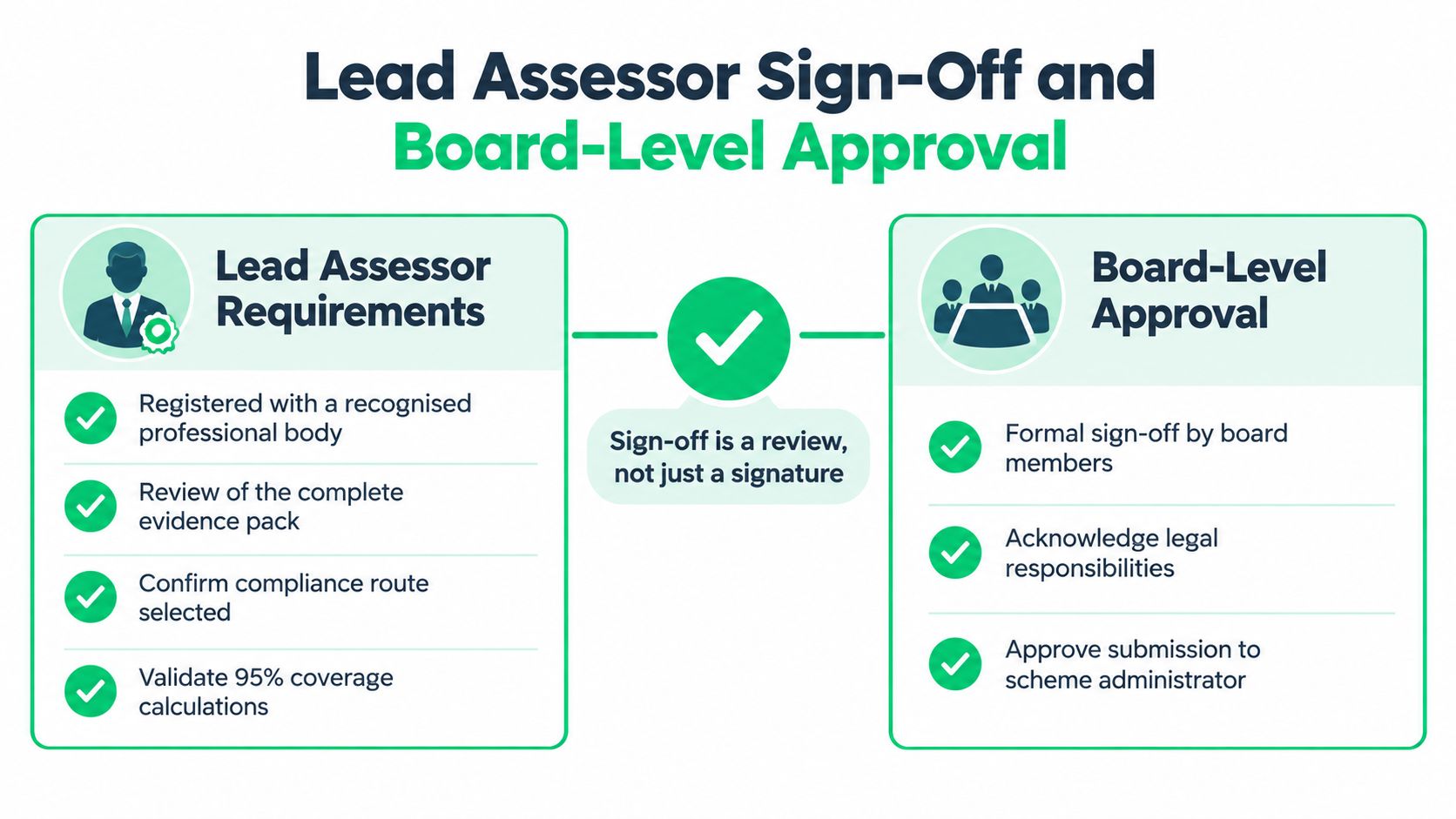
Lead Assessor sign-off should be treated as a review of the compliance case, not as a final signature added to a completed report. The assessor needs to understand the scope decision, follow the energy calculations, see how each route covers consumption and inspect the opportunities identified. A neat summary cannot substitute for source records.
The Environment Agency's Phase 3 guidance sets out the required assessment and sign-off arrangements. A Lead Assessor must meet the scheme's professional requirements, including registration with a relevant professional body. Agree early on what evidence the assessor expects, who will supply it and how gaps will be resolved. Leaving those questions until submission makes the review a scramble rather than a control.
Give the assessor a reviewable file
The evidence pack should include:
- Source consumption data: Records showing the energy quantities, reporting periods, entities and sites covered.
- Calculation trail: Units, conversion factors, estimation methods and any reconciliation between bills, meters and internal records.
- Coverage calculation: A clear demonstration that the selected routes cover the required share of total consumption.
- Route evidence: Audit material, certification scope or other supporting documentation relevant to the route selected.
- Opportunity register: Measures linked to the energy use they address, with savings estimates and assumptions that can be explained.
The opportunity register matters because ESOS isn't only about proving that an assessment happened. The recommendations need to be intelligible enough for management to consider and for subsequent reporting to track.
Separate assessment approval from progress reporting
The Lead Assessor's review and the director-level approval for progress updates are related controls, but they aren't interchangeable. Each required update must report progress against the action plan and be signed off at board level or by an equivalent director. The director should have enough context to approve what is reported, including how the organisation estimated savings and explained delays or changes.
Give the approver a concise decision pack: the status of each measure, supporting evidence, the basis for savings figures and any significant changes in assumptions. Board approval should confirm accountability for the submission, not merely acknowledge that a form is ready to send.
Where Phase 3 Submissions Quietly Fail
A submission can look complete and still have a weak evidence trail. The government's Phase 3 post-implementation review recorded 8,581 corporate groups submitting a notification, about 87% of the Environment Agency's estimated 9,871 qualifying groups. Of those that notified, 7,145 confirmed they were required to comply, according to the ESOS post-implementation review. Those figures make scope assurance and data quality central questions, not administrative footnotes.
- Group scope: The holding company's file lists the main operating entities but leaves out a subsidiary or an entity affected by an ownership change. Fix: Reconcile the legal-entity chart to the qualification decision and retain the basis for including or excluding each relevant entity.
- Transport fuel: The workpaper treats fleet fuel as a small residual without testing the total. Fix: Collect fuel records across the relevant operations and include them in the energy denominator before deciding what can be excluded.
- Landlord data: A tenant's energy figure doesn't match the landlord statement or facilities record. Fix: Document the source and allocation method, then reconcile the reported figure to the records available.
- Incomplete periods: A spreadsheet contains partial-year bills but presents the total as if it were complete. Fix: Identify missing periods explicitly, document the estimation method and make sure the assessment uses evidence appropriate to the requirement.
- Unverified estimates: Teams use estimates to fill gaps but don't retain the assumptions or conversion basis. Fix: Record the method, inputs and responsible owner so another reviewer can reproduce the calculation.
The review's notification figures don't tell you why any particular organisation did or didn't submit. They do underline why a company shouldn't assume that a completed form proves its boundary and evidence are sound. The practical test is whether your workpaper tells a consistent story from group scope to energy total to reported coverage.
Where to Go From Here
Treat Phase 3 as a data foundation that should support the organisation's wider reporting, not as a standalone file to reopen only when someone asks. Energy records can contribute to related work on SECR, PPN 006 and other reporting requirements, but each framework has its own purpose and rules. A joined-up carbon management approach can reduce duplicated collection while preserving a clear audit trail.
Sequence the work
Use the next ninety days to put the evidence and ownership in order:
- Confirm scope: Recheck the participant group, qualification evidence and ownership decisions.
- Build the energy denominator: Reconcile buildings, processes and transport to source data, and document gaps.
- Choose the route mix: Map each material energy stream to its supporting compliance route.
- Brief the Lead Assessor: Agree the evidence needed, review points and responsibilities.
- Prepare governance: Assign owners to action-plan measures and give directors a clear basis for progress approval.
Start this week by naming one accountable owner, requesting the group chart and collecting the existing energy workpapers. Then identify where transport, leased sites or entity changes have left gaps. That will tell you whether the immediate priority is correcting scope, improving the data trail or preparing a credible progress update.
The practical aim is simple: one consistent evidence trail that supports the Phase 3 action plan, related carbon reporting and future compliance decisions. Keep the underlying records organised, and the next internal question won't require another round of spreadsheet archaeology.
ESG Consulting advises UK organisations on ESOS delivery, including energy coverage, site audits and registered Lead Assessor sign-off, alongside carbon reporting and wider sustainability requirements. If you need a clear review of your Phase 3 evidence and action-plan reporting, visit ESG Consulting to discuss the support your organisation needs.