esos phase 3, esos compliance, energy audit, lead assessor, esos checklist
ESOS Phase 3: A Practical Guide for UK Organisations
By ESG Consulting Team · · 15 min read
A sustainability director opens an ESOS Phase 3 file and finds three problems at once: the group boundary is unclear, site energy records don't reconcile, and the audit findings are still sitting in a report rather than a delivery plan. That's a familiar position for organisations that treated compliance as a deadline to meet, not a programme to run.
ESOS Phase 3 is now a completed compliance period, but its practical lesson still matters: an assessment is useful only when the organisation turns identified opportunities into owned, funded and verified work. The first task is to understand what the scheme required and what the evidence says. The next is to make sure the findings lead to decisions.
Table of Contents
- What ESOS Phase 3 Is and Who It Applies To
- The Phase 3 Compliance Clock and Key Dates
- The 95% Energy Coverage Rule Explained
- Choosing the Right Compliance Route for Your Organisation
- The Lead Assessor Role and What Sign-Off Really Means
- What Phase 3 Participation Data Tells Us About UK Compliance
- Turning the ESOS Opportunity Register into Real Savings
- ESOS Phase 3 Checklist and Common Board-Level Questions
What ESOS Phase 3 Is and Who It Applies To
A UK compliance officer opens a Phase 3 brief and has to answer a basic question before commissioning any work: is the organisation in scope, and which entities belong in the assessment? ESOS, the Energy Savings Opportunity Scheme, is a mandatory UK regime requiring qualifying organisations to assess their energy use and identify opportunities to improve efficiency. It is not an audit commissioned at a company's discretion.
Phase 3 eligibility was tested on 31 December 2022. The principal test applied to organisations classified as large undertakings on that date, including relevant corporate groups. The assessment therefore couldn't be scoped by looking only at the name on one operating company's energy bills. The responsible team needed to establish the group boundary and consider the entities and energy use that fell within it. The Environment Agency's ESOS guidance explains the scheme's eligibility and compliance requirements.
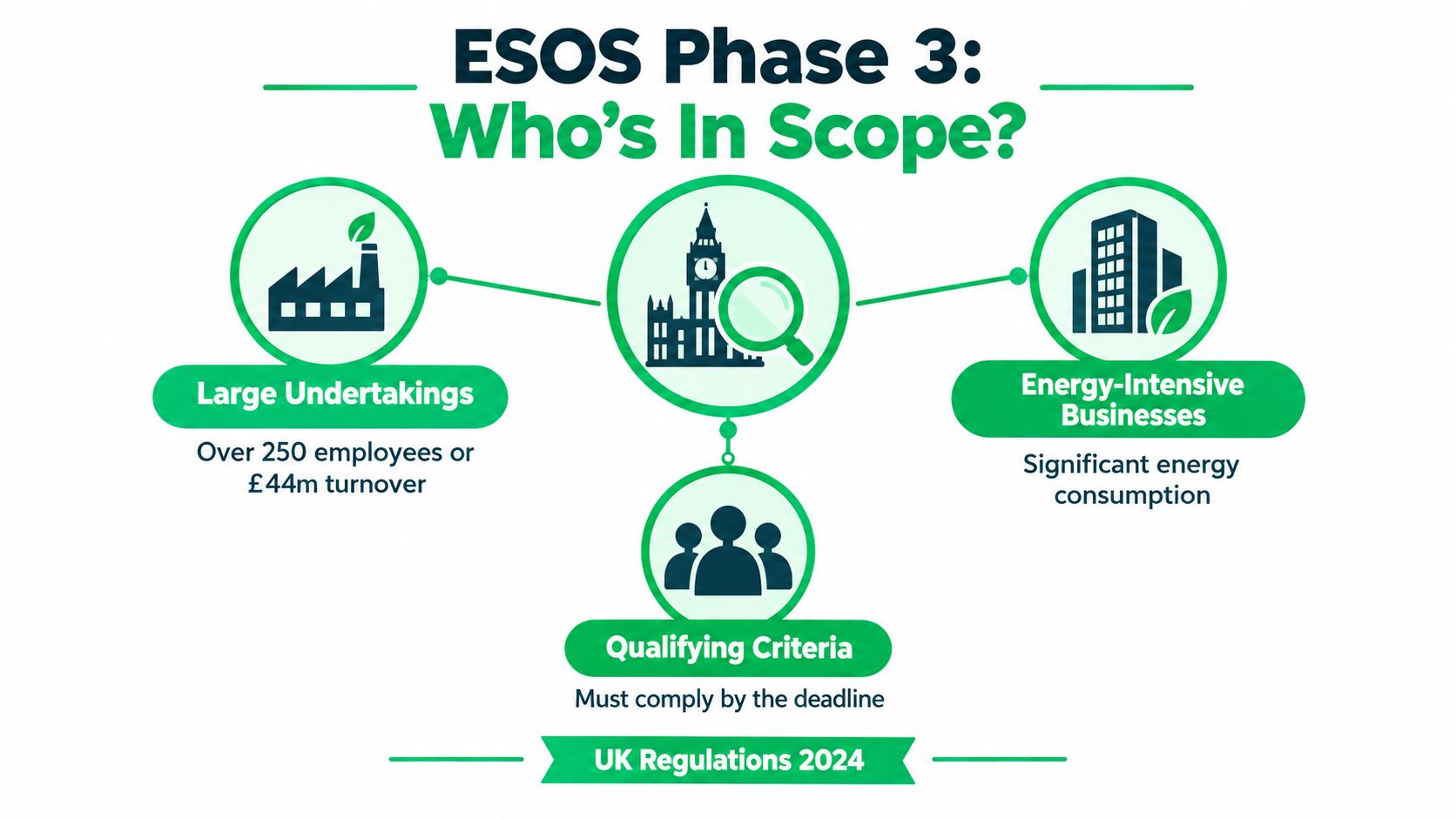
Don't assume that a complicated corporate structure removes the obligation. Group arrangements can change how an organisation determines scope and assigns responsibility, so the first practical step is to confirm the qualification position and document the boundary. If the organisation doesn't qualify, record the basis for that conclusion rather than leaving the question unresolved.
Practical rule: Confirm the qualification position and group boundary before you ask for audit proposals. A supplier can't fix an unclear scope by producing a polished report.
ESOS is distinct from other reporting obligations, even where the same energy data supports more than one regime. If your team needs to check how wider obligations fit together, use this guide to UK sustainability rules and regulations. The rest of this guide focuses on how Phase 3 worked, what its evidence says, and how to treat the resulting opportunity register as the start of delivery rather than the finish.
The Phase 3 Compliance Clock and Key Dates
Phase 3 ran on a fixed timetable, and the dates did different jobs. The compliance period covered 6 December 2019 to 5 December 2023. The qualification date was 31 December 2022. Confuse the two and you test eligibility at the wrong point: the period defines the phase, while the qualification date decides who was in scope.
Three deadlines then shaped the endgame. The original notification deadline was 5 December 2023. Government extended the compliance date by six months, to 5 June 2024, and organisations that still hadn't notified were given a further date of 6 August 2024. The extensions changed when you could notify. Qualification, evidence and assessment obligations stayed exactly where they were.
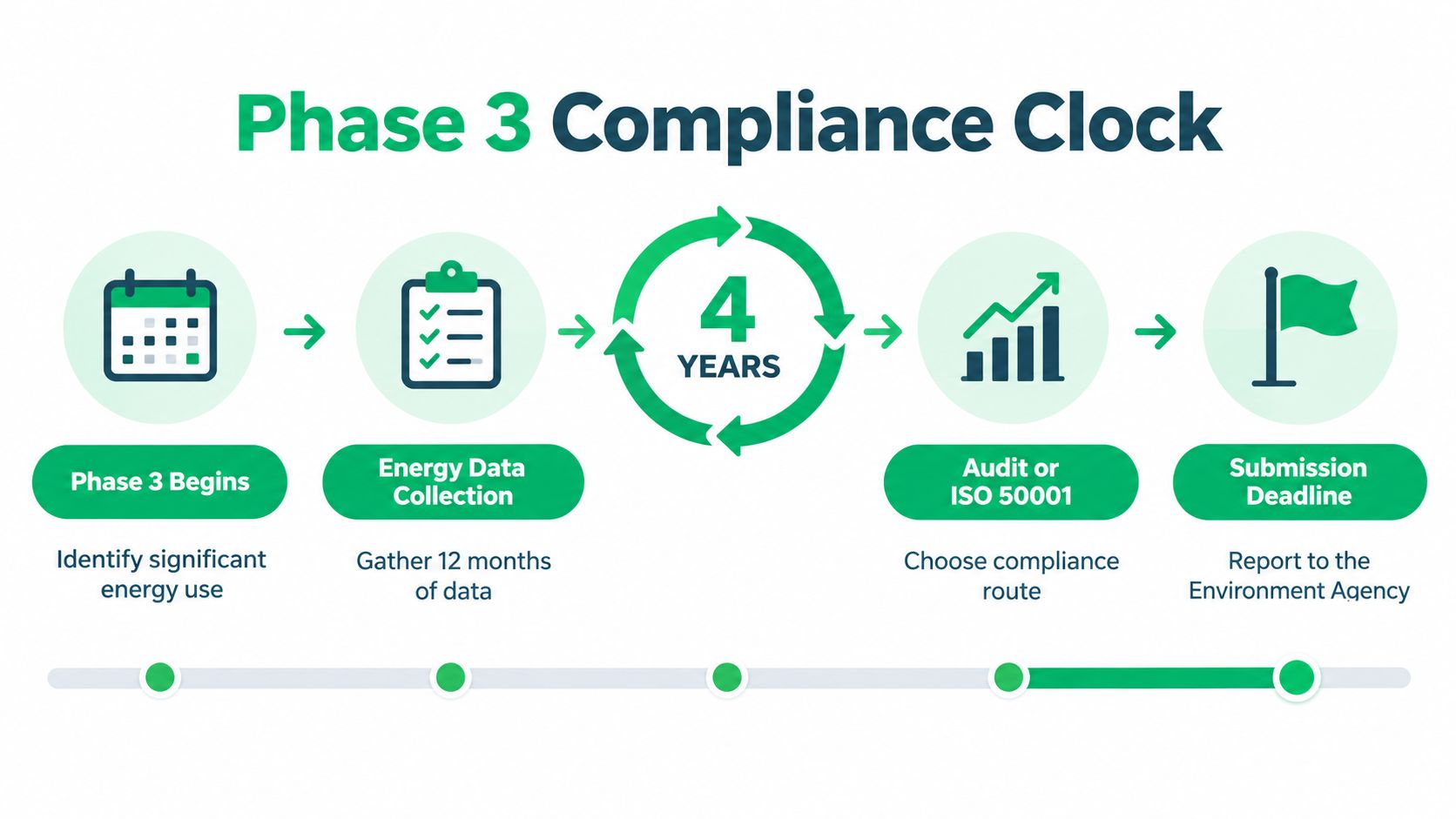
Put your organisation on the timeline
Work the dates in sequence. Confirm the large-undertaking position at the qualification date, assemble the energy data and assessment evidence for the phase, choose the compliance route, then complete the notification. Each step produces evidence the next one relies on.
Sequence matters because assessment, sign-off and notification are separate obligations. Audited data without a submitted notification is non-compliance. A filed notification without retained records is a problem waiting for the regulator's questions.
The Environment Agency requires organisations to be assessed as a whole once every four years, as set out in its ESOS guidance. Treat each phase as the start of a delivery programme: it should close with a costed opportunity register, named owners and tracked actions, ready for verification before the next cycle begins.
Use the timeline to diagnose gaps precisely. Audit completed, notification missed: that's a notification failure. Notification filed, records thin: that's an evidence failure. Give each issue a named owner and keep the remedial actions separate, since fixing one will never cure the other.
For a visual overview of the process, this video accompanies the compliance timeline:
The 95% Energy Coverage Rule Explained
A coverage calculation fails when the inventory is built around easy meters. Phase 3 raised the bar to at least 95% of total energy use, up from 90% in Phase 2, and cut the de minimis allowance from 10% to 5%. That leaves little room for streams excluded because the data is awkward, leased or spread across several accounts.
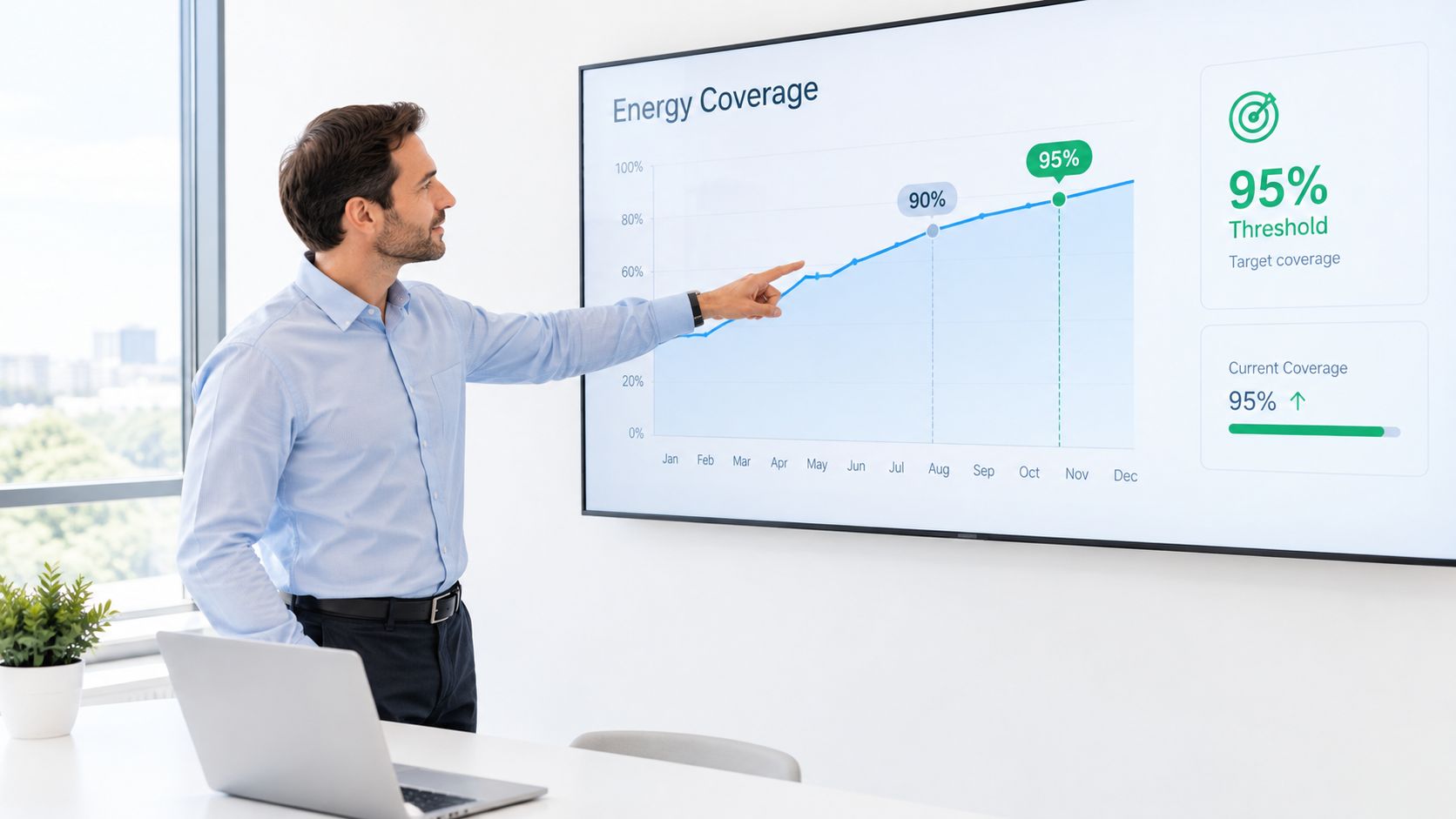
The practical risk sits at the edge of the estate. Small sites, short leases, transport fuel, landlord-controlled supplies and fragmented utility accounts are exactly the places where consumption gets missed. If the team starts with head office and flagship facilities, the spreadsheet can look complete while the group total is wrong.
Build a defensible coverage calculation
Start with total consumption for a 12-month reference period that includes the qualification date. Record the sources and assumptions behind the total: gap treatment, estimates, conversions, and accounts that span more than one site or legal entity. Then rank assets and activities by consumption so the team can see which categories dominate the threshold decision.
Map every part of that inventory to the audit, DEC, GDA or management-system route used for evidence. A reviewer should be able to trace the calculation from group total to covered energy without asking for missing context. A tidy spreadsheet fails if it cannot show which assets were included, which were excluded and how the figures were reconciled.
Treat the 5% allowance as a ceiling on uncovered energy. Keep excluded streams as controlled exceptions with reasons, owners and evidence, ready to be challenged later.
If the remaining sites or activities contain repeatable measures, include them: the additional opportunities usually outweigh the effort of extending the inventory past the compliance boundary. The test is commercial as well as procedural, so weigh collection effort against the value of understanding those streams.
Use the regulator's guidance as the benchmark for the file, and give the coverage schedule a delivery job after sign-off. Each assessed stream should feed a costed action with a named owner, a verification method and a review date, so Phase 3 closes as a tracked savings programme with evidence behind it.
Choosing the Right Compliance Route for Your Organisation
The right compliance route depends on what the organisation already has in place, how its energy use is managed, and whether existing systems cover the relevant scope. Phase 3 allowed organisations to use energy audits, qualifying management systems, Display Energy Certificates (DECs) or Green Deal Assessments (GDAs), including a combination of routes where appropriate. Whichever route is chosen, the organisation still has to demonstrate the required energy coverage.
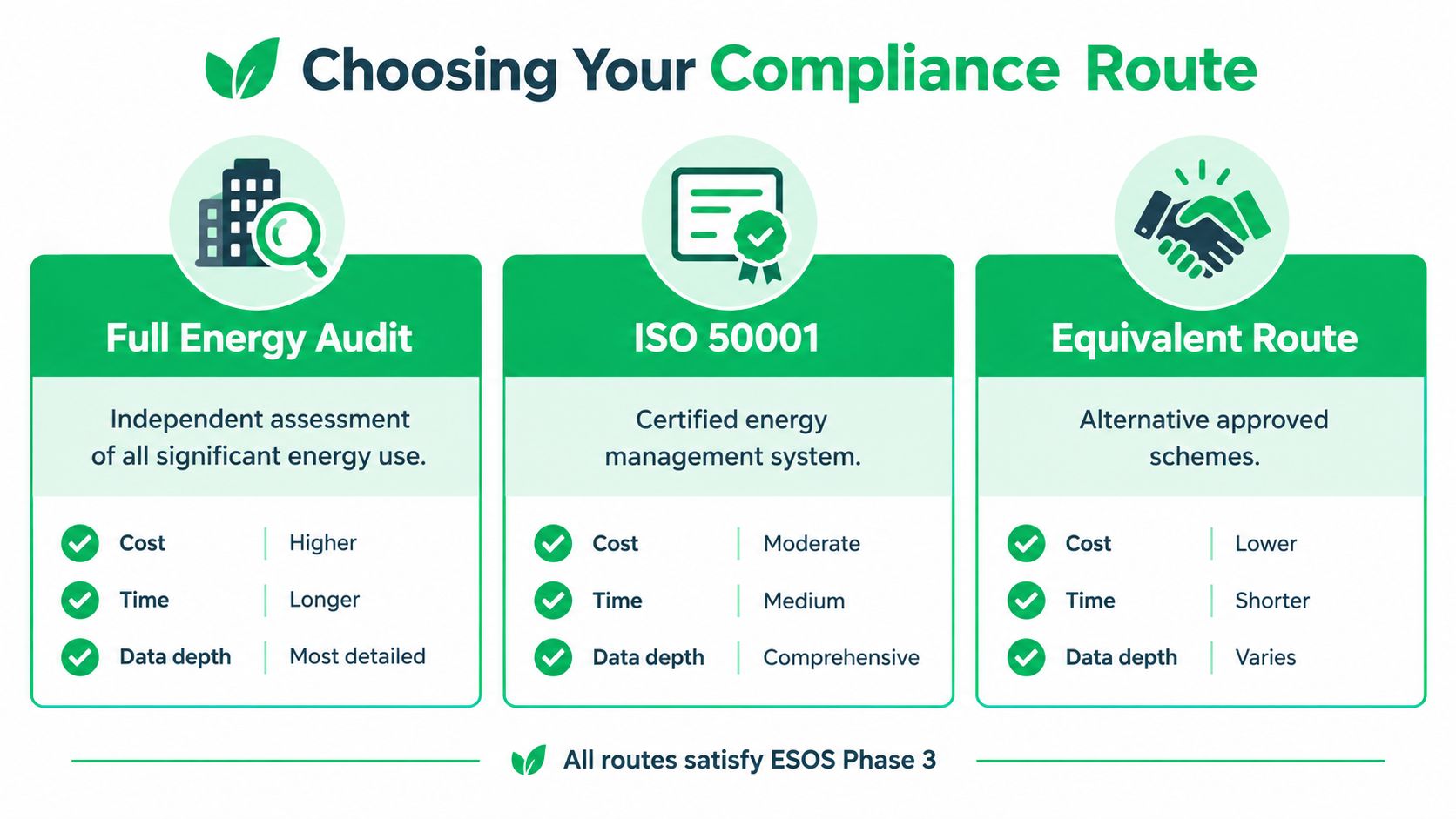
Match the route to the evidence
A full energy audit is the direct option when the organisation needs a structured assessment of significant energy use and doesn't already have a suitable system covering it. It can give the team a practical opportunity register, but it depends on sound data, clear site access and an agreed scope.
A qualifying ISO 50001 or equivalent energy management system may be a better fit when the organisation already operates a suitable system across the relevant parts of its estate. Don't assume that holding a certificate settles the ESOS question. Check that the system and its documented scope support the required coverage and that the organisation can produce evidence.
DECs and GDAs could also support compliance in Phase 3 where the applicable requirements were met. They weren't a universal shortcut: the organisation still needed to confirm what the records covered and whether the route, alone or combined with another route, accounted for the required energy use.
A mixed approach can make sense when different parts of the organisation have different evidence. For example, an established management system might cover one part of the estate while audits address other operations. The risk is a coverage gap between the routes. Make a single map of the group's energy use and assign each stream to a route; don't rely on separate providers to reconcile their scopes for you.
| Route | Consider it when | Check before relying on it |
|---|---|---|
| Energy audit | The organisation needs a direct assessment and opportunity register | Scope, energy data and audit evidence |
| ISO 50001 or equivalent | A suitable system already covers the relevant operations | System scope and supporting records |
| DECs or GDAs | Existing assessments may cover relevant energy use | Applicability and combined coverage |
For wider context on how energy compliance connects with reporting obligations, see this guide to UK carbon reporting requirements. Choose the route that fits the evidence you can maintain, not the one that sounds simplest in a proposal.
The Lead Assessor Role and What Sign-Off Really Means
For an audit route, the Lead Assessor is responsible for assessing and signing off the ESOS assessment. That sign-off should sit at the end of an evidence chain, not function as a stamp applied to a report after the substantive work has finished. The organisation remains responsible for providing accurate information and completing its compliance process.
Test the assessor before appointment
Before engaging a Lead Assessor, ask how they will establish the group boundary, reconcile energy data, test coverage and record assumptions. Ask what documentation they expect from the organisation and how they'll handle unclear or incomplete records. A competent approach should make responsibilities clear before fieldwork begins.
The assessor's work should be traceable. The organisation needs to retain records that show the energy information used, the basis for the assessment, the route selected and the reasoning behind the coverage position. If the organisation can't explain how a conclusion was reached, a signature alone won't repair the evidence gap.
A robust sign-off is the end of a documented assessment, not a substitute for one.
An organisation may use an external assessor or have an appropriately qualified member of staff lead the work. In either case, the business should identify who owns data provision, who approves the scope and who is accountable for retaining records. Internal familiarity with sites can help, but it doesn't remove the need for independence of judgement and clear evidence.
Keep sign-off and notification distinct
Lead Assessor sign-off supports the assessment, while notification is the formal step with the Environment Agency. The organisation should understand who submits the notification and verify that the information reported is consistent with the assessment records. Keep confirmation of submission with the supporting documentation.
Don't wait until the end to involve the assessor. Early engagement lets the organisation resolve gaps in site lists, energy accounts and route coverage before they become urgent. It also gives directors a clearer view of what the assessment can support, what needs further evidence and which opportunities deserve a place in the delivery plan.
What Phase 3 Participation Data Tells Us About UK Compliance
The participation figures show two things at once: a sizeable share of the estimated qualifying population had not engaged by the reporting point, and those that did generated a substantial pipeline of identified savings. An Environment Agency estimate put the qualifying population at 9,871 corporate groups. By the published reporting point in February 2025, 8,581 groups, or 87% of that estimated population, had submitted a notification of compliance, and 7,145 of those confirmed they were required to comply. These figures come from the Environment Agency's Phase 3 evaluation.
Read the gap carefully. A notification total is not a verified count of obligated organisations, and a non-notification figure is not automatically a confirmed breach. Even so, a material share of the estimated population had not notified by that point. If your organisation filed late, or scrambled to file, treat that pattern as a warning about your own data readiness rather than a statistic about other people's failures.
What the action plans show
Among groups that submitted a Phase 3 notification, 5,403, or 76%, had submitted the newly required action plan. Of those plans, 4,716, equivalent to 87%, included at least one energy-saving action, the same evaluation reports. Most participants converted audit findings into proposed measures. The figures say nothing about whether those measures were approved, funded or installed.
The same evaluation recorded 47 TWh of potential annual energy savings identified through Phase 3 audits, against approximately 900 TWh of reported energy consumption over a 12-month period around the qualification date. On a simple comparison, the identified potential is about 5% of reported consumption. Treat that as a pipeline estimate rather than a delivered reduction.
Use the data to pressure-test your own programme. Ask which proposals have an accountable owner, a signed investment decision and a defined method for verifying realised savings. An opportunity register that never reaches a board investment decision is documentation, and documentation does not cut your energy bill.
Turning the ESOS Opportunity Register into Real Savings
An organisation can complete every ESOS obligation and still deliver no decarbonisation at all. Assessment done, Lead Assessor sign-off obtained, notification submitted, and the recommendations left unfunded in a register nobody owns. The government's Phase 3 compliance guidance, cited earlier, confirms that implementation is not required and that no penalty applies to a missing action plan or progress update.
That gap is where your programme either starts or stalls. Treat the opportunity register as the opening of a delivery programme with its own budget line, not a compliance artefact to file away. Give each measure a named operational owner. Then force an investment decision using the criteria your board already applies: payback, carbon impact, operational risk, capital constraints and procurement timing.
Turn recommendations into controlled work
Every approved action needs three things before work begins: a recorded baseline, a defined intervention and a method for testing what changed. Document energy use before implementation, describe the equipment or process change, then track realised kWh and cost savings against that baseline. Keep invoices, commissioning records, meter data and operational notes attached to each action so you can evidence both the work and the result if the scheme regulator or your board asks.
A strong recommendation can still need sequencing. If a measure competes with planned maintenance, a contract renewal or a site refurbishment, the delivery plan should record who decides and when the organisation revisits it. Deferral with a named decision-maker is legitimate. Silence is not.
As the same compliance publication sets out, government analysis estimates that Phase 3 changes could deliver an additional 28 TWh of energy savings across participants between 2024 and 2037, worth approximately £1.12 billion in participant energy-bill savings. Those are projections, not delivered outcomes. Your own tracking is the only evidence of what your organisation saved.
If a recommendation has no owner, costed scope or verification method, it isn't yet an implementation plan.
Fold ESOS actions into your SECR narrative, net-zero planning and board capital decisions so teams stop working from conflicting assumptions about energy, cost and emissions. A joined-up carbon management programme brings those decisions into a single place. ESG Consulting is one UK consultancy that supports ESOS assessments alongside carbon reporting and net-zero planning. Choose any delivery partner on scope clarity, accountable senior oversight and the evidence they leave in your hands.
ESOS Phase 3 Checklist and Common Board-Level Questions
Use this checklist to keep ownership clear:
- Scope: Confirm the qualification position and group boundary.
- Coverage: Reconcile energy data and document the coverage calculation.
- Route: Record why the chosen route, or combination, fits the evidence.
- Assessor: Confirm sign-off responsibilities and retain supporting records.
- Notification: Verify submission and keep its confirmation.
- Delivery: Assign owners, costs and verification methods to proposed actions.
If the organisation missed the Phase 3 notification deadlines: Don't treat the missed date as resolved. Establish the organisation's current position and obtain advice on the appropriate next step.
Is ISO 50001 alone enough? Only if the management system and its scope satisfy the applicable ESOS requirements. Verify the evidence rather than assuming certification is sufficient.
Does ESOS replace SECR? No. They're separate obligations, though energy data and delivery evidence may support both.
What's the audit cost? There's no defensible universal figure. Scope, estate complexity, data quality and the chosen route determine the work. Get a scoped proposal that makes assumptions and deliverables explicit.
ESG Consulting supports UK organisations with ESOS assessment scoping, site audits, energy-coverage evidence and registered Lead Assessor sign-off, alongside carbon reporting and net-zero planning. If your Phase 3 findings still need owners, costs and verification, visit ESG Consulting to discuss a practical delivery approach.