scope 3 emissions, carbon accounting, value chain emissions, GHG protocol, ESG reporting
How to Calculate Scope 3 Emissions: A Practical Guide
By ESG Consulting Team · · 13 min read
Your finance team has pulled the energy bills, facilities has supplied fuel records, and someone has assembled a travel spreadsheet. Then a customer asks for Scope 3 emissions, including purchased goods, freight and employee commuting. You've got useful fragments, but not yet an inventory you'd be comfortable putting in front of a procurement reviewer.
Table of Contents
- Why Scope 3 Feels Overwhelming and What Actually Changes That
- Mapping Your Value Chain Across the 15 Scope 3 Categories
- Choosing Between Activity-Based and Spend-Based Methods
- Building a Data Template You Can Actually Use
- Selecting the Right Emission Factors for Each Category
- Avoiding Double Counting and Boundary Errors
- Managing Uncertainty and Getting Ready for Assurance
Why Scope 3 Feels Overwhelming and What Actually Changes That
The difficult part isn't the arithmetic. It's deciding what belongs in the inventory, finding evidence for activities you don't control, and making sure different teams haven't counted the same activity under different names. Asking procurement for supplier emissions without defining the reporting boundary usually produces a folder of incompatible documents.
Scope 3 needs a category-by-category build, not a single estimate attached to your electricity and fuel totals. Assign each relevant category a data owner, calculation method and evidence requirement before requesting information. That makes missing data visible early, rather than leaving the sustainability team to discover gaps at sign-off.
Start with the reporting purpose
A customer questionnaire, corporate footprint and government tender may ask for different coverage. Establish which output you need, using your organisation's UK carbon reporting requirements as the starting point. Don't let an available spreadsheet determine the scope of your disclosure.
The foundational calculation is activity quantity × the relevant emission factor, with kilograms of carbon-dioxide equivalent divided by 1,000 to report tonnesCO2e, as explained in the UK Government greenhouse-gas calculation guidance. The quantity might describe fuel, energy, materials, travel or waste; the factor must match that activity and its unit.
Practical rule: A reviewer should be able to trace an emissions result back to the activity record and understand every decision between them.
Learning how to calculate Scope 3 emissions therefore means learning how to organise evidence as much as how to apply factors. A defensible first inventory can contain estimates. What it can't contain is an unexplained mixture of supplier totals, financial proxies and physical quantities.
Keep the initial build manageable: establish coverage, prioritise consequential gaps and approve assumptions explicitly. You're building a repeatable reporting process, not trying to obtain perfect information from every supplier before doing any calculations.
Mapping Your Value Chain Across the 15 Scope 3 Categories
Start with how your organisation buys, operates and sells. Procurement records identify goods and services; asset registers identify capital purchases and leasing arrangements; logistics teams explain transport legs. Product and commercial teams are needed to assess what happens after a sale.
The UK Government Scope 3 reporting-landscape guidance describes the 15 GHG Protocol categories, covering upstream and downstream value-chain emissions. It also explains that Carbon Reduction Plans under PPN 06/21 disclose Scope 1, Scope 2 and a specified subset of five Scope 3 categories. A procurement disclosure and a complete corporate inventory aren't interchangeable.
Use the category map to prompt conversations with the people who understand these activities.
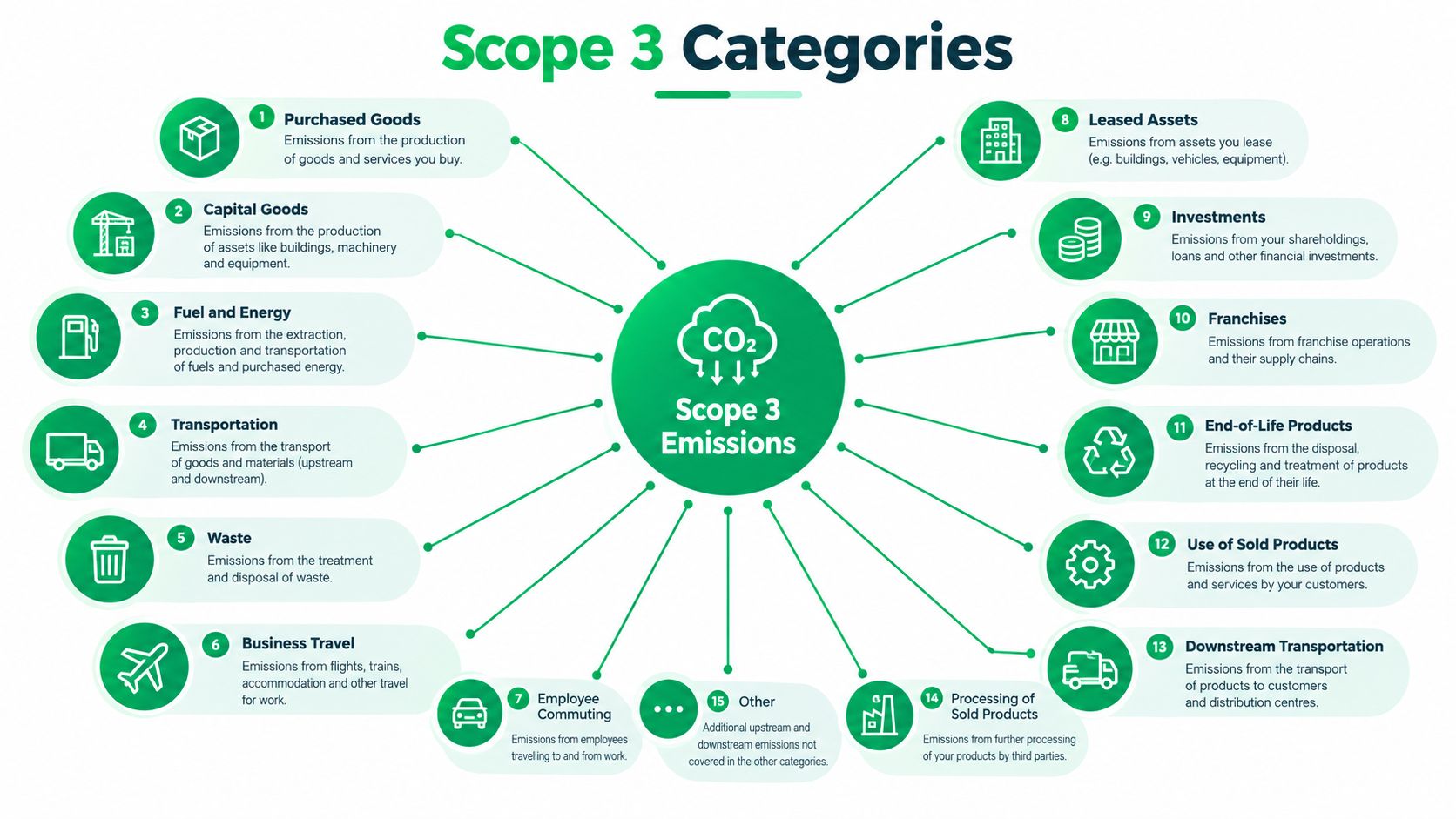
Group activities before prioritising them
Treat these as working clusters, not alternative reporting categories:
- Purchasing and incoming supply: Screen purchased goods and services, capital goods, fuel- and energy-related activities, and upstream transport together.
- Activities supporting operations: Ask facilities, HR and travel teams about operational waste, business travel, commuting and leased assets.
- Activities after sale: Examine downstream transport, processing, product use and end-of-life treatment, alongside relevant leasing and other business relationships.
For a services organisation, start by testing procurement and employee-related activities. For a manufacturer, investigate purchased materials, logistics and what customers do with sold products. These are screening priorities, not claims about which category must dominate your footprint.
Assess likely materiality using spend, physical volume and supplier risk. Buyer requests may make a category urgent without making it the largest emissions contributor. Keep those decisions separate.
Record your organisational boundary, the activities covered and the rationale for exclusions in a category-coverage statement. A category with no relevant activity is different from a category where nobody has collected data yet. Have the responsible business team confirm that distinction before approving an exclusion.
Choosing Between Activity-Based and Spend-Based Methods
Choose the method that answers the question your data can support. A procurement ledger can provide an initial supply-chain estimate, but it can't demonstrate that a material substitution reduced physical emissions if the calculation only reflects expenditure.
The UK Government sustainability reporting guidance supports a controlled estimation hierarchy: supplier-specific emissions data first, product or activity-based data next, and spend-, mass-, distance- or industry-average proxies as temporary estimates. Record each estimate's geography, price year, inflation treatment, sector classification, allocation method and uncertainty.
Activity-based vs spend-based Scope 3 calculation methods
| Dimension | Activity-based | Spend-based |
|---|---|---|
| Input | Physical quantity, such as material mass or travel distance | Expenditure mapped to a procurement sector |
| Factor | Emissions per matching activity unit | Emissions per GBP at the factor's price year |
| Useful application | Activities with usable quantities and clear boundaries | Initial procurement screening and unresolved data gaps |
| Main limitation | Quantities may lack product, route or treatment detail | Price changes can affect results without physical changes |
| Evidence | Supplier records, travel bookings, weights or activity logs | Reconciled ledger, sector mapping and adjustment records |
Activity-based isn't automatically accurate. A waste tonnage without its treatment route, or a travel distance without transport mode, may still require substantial assumptions. Likewise, a supplier's corporate emissions total isn't directly usable unless you can establish the share and boundary relevant to your purchases.
Work through a procurement category
For purchased packaging, take the recorded mass and multiply it by a compatible material factor. If material quantities aren't available, isolate packaging expenditure, map it to an appropriate sector and adjust that expenditure to the factor's price year before applying the spend factor.
Use the tonnes conversion established above, then record the result alongside its method. This is a calculation workflow, not a numerical example: without verified quantities and a compatible factor, a worked total would imply evidence you don't have.
Don't apply both routes to the same packaging purchase. Use spend-based screening to identify where better evidence matters, then replace the estimate when usable activity or supplier data arrive.
Your wider business carbon footprint should retain the distinction between physical activity, supplier-reported emissions and financial estimates. They can coexist in an inventory, but they shouldn't be presented as equally precise.
Building a Data Template You Can Actually Use
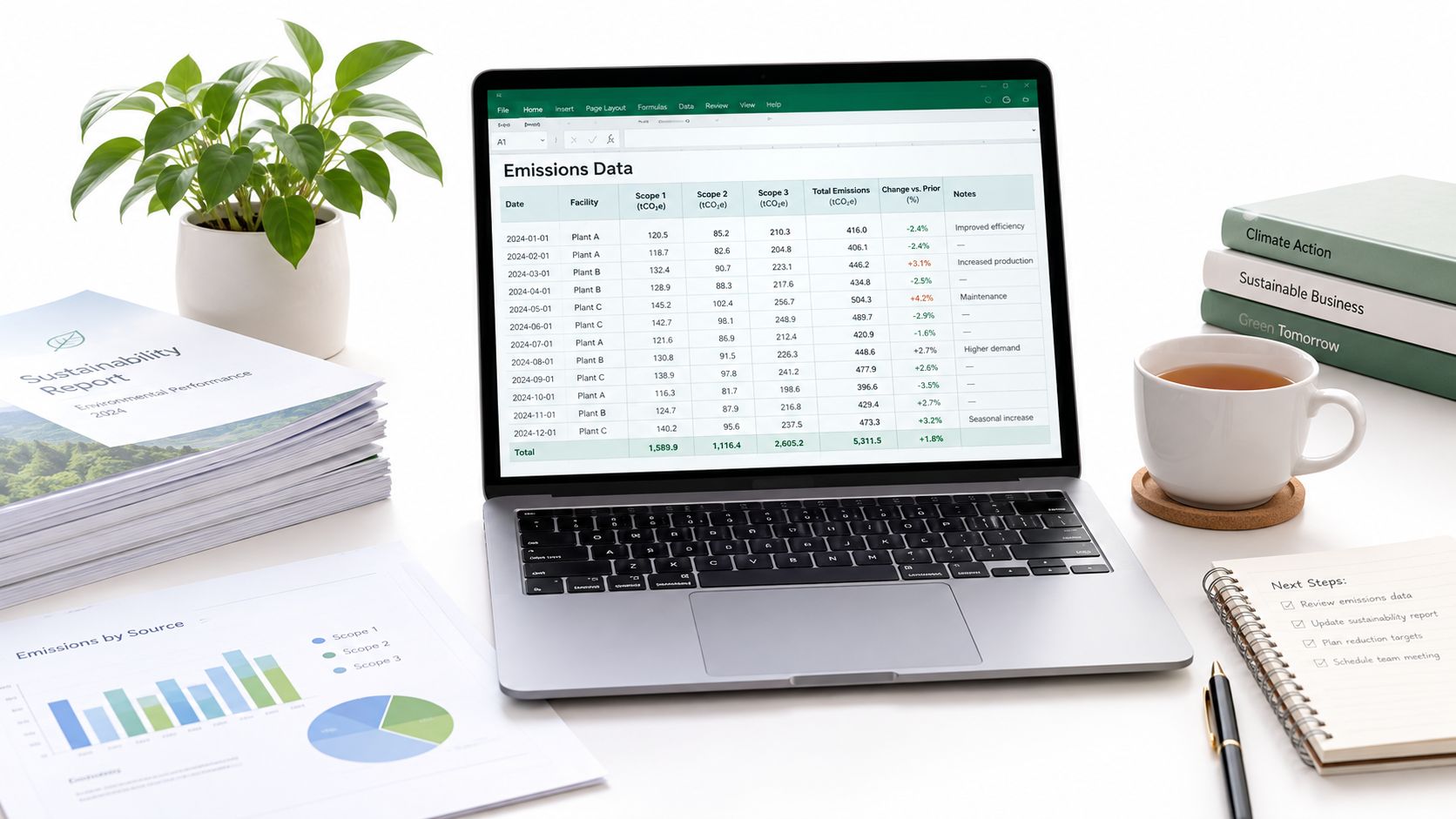
Consider a typical first build: finance exports procurement transactions, the travel coordinator downloads bookings, and facilities requests waste records. These teams don't need to become carbon-accounting specialists. They need clear fields, agreed ownership and a way to flag uncertainty without losing the underlying evidence.
Keep the working register beside the source documents, rather than treating the final dashboard as the evidence archive.
Separate inputs from calculation controls
A spreadsheet is workable if reviewers can distinguish imported records, approved assumptions and calculated outputs. Protect formula fields and retain the original exports instead of overwriting them during cleansing.
Build the register around these field groups:
- Identity and coverage: Reporting period, entity, site, Scope 3 category, activity description and record identifier.
- Activity evidence: Quantity, unit, source document, data owner and whether the input is recorded or estimated.
- Calculation details: Method, factor name, factor year and version, factor unit, unit conversion, and global-warming-potential treatment.
- Review trail: Calculated kgCO2e and tonnesCO2e, assumptions, boundary notes, approval status and reviewer comments.
The inventory workflow should use a consistent 12-month reporting period, progressing from boundaries and category mapping through prioritisation, supplier data collection and reconciliation, alongside the government conversion-factor collection for company reporting.
Resolve gaps visibly
Suppose a waste contractor supplies invoices but no weights. Facilities should flag the missing quantity; the sustainability team should document an estimation method and request better evidence. Nobody should enter an unsupported zero to complete the spreadsheet.
Give each gap an owner and a resolution status. Keep estimates in the register so they remain reviewable, rather than hiding them in a separate calculation file.
Use the video as a supplementary resource alongside your working register.
Reconcile imported procurement and travel records with their source systems before applying factors. An immaculate formula won't correct an incomplete export or an activity assigned to the wrong reporting period.
Selecting the Right Emission Factors for Each Category
A factor is only useful when its activity, unit and emissions boundary match your input. Finding a familiar label in a workbook isn't enough. Read the factor description and methodology before making it part of an approved calculation.
For UK activity data, start with the DESNZ collection referenced above. For expenditure estimates, use a spend-based factor that matches the procurement sector and document its financial basis. For supplier-specific information, check what the supplier has measured and how they've allocated emissions to the goods or services you purchased.
Use the factor-selection process as a control, not a lookup exercise.
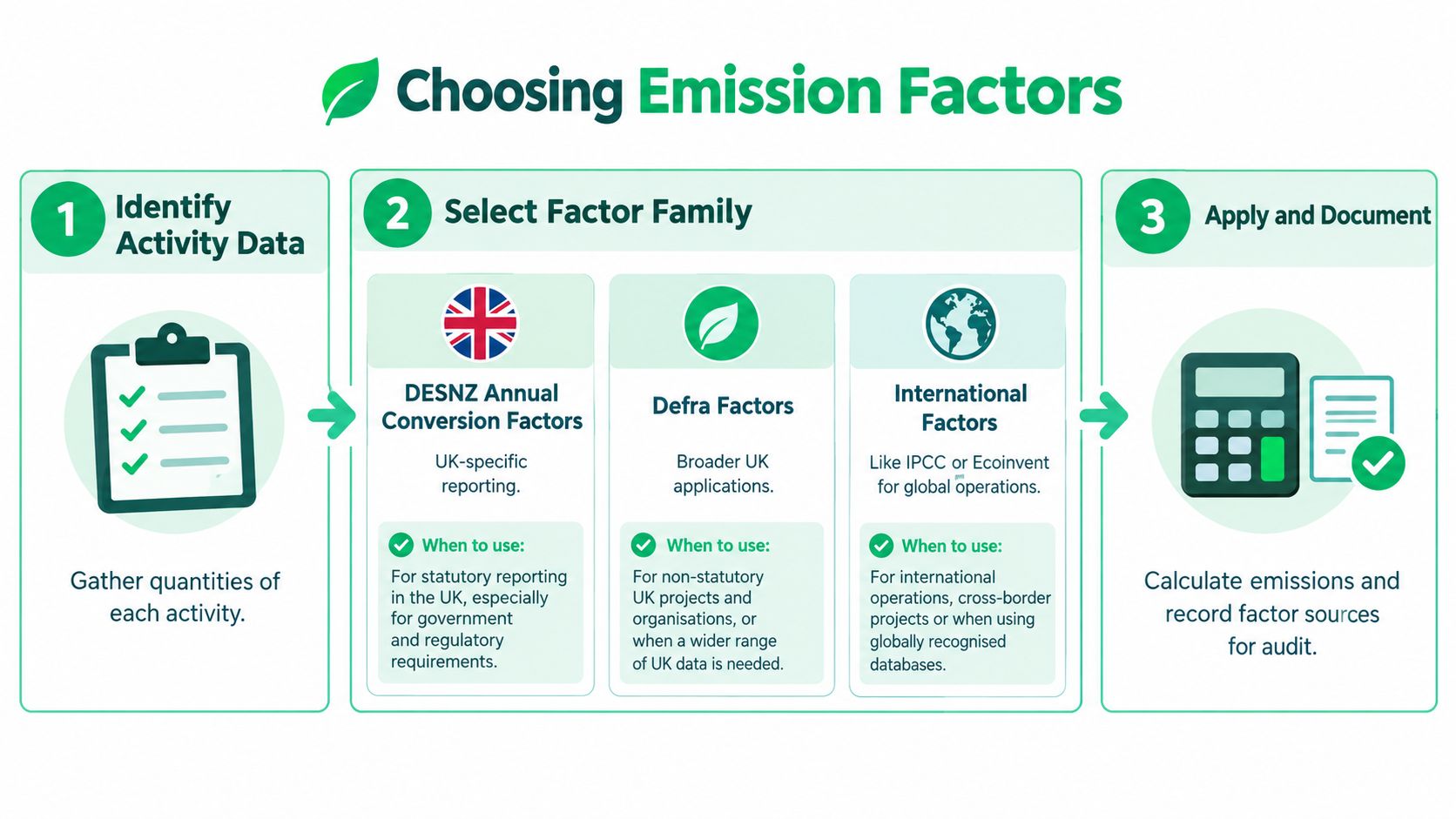
Check compatibility before calculating
Make the selection decision visible in the register:
- Activity match: Confirm that the factor describes the material, journey, treatment route or energy-related activity being reported.
- Unit match: Check volume, mass, distance or energy units, and document any conversion.
- Boundary match: Establish which lifecycle stages the factor includes and excludes.
- Version control: Retain the factor file and the approved selection, not just a hyperlink to a page that may change.
Supplier engagement is worthwhile when a category appears material, the current proxy is weak, or procurement wants to evaluate a specific reduction decision. Ask for the reporting period, calculation boundary, allocation basis and supporting methodology, rather than requesting a carbon number alone.
A detailed supplier response isn't necessarily better evidence. Its boundary must fit your purchase, and its allocation must be explainable.
Control changes between reporting cycles
Keep an approved factor library so different analysts don't select inconsistent versions for comparable activities. When official methodology changes materially, assess whether you need to recalculate prior results under your documented policy.
Replacing a proxy with supplier-specific data also needs a change record. Otherwise, a reported movement may reflect better information rather than operational decarbonisation.
The practical trade-off is between detail and usability. Accept a clearly labelled industry-average estimate where evidence is limited, but don't let that estimate become permanent by default. Connect each weak factor choice to a targeted data-improvement action.
Avoiding Double Counting and Boundary Errors
A supplier reporting emissions doesn't remove them from your value chain. The same activity can legitimately appear in different organisations' inventories. Your task is to prevent duplication within your own calculation, not eliminate emissions because a contractor already reports them.
The UK Government condensed conversion-factor workbook distinguishes purchased-electricity emissions from associated transmission-and-distribution and upstream fuel components. That separation matters: an electricity purchase can support distinct Scope 2 and Scope 3 calculations, but those components mustn't be merged or counted twice.
Use the checklist to prompt boundary questions, then resolve them against your actual organisational controls and supplier evidence.
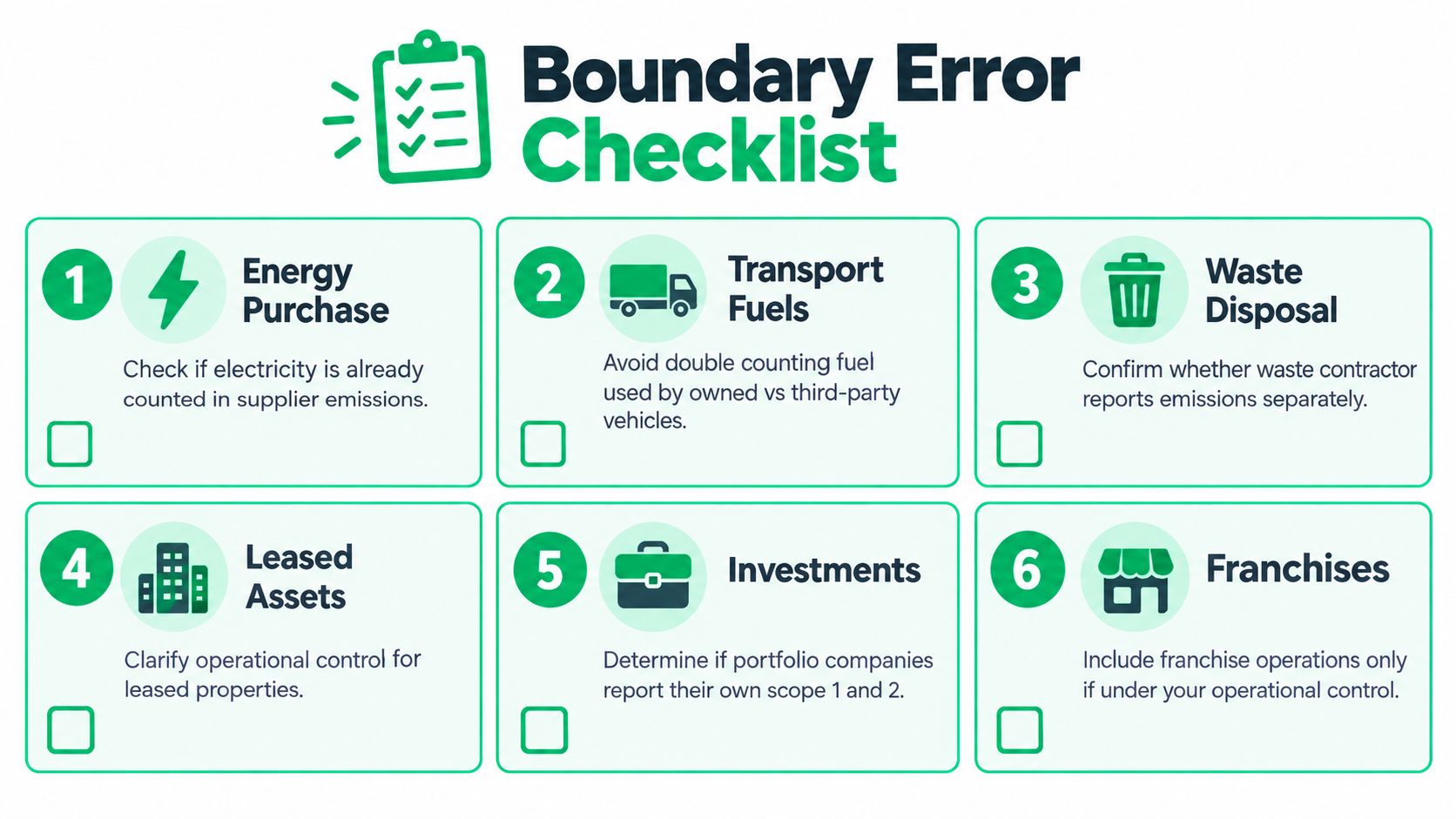
Reconcile sources rather than deleting overlaps blindly
| Potential overlap | Question to resolve |
|---|---|
| Purchased goods and freight | Does the product footprint already include the transport leg you're calculating separately? |
| Transport services and fuel | Who operates the vehicle, and which emissions does the service factor include? |
| Operational waste and contractor data | Is the contractor's allocation already represented in your waste calculation? |
| Business travel and commuting | What journey purpose and classification rule apply? |
| Energy-related activities | Which combustion, upstream and loss components have already been included? |
Well-to-tank factors cover upstream extraction, refining and transportation before fuel combustion. Don't add them indiscriminately to a combined factor that already includes those stages.
Build a category-to-source register
For every potentially overlapping activity, record its owner, supplier boundary, factor, period, unit and inclusion rationale. Add a field confirming whether another calculation already captures the same emissions. A product footprint that includes delivery requires a different reconciliation from one that ends before dispatch.
Leased assets need particular care: establish organisational control and existing scope coverage before assigning them. Likewise, don't exclude an activity merely because another entity operates it.
For procurement, the required subset includes upstream and downstream transport, operational waste, business travel and commuting, as identified in the reporting guidance already cited. Preserve those lines in the buyer-facing output even where other corporate categories appear more material.
Completeness and relevance answer different questions. A buyer needs the requested coverage; management needs an inventory that identifies meaningful reduction opportunities.
Managing Uncertainty and Getting Ready for Assurance
A recorded quantity is not the same as a directly measured emissions result. Travel distance may come from booking records, while emissions still depend on a modelled factor. Supplier figures can also contain estimates and allocation assumptions, so avoid describing every primary-data calculation as measured emissions.
Assess data quality by category, considering coverage, specificity, reporting-period alignment and confidence in the boundary. Keep the largest contributors with weak evidence at the top of the supplier-engagement list. Don't spend the reporting cycle refining a minor line while leaving a consequential procurement category poorly mapped.
Run a pre-assurance review
Before figures leave the working team, check that:
- Coverage is approved: Relevant activities are included, and exclusions have a business rationale and accountable owner.
- Inputs reconcile: Procurement, travel and operational records agree with the underlying systems or have explained differences.
- Calculations reproduce: Factor selections, conversions, allocation rules and assumptions are retained.
- Boundaries are resolved: Overlapping sources have documented treatment, not informal analyst decisions.
- Evidence is accessible: Reviewers can locate source records and approvals without relying on the spreadsheet author.
- Changes are explained: Method replacements, factor revisions and any recalculations have an approved record.
Use a sustainability audit to test the reporting process as well as the total. Ask a reviewer who didn't build the inventory to reproduce a selected calculation from source evidence. If they need the original analyst to explain undocumented steps, the process still depends too heavily on individual knowledge.
Assurance readiness: Transparency about limitations is more defensible than precision your evidence can't support.
Make uncertainty actionable
Disclose which categories rely on proxies and why. For government Carbon Reduction Plans, explain missing data rather than using unsupported zero or not-applicable entries, consistent with the sustainability reporting guidance discussed earlier.
Translate weaknesses into specific next-cycle tasks: procurement requests product-level boundaries, facilities obtains treatment-specific waste records, and HR improves commuting inputs. Assign each task an owner and connect it to the decisions the improved evidence will support.
An inventory is ready for review when another person can understand its coverage, reproduce its calculations and identify its limitations. That's also when management can begin using it responsibly to prioritise decarbonisation.
ESG Consulting offers Scope 3 inventory support through value-chain mapping, supplier engagement and assurance-ready evidence trails, alongside UK procurement Carbon Reduction Plans. Visit the team to discuss your reporting purpose, current data gaps and the support needed to take your first inventory from scoping through to sign-off.