net zero consultancy, carbon strategy, SBTi, net-zero pathway, ESG consulting
What a Net Zero Consultancy Actually Does
By ESG Consulting Team · · 15 min read
The board has approved a net-zero target. The annual report contains the commitment, the sustainability team has prepared a presentation, and stakeholders are asking what happens next. Then the finance director asks the question that exposes the gap: Which projects will deliver the reductions, in what order, at what cost, and with what evidence?
A target can be approved in an afternoon. A pathway that survives scrutiny requires reliable emissions data, operational modelling, capital planning, accountable owners and controls that support assurance. That's the practical role of a net zero consultancy. It turns a public ambition into a programme the organisation can fund, implement, monitor and defend.
Table of Contents
- Why Ambition Alone Fails Without a Costed Pathway
- The Three Outputs Every Net-Zero Strategy Requires
- How SBTi Targets and Transition Plans Shape Decarbonisation Pathways
- Why Scope 3 Baselines Are Often Defended Poorly
- Fixed-Scope Advisory Versus Fragmented Reporting Work
- What a Credible Net-Zero Partnership Should Deliver
- Questions to Ask Before Commissioning Net-Zero Advisory Work
Why Ambition Alone Fails Without a Costed Pathway
A board signs off a 2050 net-zero pledge. The language is clear, the ambition is credible, and the communications team has a launch plan. Yet when directors ask which buildings will be upgraded first, whether the electricity network can support electrification, how suppliers will provide Scope 3 data or what capital is available, the answers are tentative.
That situation is common because target-setting and delivery planning are different disciplines. A target describes the destination. A consultancy engagement should test the route, the constraints and the evidence required to demonstrate progress. It should also identify when a technically attractive measure needs to be postponed, redesigned or rejected because its cost, timing or delivery risk makes the overall pathway weaker.

The UK target creates a delivery obligation
The UK's national framework gives this work more weight than a voluntary corporate campaign. In June 2019, Parliament amended the Climate Change Act 2008 to require the UK to reduce net greenhouse-gas emissions by at least 100% from 1990 levels by 2050, replacing the former 80% target. The Government's pathway also identifies a 78% reduction by 2035, including international aviation and shipping, as explained in the UK net-zero target explainer.
The challenge is not theoretical. UK territorial emissions were estimated at 367 million tonnes of carbon-dioxide equivalent in 2025, a 54% reduction from 1990 levels, leaving a substantial transformation still to complete after three decades of progress. Government modelling indicates that power-sector emissions may need to fall by 95 to 98%, heat and buildings by 98 to 100%, transport by 76 to 86%, and fuel supply by 71 to 99% compared with 2019 levels by 2050. Those pathways create demand for emissions inventories, target modelling, transition planning, governance, disclosure and implementation.
A practical decarbonisation strategy therefore starts with scoping, not slogans. The consultant establishes organisational boundaries, data owners, operational dependencies, regulatory exposure and investment constraints before recommending a target or project list.
Practical rule: If a target cannot be translated into named interventions, owners, dates, funding decisions and evidence requirements, it's an aspiration rather than a delivery plan.
The strongest advisers connect carbon accounting to finance. They quantify the baseline, separate controllable reductions from external changes, test procurement and supply-chain assumptions, and create a record that can support board decisions and stakeholder scrutiny. The output isn't another polished report. It's a route map for deciding what the organisation should do next, what it should avoid doing prematurely and how it will prove that the pathway is working.
The Three Outputs Every Net-Zero Strategy Requires
A useful engagement produces three connected outputs. Each answers a different board-level question:
- What are we emitting, and can we prove it?
- Which interventions should we fund, and in what sequence?
- Who is accountable for delivery, and how will progress be governed?
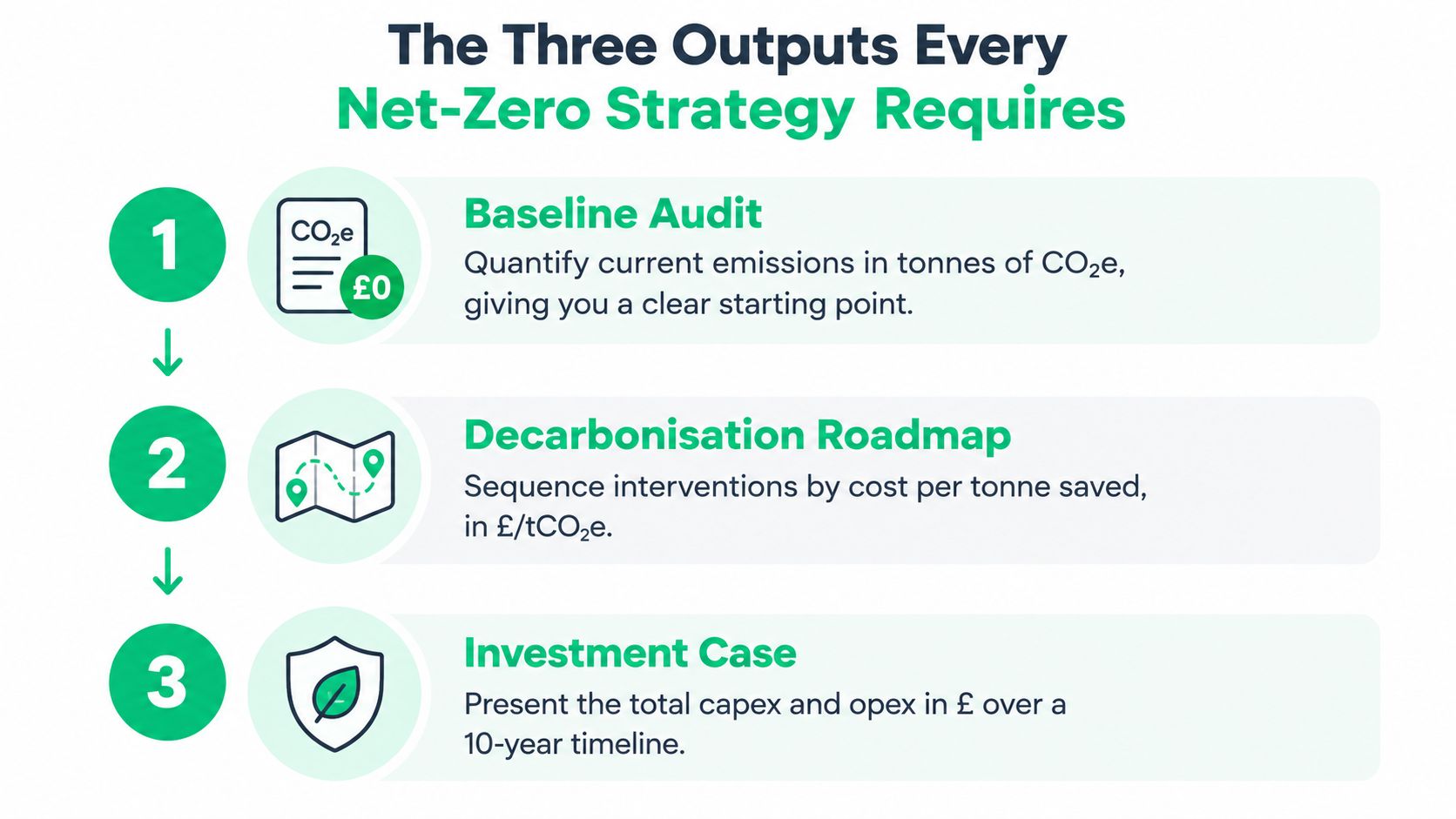
A traceable emissions inventory
The inventory is the foundation. Scope 1 and Scope 2 figures should trace back to source records, calculation methods, organisational boundaries and review controls. A credible consultant won't just populate a spreadsheet. They'll document assumptions, resolve inconsistencies, assign data ownership and identify where estimates could affect the target pathway.
Scope 3 requires a different approach. The organisation needs value-chain mapping, category prioritisation and proportionate supplier engagement. Spend-based estimates can help establish an initial view, but they shouldn't be presented as precise measurements when the underlying data is weak. The inventory should show confidence levels and a plan for replacing estimates with stronger primary data.
A costed and sequenced pathway
Technical feasibility is only one decision criterion. A heat-pump programme might reduce emissions substantially but depend on building fabric, grid capacity, planning, procurement and skilled installers. Fleet electrification may look straightforward until vehicle duty cycles, depot infrastructure and replacement dates are modelled.
A useful pathway ranks measures by abatement potential, capital requirement, operating impact, payback, funding availability and implementation risk. It can include a marginal-abatement-cost curve, but the curve must reflect more than cost per tonne. It should also show dependencies, delivery confidence and the consequences of delay.
The consultant then tests scenarios rather than presenting one supposedly certain forecast. Energy prices, financing conditions, technology availability and organisational adoption can all change the order of investment. A financeable plan makes those sensitivities visible.
A governance-ready transition plan
The third output turns analysis into management action. It links board oversight, executive ownership, capital allocation, procurement, operational milestones and reporting controls to quantified interventions.
A transition plan should state who approves projects, who owns the data, which decisions need escalation and how delivery will be reviewed. It should also explain why a measure has been selected, what reduction it is expected to deliver, what assumptions support that estimate and what evidence will confirm performance.
The video below provides an additional visual reference for how organisations can structure a net-zero strategy:
The three outputs reinforce one another. Weak data undermines the investment case. An uncosted pathway leaves governance with no practical decisions to make. A transition plan without quantified interventions becomes a communications document rather than an operating instrument.
How SBTi Targets and Transition Plans Shape Decarbonisation Pathways
A science-based target and a transition plan perform different jobs. The Science Based Targets initiative Corporate Net-Zero Standard v2.0 provides a structure for testing whether the organisation's ambition is consistent with climate science. A Transition Plan Taskforce-aligned plan explains how governance, strategy, investment, risk management, metrics and delivery will work in practice.
That distinction matters. External validation of ambition doesn't prove that an organisation can deliver the projects required. Conversely, a detailed project list can still fall short if the target lacks a credible scientific basis. A consultant should use the two frameworks as complementary controls, not as interchangeable badges.
Testing interventions rather than relying on averages
Aggregate percentage reductions can conceal weak assumptions. A credible model tests the main sources separately:
- Buildings: Heat demand, building fabric, controls, heating-system replacement and purchased electricity should be assessed at asset level.
- Transport: Fleet replacement dates, vehicle suitability, charging infrastructure and operational duty cycles need separate treatment.
- Procurement: Supplier engagement, product specifications, contract terms and purchasing decisions should connect to Scope 3 reductions.
- Energy: Efficiency, demand reduction, renewable procurement and grid effects must be distinguished from one another.
The UK's emissions profile shows why this granularity matters. In 2024, domestic transport accounted for 30% of territorial emissions, buildings and product uses 22%, agriculture 12%, industry 12%, electricity supply 10%, fuel supply 8% and waste 6%, according to the UK greenhouse-gas emissions statistics. Transport and buildings together represented 52%, but that doesn't mean one generic intervention can address both.
The same source reports that UK territorial emissions were estimated at 373 MtCO2e in 2024, 3% below 2023 and 53% below the 1990 baseline. The reduction in electricity-supply emissions was strongly influenced by higher electricity imports, increased renewable generation and the closure of the UK's last coal-fired power station. Consultants should therefore avoid claiming an organisation has decarbonised merely because the grid has changed. The model must isolate reductions controlled by the organisation.
Buildings expose the implementation gap
The Climate Change Committee's 2025 assessment, summarised by the UK Green Building Council, reported that only 38% of the emissions reductions required in the building sector had credible plans, while 14% had insufficient plans. It also reported that 71% of new homes still used fossil-fuel boilers.
For a property portfolio, hospital estate or public-sector organisation, a credible transition plan needs asset-level baselines, heat-demand analysis, grid-capacity checks, capital sequencing and measurable annual milestones. It should record dependencies such as planning, procurement, workforce capability and supplier availability. The SBTi net-zero standard can help frame the target, but the transition plan must show how the organisation will implement it.
Why Scope 3 Baselines Are Often Defended Poorly
The usual advice is to obtain better supplier data. That advice is directionally correct but operationally incomplete. Waiting for every supplier to provide perfect information can delay decisions, while unqualified estimates can create false precision.
An Imperial College summary reports that 87% of UK SMEs surveyed were unaware of their total carbon emissions, as described in the Scope 3 briefing paper. An organisation can't assume that every supplier has the systems, expertise or resources to respond to a detailed carbon questionnaire. The consultant's task is to create a defensible method for working with imperfect information.
Build a data hierarchy
A mature baseline distinguishes data quality rather than hiding it. Primary supplier data may be appropriate for material categories or strategic suppliers. Where it isn't available, the organisation can use activity data, recognised emission factors or carefully controlled spend-based estimates, provided the method and limitations are recorded.
Each category should carry a confidence rating and an uncertainty range where appropriate. The inventory should state:
- Boundary: Which entities, products, services and periods are included?
- Method: How were activity data and emission factors combined?
- Confidence: Which figures are measured, estimated or modelled?
- Governance: Who reviewed the assumptions and approved the result?
- Improvement plan: Which estimates will be replaced, when and why?
This approach is more credible than presenting every figure with equal certainty. Auditability concerns the quality of the process and evidence trail as well as the numerical result.
Engage suppliers without exporting the burden
Supplier engagement should be proportionate. A large strategic supplier may warrant primary-data requests, workshops and contract discussions. A smaller supplier may need a concise questionnaire, practical guidance and time to improve its records. Requiring every supplier to complete the same complex template can damage relationships without producing better information.
Procurement teams can improve data quality by defining minimum information requirements, including carbon questions in appropriate tenders and using contract reviews to discuss improvement. They should avoid treating estimates as a reason to punish smaller suppliers. The immediate objective is a transparent baseline and a prioritised improvement programme.
Defensible does not mean perfect. It means the organisation can explain the method, the uncertainty, the decision made and the next step to improve the evidence.
Scope 3 work should also connect to commercial decisions. A category that appears material may require redesign, supplier substitution or contract changes. A category with low confidence may need targeted primary-data collection before the organisation commits to a major reduction claim. The Scope 3 emissions guide is useful for framing those categories, but implementation depends on the organisation's value chain and procurement influence.
Fixed-Scope Advisory Versus Fragmented Reporting Work
Two organisations can spend a similar amount on sustainability work and receive very different levels of confidence. One commissions separate vendors for an emissions inventory, a disclosure, a target submission and a supplier questionnaire. The other appoints a named account lead with responsibility for maintaining the logic from initial scope through to sign-off.
Fragmentation isn't automatically wrong. Specialist input can be valuable, particularly for complex engineering, legal or assurance questions. The problem appears when no one owns the connections between outputs. A Scope 1 figure in one report may use a different boundary from the target model. A transition plan may recommend projects that the finance team hasn't reviewed. A disclosure may describe controls that don't exist in the underlying process.
The difference in operating models
| Fragmented reporting work | Fixed-scope advisory |
|---|---|
| Separate briefs and methodologies | One agreed scope and methodology |
| Multiple handovers | A named lead accountable for continuity |
| Responsibility divided across vendors | Clear ownership from brief to sign-off |
| Corrections often occur late | Evidence and controls designed from the start |
| More reports may be produced | Outputs are connected to decisions |
For assurance readiness, continuity matters. The organisation needs to retrieve source data, calculation logic, approvals, assumptions and changes in methodology without reconstructing the project after publication. A fixed scope and fee can create useful discipline because both sides agree what will be delivered, what isn't included and which decisions require a change control.
Regulatory work rewards consistency
ESOS assessments illustrate why specialist accountability matters. An assessment requires registered Lead Assessor sign-off, so the organisation needs a process that supports the assessor's review and preserves the required evidence. SECR narratives also benefit from consistent data methodologies across reporting years, especially when energy consumption, emissions and intensity ratios need to be explained to readers.
Good advice includes identifying when an obligation doesn't apply. Producing unnecessary work isn't a mark of maturity. A capable adviser should assess applicability across frameworks such as SECR, ESOS, UK SRS, CSRD and public procurement requirements, then recommend the proportionate response.
The right model depends on the organisation's needs. A business with a mature internal team may commission narrowly defined technical work. A board facing inconsistent data, shifting obligations and multiple reporting demands may benefit more from one accountable lead who can challenge assumptions and keep the delivery record coherent.
What a Credible Net-Zero Partnership Should Deliver
The UK net-zero economy is now large enough to affect mainstream business decisions. Independent analysis estimated that it generated £83.1 billion in gross value added during 2024, including £28.8 billion directly from net-zero businesses and £54.3 billion through supply-chain and wider economic effects. The same analysis estimated 951,000 full-time-equivalent jobs, equal to 2.9% of total UK employment, with 10.1% growth between 2023 and 2024, as reported in the UK net-zero economy analysis.
That footprint changes the consultancy brief. Net zero affects procurement, investment, workforce planning, competitiveness and customer requirements, not just environmental reporting. Organisations need evidence that can withstand review from boards, investors, customers, regulators and public-sector buyers.
Look for decisions, not documents
A credible partnership should leave the organisation with practical answers:
- Data: Which emissions figures are reliable, estimated or still missing?
- Regulation: Which obligations apply, and which do not?
- Investment: Which measures should be funded first, and what dependencies could delay them?
- Operations: Which teams own delivery, data and performance review?
- Supply chain: Which categories and suppliers require stronger evidence?
- Claims: Can published statements be traced to approved calculations and records?
The 2025 estimate placed the UK net-zero economy at £105 billion of GVA and 1.1 million supported workers, including 308,000 jobs directly supported by net-zero businesses, 520,000 in supply chains and 234,000 through wider economic activity, according to the same analysis. These figures are estimates for 2025, not a guarantee of commercial return for any individual organisation. They do, however, show why credible climate information increasingly sits inside core business planning.
The test is investability
A consultancy that only produces a target may satisfy a communications need. A consultancy that builds a costed pathway gives finance, operations and the board a basis for decisions. That includes saying no to measures that don't work under realistic constraints, flagging where better data is essential and distinguishing compliance with a target from genuine emissions abatement.
The most useful partnership combines carbon accounting, regulatory interpretation, operational knowledge, procurement engagement, financial modelling and governance. It doesn't remove uncertainty. It makes uncertainty visible enough for directors to manage.
Questions to Ask Before Commissioning Net-Zero Advisory Work
Before appointing a net zero consultancy, ask questions that reveal delivery capability rather than presentation quality:
- Who is accountable from scoping through sign-off? Confirm whether there's a named account lead and clear escalation route.
- What exactly is included? Request a fixed scope, fee, timetable, data list, assumptions and change-control process.
- Can the inventory withstand assurance? Ask how source records, emission factors, boundaries, calculations, approvals and revisions will be controlled.
- How will interventions be sequenced? Require capital costs, operating effects, payback considerations, dependencies, delivery risks and reduction estimates.
- How will Scope 3 uncertainty be handled? Look for a data hierarchy, confidence ratings, uncertainty treatment and a plan for improving supplier evidence.
- Which requirements apply to us? Ask the adviser to assess SECR, ESOS, UK SRS, CSRD, PPN 006, TPT alignment and any relevant NHS or customer requirements, rather than assuming every framework applies.
- What happens after the report? Confirm who monitors milestones, updates the pathway and supports board review.
A strong adviser should challenge the target, the data and the investment case. If the proposed work produces more paperwork but leaves the organisation unable to explain what will be funded, who will deliver it or how results will be evidenced, it hasn't solved the central problem.
ESG Consulting helps UK organisations build auditable emissions inventories, costed decarbonisation pathways and governance-ready climate disclosures, with each engagement led by a senior consultant from scoping through sign-off. Visit ESG Consulting to discuss a net-zero programme designed around your regulatory exposure, operational constraints and investment decisions.