sustainability reporting, ESG disclosure, UK SRS, TCFD reporting, SECR compliance
Sustainability Reporting Explained for UK Businesses
By ESG Consulting Team · · 15 min read
The board pack looks reassuring. The climate narrative is polished, the targets are prominent, and the annual report describes strong governance. Then the assurance team asks three straightforward questions: Which entities are included? What evidence supports the emissions figure? Why did last year's number change?
The room often goes quiet. The data sits across utility invoices, procurement systems, spreadsheets, supplier responses and operational estimates. No one person owns the calculation from source record to published metric. The report may read well, but its control environment is immature.
That situation is now common across UK businesses. Sustainability reporting has moved from a voluntary communications exercise towards a board-level reporting discipline, with regulatory requirements, investor scrutiny and assurance expectations converging. The organisations that cope best don't start by writing better prose. They define scope, control the data and make every material statement traceable to evidence.
Table of Contents
- Why Sustainability Reporting Now Feels Like Financial Reporting
- What Sustainability Reporting Actually Means
- The Main Frameworks UK Organisations Actually Use
- Working Out Which Rules Apply to Your Organisation
- Building the Data Behind the Numbers
- Why More Detail Can Sometimes Make Reporting Worse
- Getting Your Report Ready for Assurance
- A 90-Day Sustainability Reporting Readiness Plan
Why Sustainability Reporting Now Feels Like Financial Reporting
The first audit request often exposes the gap. A finance director can explain the group boundary, the source of a major balance and the approval route for a material adjustment. The sustainability team may know the headline emissions figure but struggle to identify which sites, subsidiaries, fuels or suppliers support it.
That gap matters because UK climate disclosures now sit within mainstream corporate reporting. For financial years beginning on or after 1 January 2021, premium-listed commercial companies had to include a statement in their annual financial report explaining whether their disclosures followed the Task Force on Climate-related Financial Disclosures recommendations, including any departures, as set out in the FCA's review of 2021 reporting.

The boardroom test
An audit committee needs more than polished climate language. It needs evidence that each material disclosure has a named owner, a consistent methodology and records that can be retrieved and reviewed.
The FCA found that nearly every company in its sample made climate-related disclosures. Reporting was stronger for Governance and Risk Management than for Strategy, Metrics and Targets, according to the same review. That difference is a control warning: governance wording can be coordinated centrally, while transition information depends on connected records covering risk assessment, scenario analysis, emissions, investment decisions and target performance.
Practical rule: Treat every sustainability KPI as if an assurance provider will request its source record, calculation and approval history.
Statutory reporting has reinforced that expectation. From 1 April 2019, SECR brought energy and emissions information into annual reports for qualifying UK companies and limited liability partnerships. The Financial Reporting Council's ESG and climate materials make clear that meeting minimum disclosure requirements does not automatically create reporting that helps users make decisions.
A defensible sustainability report therefore needs a defined boundary, a stated basis of preparation, controlled inputs, documented calculations, review controls and an explanation of changes between reporting periods. The narrative should interpret that controlled dataset. It cannot replace the controls behind it.
What Sustainability Reporting Actually Means
Think of sustainability reporting as accounts built from operational information rather than only monetary transactions. A fuel invoice becomes evidence of consumption. A meter reading supports electricity use. A supplier response may inform a value-chain estimate. Each record enters a controlled process before it becomes a published figure.
The report itself is only the final document. Sustainability reporting is the repeatable system used to identify, measure and disclose environmental, social and governance information about an organisation's impacts, risks and performance.
Three layers of a defensible disclosure
A sustainability narrative says what the organisation believes or intends. For example, it may describe a commitment to reduce operational emissions. A metric quantifies a defined performance measure, such as energy consumed or Scope 1 emissions. A disclosure connects the metric to its boundary, method, context, performance and, where relevant, target.
That distinction prevents a common error. A company can state a credible ambition without having a reliable baseline. It can publish a carbon number without explaining which legal entities or activities are included. It can present improvement without separating an operational change from a revised emissions factor or better supplier data.
Use a financial-reporting analogy:
- Boundary: Which companies, sites, activities and value-chain relationships are included?
- Chart of accounts: Which categories capture electricity, gas, fuels, travel, purchased goods or waste?
- Source records: Which invoices, meter readings, fuel logs and supplier submissions support the input?
- Calculation method: Which conversion factors, assumptions and estimation techniques turn activity data into a metric?
- Controls: Who checks completeness, unusual movements, changes in methodology and management approval?
- Basis of preparation: What definitions and exclusions allow a reader to understand the result?
Why repeatability matters
A single polished report can hide weak processes. A controlled report allows the team to reproduce the figure, explain a movement from the previous period and preserve an audit trail for future assurance.
That's why sustainability reporting should start with the data architecture, not the design brief. Choose the framework after identifying the required disclosures, but build the evidence trail before drafting claims. The strongest report is not the longest one. It's the one an informed reviewer can follow from published statement back to source record.
The Main Frameworks UK Organisations Actually Use
A board may receive one climate dashboard, an investor another questionnaire, and an EU subsidiary a separate sustainability request. The answer is not three disconnected reporting processes. Each framework addresses a different audience and needs its own evidence, ownership and review.
TCFD-aligned climate reporting structures climate-related financial disclosures around governance, strategy, risk management, and metrics and targets. It gives boards, investors and regulators a way to assess how climate risks and opportunities affect the organisation. GRI takes a wider impact view, covering environmental and social effects for a broader stakeholder audience.
CDP collects environmental information through structured questionnaires used by investors, customers and supply-chain partners. Its questions may draw on existing climate and emissions work, but each response still needs consistent evidence. CSRD and ESRS apply where an organisation falls within the EU regime. They can require detailed sustainability information and a documented materiality assessment.
The UK's emerging baseline is UK SRS S1 and S2. UK SRS S1 covers general sustainability-related financial information, while UK SRS S2 focuses on climate-related disclosures and is based on the ISSB standards. The UK Government's guidance on UK Sustainability Reporting Standards confirms that the final standards were published on 25 February 2026 and were initially available for voluntary use.
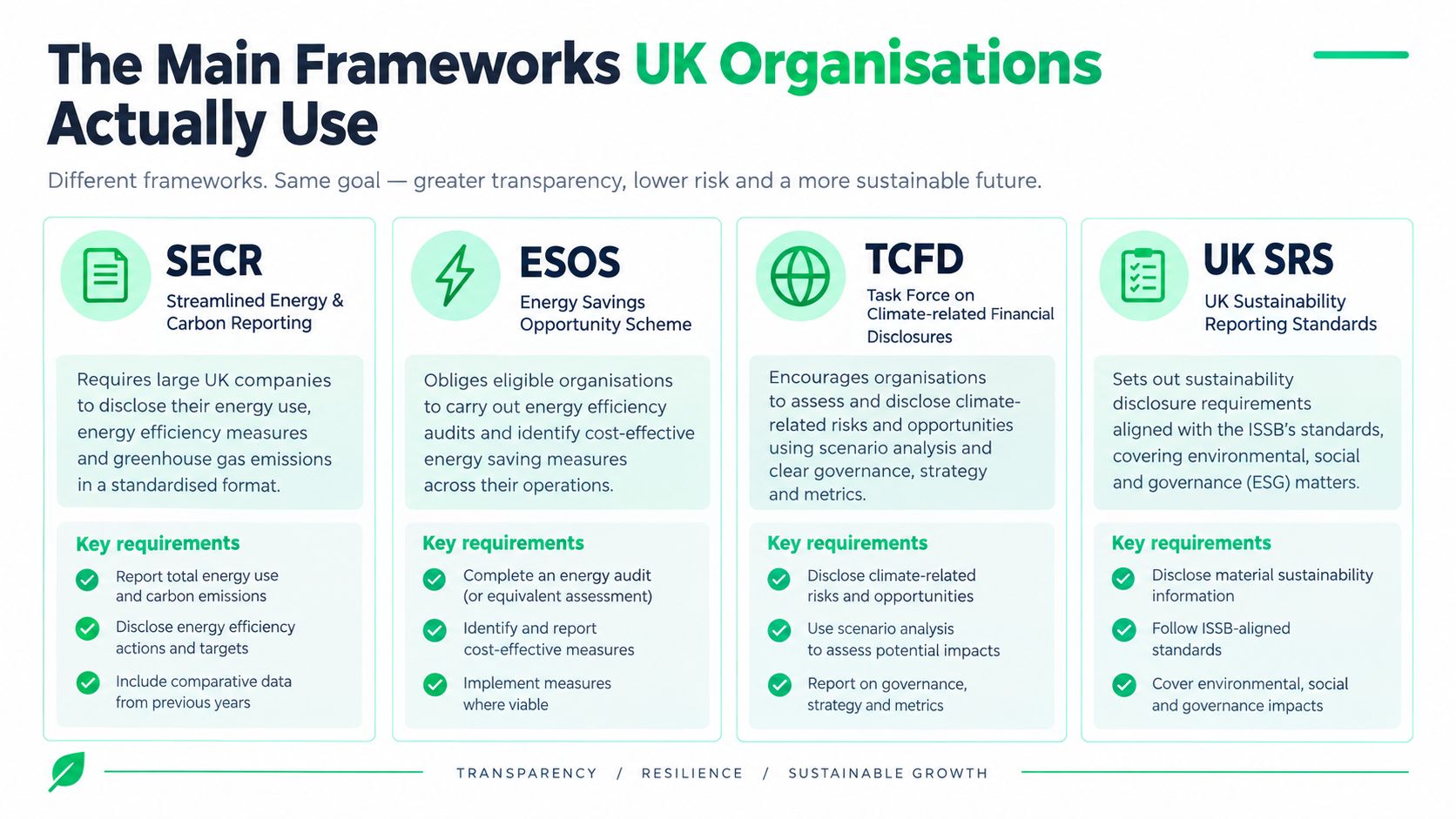
How the major UK-relevant frameworks compare
| Framework | Primary audience | UK status | Reusable for UK SRS |
|---|---|---|---|
| SECR | Investors, regulators and annual-report users | Mandatory for qualifying organisations | Energy, emissions, boundaries and methodologies can support climate metrics |
| TCFD or CFD | Boards, investors and regulators | Applicable climate-reporting requirements for relevant organisations | Governance, risk, strategy and metrics provide a strong foundation |
| GRI | Broad stakeholder audience | Voluntary unless required by another commitment | Selected impact data and governance evidence may be reused |
| CDP | Investors, customers and supply-chain partners | Generally voluntary | Emissions, targets, governance and risk data can be repurposed |
| CSRD and ESRS | EU regulators, investors and stakeholders | Applies where scope conditions are met | Some climate and governance data may transfer, but double materiality work may differ |
| UK SRS S1 and S2 | Investors and capital markets | Voluntary initially; FCA rules pending | Future UK baseline for sustainability-related financial disclosures |
Build one controlled evidence base, then label the outputs for each framework. Use TCFD for climate-risk architecture, GRI for broader impacts, CDP for questionnaire delivery and UK SRS as the future UK baseline. A practical framework comparison for sustainability reporting can help teams map overlap before issuing separate data requests.
Overlap reduces duplication, but it does not remove custom work. A governance statement may serve several frameworks, while a Scope 3 methodology, scenario analysis, materiality assessment or transition-plan metric may require different definitions and supporting detail for each audience. Treat the comparison as a control map, not a shortcut around review.
Working Out Which Rules Apply to Your Organisation
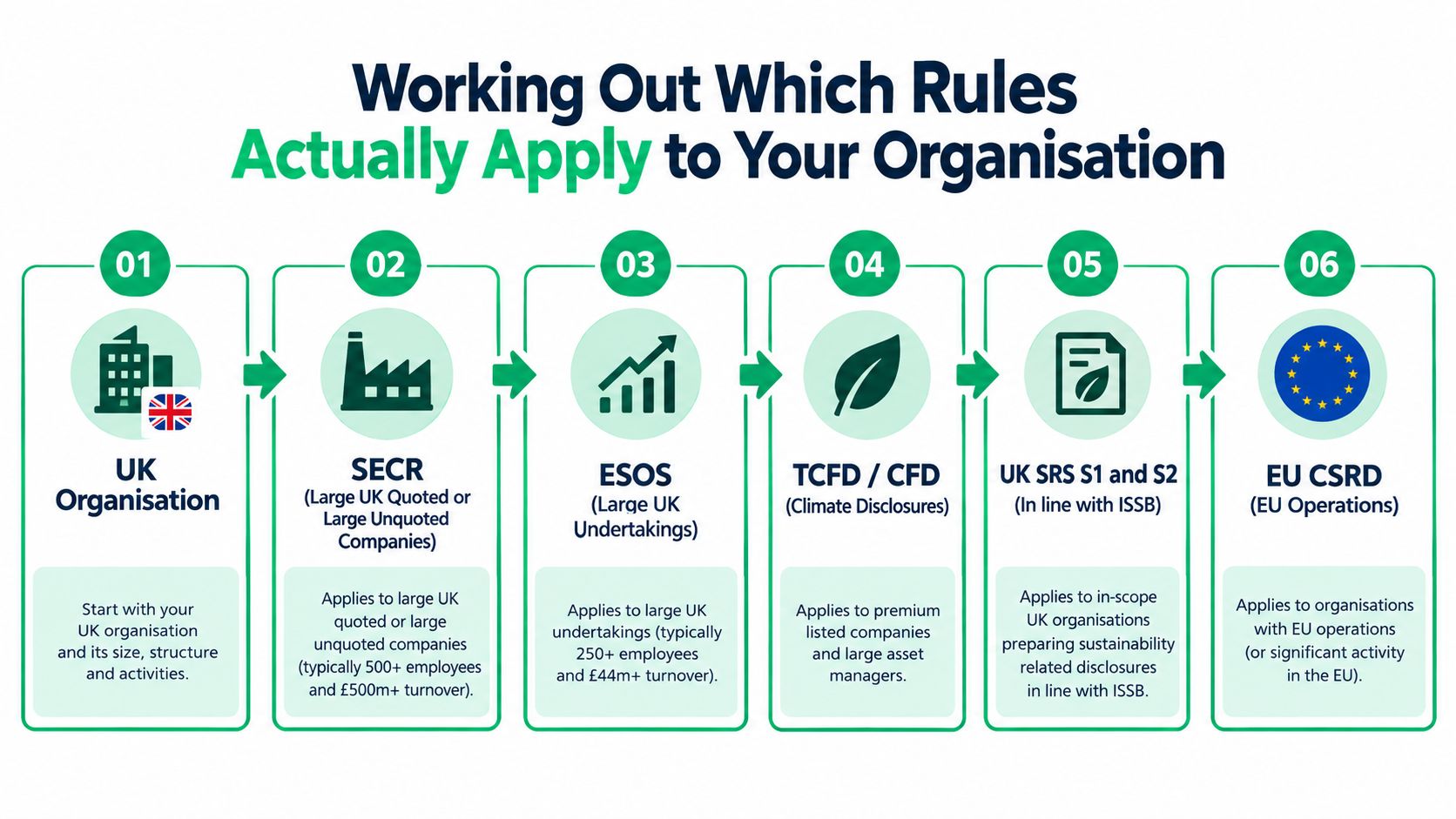
A board can approve a polished sustainability report and still fail its first serious review because the organisation applied the wrong rules to the wrong entities. Establish scope before collecting data. Otherwise, teams create avoidable work and leave material companies outside the reporting population.
Begin with SECR
For SECR, test the organisation in a fixed order:
- Identify the legal entities. List quoted companies, unquoted companies and limited liability partnerships. Do not rely only on the group chart.
- Check the quoted-company position. Quoted companies are within scope unless a low-energy exemption applies.
- Test unquoted companies and LLPs. The organisation is generally in scope when it meets at least two conditions: more than 250 employees, turnover above £36 million, or a balance sheet total above £18 million, as set out in UK Government sustainability reporting guidance.
- Record the exemption decision. Never omit a company without a documented calculation, evidence and approval supporting the conclusion.
- Reconcile the population to consolidation. Explain why each subsidiary is included or excluded, and how the reporting boundary relates to the financial group.
The resulting process should capture UK energy use, associated Scope 1 and Scope 2 emissions, at least one intensity ratio and energy-efficiency action taken during the reporting period. Retain invoices, fuel records, meter information, emissions factors and calculation notes. These records support both the disclosure and the decision that the disclosure applies.
The Government's post-implementation evidence shows why this control matters. Machine-readable annual reports included Scope 1 and at least one Scope 2 disclosure for only 67% of entities expected to report, while survey estimates of compliance ranged from 77% to 86%, according to the Government sustainability reporting guidance.
Separate current obligations from future readiness
Assess ESOS separately, then test climate-related financial disclosure requirements linked to listing status and other regulatory categories. Groups with EU operations, relevant turnover or relevant listing arrangements need a CSRD scope assessment. A UK parent does not, by itself, settle the question.
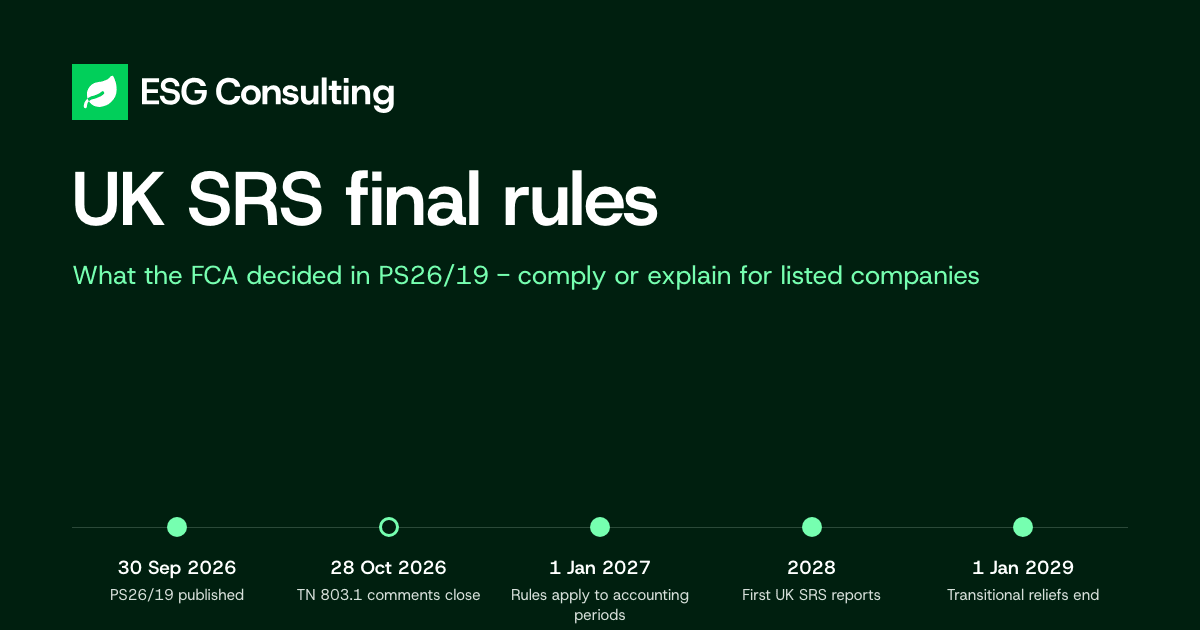
For UK SRS, distinguish voluntary preparation from mandatory application. The FCA finalised rules requiring UK SRS reporting on a comply-or-explain basis for accounting periods beginning on or after 1 January 2027, with first reporting expected in 2028. The FCA rules provide one year of transitional relief for Scope 3 emissions and two years for wider sustainability disclosures. Use the [UK SRS guidance cited above] for the policy context, but maintain an internal applicability register that records the regulatory basis, entities assessed, conclusion and approver.
Relief should sequence the work, not postpone data governance. Establish a reliable baseline and document what is not yet reported. A concise guide to sustainability reporting rules and regulations can support the initial scope assessment, but internal owners must approve the final register.
Building the Data Behind the Numbers
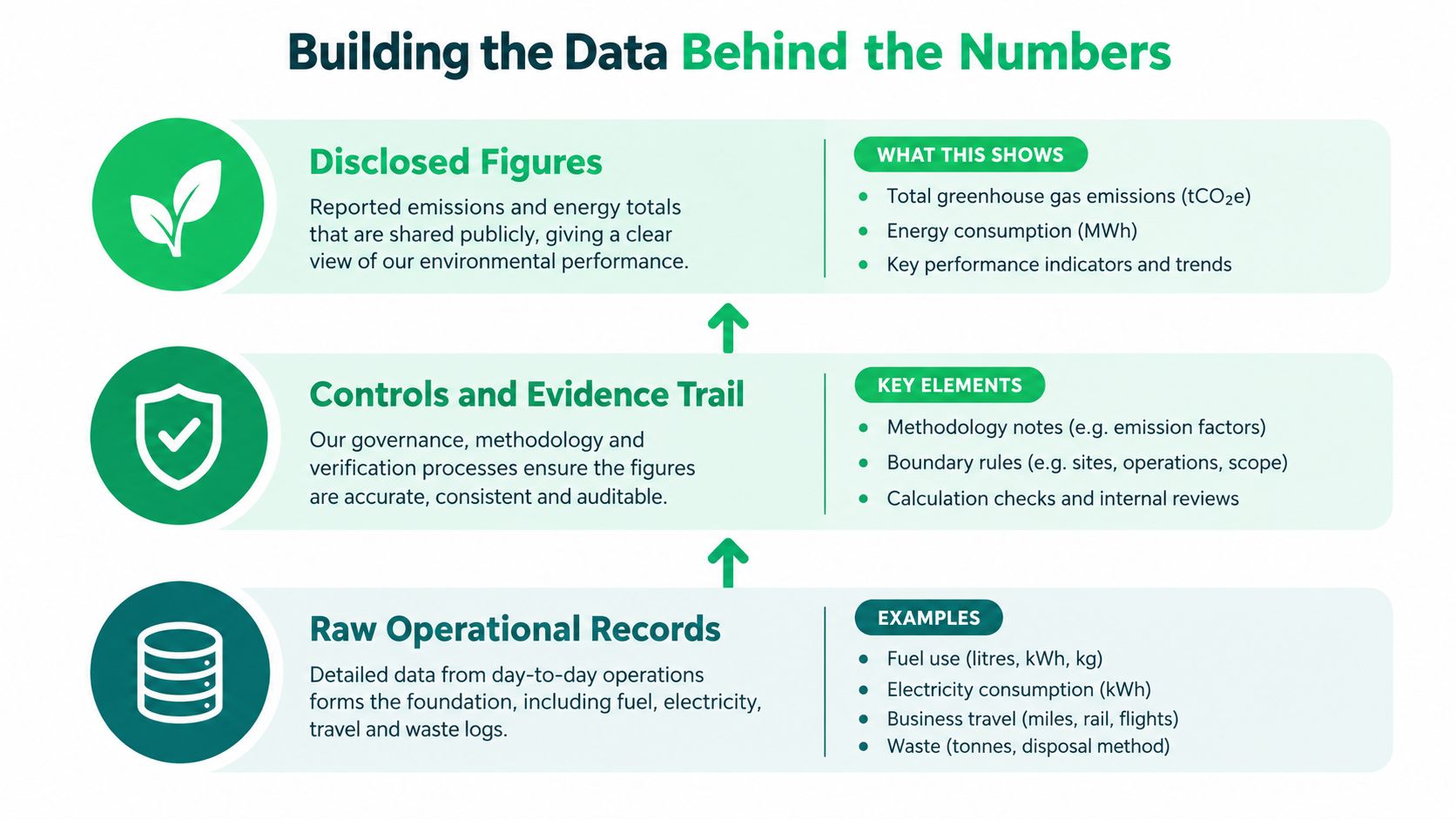
A sustainability figure can survive publication and still fail assurance if nobody can show its source, calculation, reviewer and change history. Build that evidence register before drafting the annual report. It should record where each number came from, who checked it and what changed from the previous period.
Start with operational records. Retain electricity and gas invoices, fuel logs, refrigerant records, travel data, waste records and supplier submissions in a controlled location. Assign every source a reporting period, legal entity, site or activity identifier and review status. These fields turn scattered records into an auditable trail.
The control chain
Convert those records into a defined inventory. Set organisational and operational boundaries, classify Scope 1 and Scope 2 sources, select intensity ratios and document the method for each calculation. Scope 3 needs tighter control because supplier evidence, spend data, activity estimates and category choices can materially change the result.
Link every inventory figure to its disclosure. The published number should have a calculation file, methodology note, evidence reference, reviewer and approval date. Record revisions when the team changes an emissions factor, corrects an error or adds a previously omitted site. Preserve the original evidence rather than overwriting it.
Deloitte's analysis of FTSE 100 annual reports published through 31 December 2025 found that 69% of companies made prior-year adjustments to climate and sustainability metrics, compared with 46% the previous year. Among 59 companies making greenhouse-gas-related adjustments, 75% involved Scope 3 emissions, according to Deloitte's analysis of sustainability adjustments.
A lower reported figure can reflect an operational reduction, better source data, a boundary change, a revised factor or a correction. The report must distinguish those causes. Define the restatement policy before the first adjustment: specify when prior-year figures are restated, how the reason is described, who approves it and how the original evidence is retained.
An assurance provider can work with estimates and revisions. Unexplained movement and missing records are the true control failure. The governing principle is simple: an improved number is not automatically improved performance. Trace the change to operations, methodology, boundary or data quality before presenting it as progress.
Why More Detail Can Sometimes Make Reporting Worse
Every additional Scope 3 category, target, KPI and narrative claim widens the surface area for inconsistent boundaries, weak evidence and later restatement. Directors should approve expansion only when the organisation can reproduce the underlying method and defend the result under review.
The FCA's review shows how reporting quality varies by topic. 139 companies, or 81%, reported consistently on climate targets and performance. The figures were 147 companies, or 86%, for climate-risk metrics and 152 companies, or 89%, for Scope 1, Scope 2 and, where appropriate, Scope 3 emissions, according to the FCA's multi-firm review.
Choose control over decoration
A large dataset built on unstable methods weakens confidence. A smaller dataset with a defined boundary, reliable source records and a clear explanation of limitations gives directors and investors information they can compare.
Companies should still address Scope 3 and set ambitious targets. Sequence the work instead:
- Establish the baseline: Define categories, boundaries, estimation methods and data owners.
- Test comparability: Confirm that the same method can be applied across periods and entities.
- Explain uncertainty: Identify incomplete supplier data and estimates that materially affect the result.
- Expand deliberately: Add detail only when the organisation can control, reproduce and review it.
Frameworks create reporting expectations, not evidence. Publishing a number because a framework mentions it creates avoidable assurance risk. The governing test is practical: can the organisation defend the number, explain its limitations and update it consistently? If not, improve the control before adding more detail.
Getting Your Report Ready for Assurance
A report can look polished and still fail assurance. If the team requests invoices, calculations and approvals only days before sign-off, the problem is the control system, not the deadline. Build the evidence file throughout the reporting year.
Limited assurance tests whether the control file exists, reconciles and supports the disclosure. Reasonable assurance tests whether the underlying records would withstand scrutiny comparable to a financial ledger. Choose the level required by the reporting rules, stakeholder expectations and the maturity of the control environment.
According to the same Deloitte analysis, 86 FTSE 100 companies stated that they obtained assurance over sustainability metrics in 2025, with ISAE 3000 remaining the dominant standard.
The minimum control file
For each material KPI, document:
- Owner: A named person responsible for collection, review and explanation.
- Boundary: The entities, sites, activities and periods covered.
- Baseline: The reference period and reason for selecting it.
- Method: The calculation approach, emissions factors and assumptions.
- Frequency: When data is collected, checked and approved.
- Evidence trail: Source records linked to the reported figure.
- Change log: Methodology changes, estimates, corrections and restatements.
Estimation is acceptable when it is controlled. Record why it was needed, how it was calculated, what would improve it and whether it affects comparability. An undocumented estimate cannot support an audit-grade disclosure.
Involve the assurance provider early. They should challenge control design before publication, not just inspect the finished report. A useful sustainability audit approach begins with evidence trails and control owners, then tests whether the report reflects the underlying data.
Assurance test: If a KPI owner cannot reproduce the figure without requesting files from several colleagues, the process is not ready.
Explain exclusions, data gaps and prior-year adjustments plainly. A concise limitation supported by evidence is more credible than confident wording the records cannot support. Treat every restatement as a controlled decision, with its cause, impact and approval recorded.
A 90-Day Sustainability Reporting Readiness Plan
A practical readiness programme needs a sequence, owners and deliverables. Use the following runway for the first cycle.
Days 1 to 15, scope and ownership. The company secretary, finance lead and ESG lead confirm applicability across SECR, ESOS, TCFD or CFD, UK SRS and CSRD. Deliverable: an approved legal-entity and reporting-obligation register.
Days 16 to 35, evidence mapping. Operations and finance map electricity, fuel, travel, waste, procurement and supplier records to each entity and site. Deliverable: a source catalogue showing gaps, owners and retention requirements.
Days 36 to 55, methodology and boundaries. The ESG lead documents Scope 1 and Scope 2 calculations, intensity ratios, Scope 3 categories, assumptions and organisational boundaries. Deliverable: a controlled basis-of-preparation document.
Days 56 to 70, restatement policy and KPI map. Finance and the audit committee assign an owner, reviewer, baseline, frequency and approval route to every material KPI. Deliverable: a signed KPI control matrix and prior-year adjustment policy.
Days 71 to 90, dry run. Internal audit or an independent reviewer selects disclosures and traces them to evidence, tests reconciliations and challenges narrative claims. Deliverable: a remediation log with board-level decisions on unresolved gaps.
Don't treat SECR as a narrative paragraph, skip legal-entity reconciliation or use transitional relief as permission to delay basic data governance. Those shortcuts create a report that may look complete while remaining difficult to defend.
ESG Consulting helps UK organisations scope SECR, ESOS, UK SRS, TCFD and CSRD obligations, build Scope 1, Scope 2 and Scope 3 inventories, and create evidence trails designed for assurance. Visit ESG Consulting to discuss a readiness assessment, first-cycle disclosure or audit-grade reporting programme.