Procurement-ready carbon reporting for UK B2B SaaS
A South West marketing analytics platform needed a Scope 1, 2 and 3 carbon footprint and a PPN 006 Carbon Reduction Plan before public sector and enterprise buyers would sign. We delivered both to the GHG Protocol Corporate Standard within 7 days of receiving the final data.
Case StudiesB2B SaaS
- B2B SaaS
- South West England
- Scope 1, 2 and 3
- PPN 006
- Turnaround from final data to delivery
- 7 days
- Scope 3 categories screened for relevance
- 15
- Public sector and enterprise clients won in 2026
- 5+
- Carbon Reduction Plan for public tenders
- PPN 006
Missing carbon data stalled new contracts
The client is a B2B marketing analytics platform based in the South West of England, with around £1m annual turnover and fewer than 10 employees. Its buyers include UK government agencies, FTSE-listed companies and large private enterprises, each of which requires supplier emissions data for its own Scope 3 reporting.
Public sector buyers also required a Carbon Reduction Plan formatted to Procurement Policy Note 006 (PPN 006). With no prior emissions reporting in place and live commercial contracts waiting on the figures, missing carbon data had become the final barrier to signing new business.
Building a defensible GHG Protocol inventory
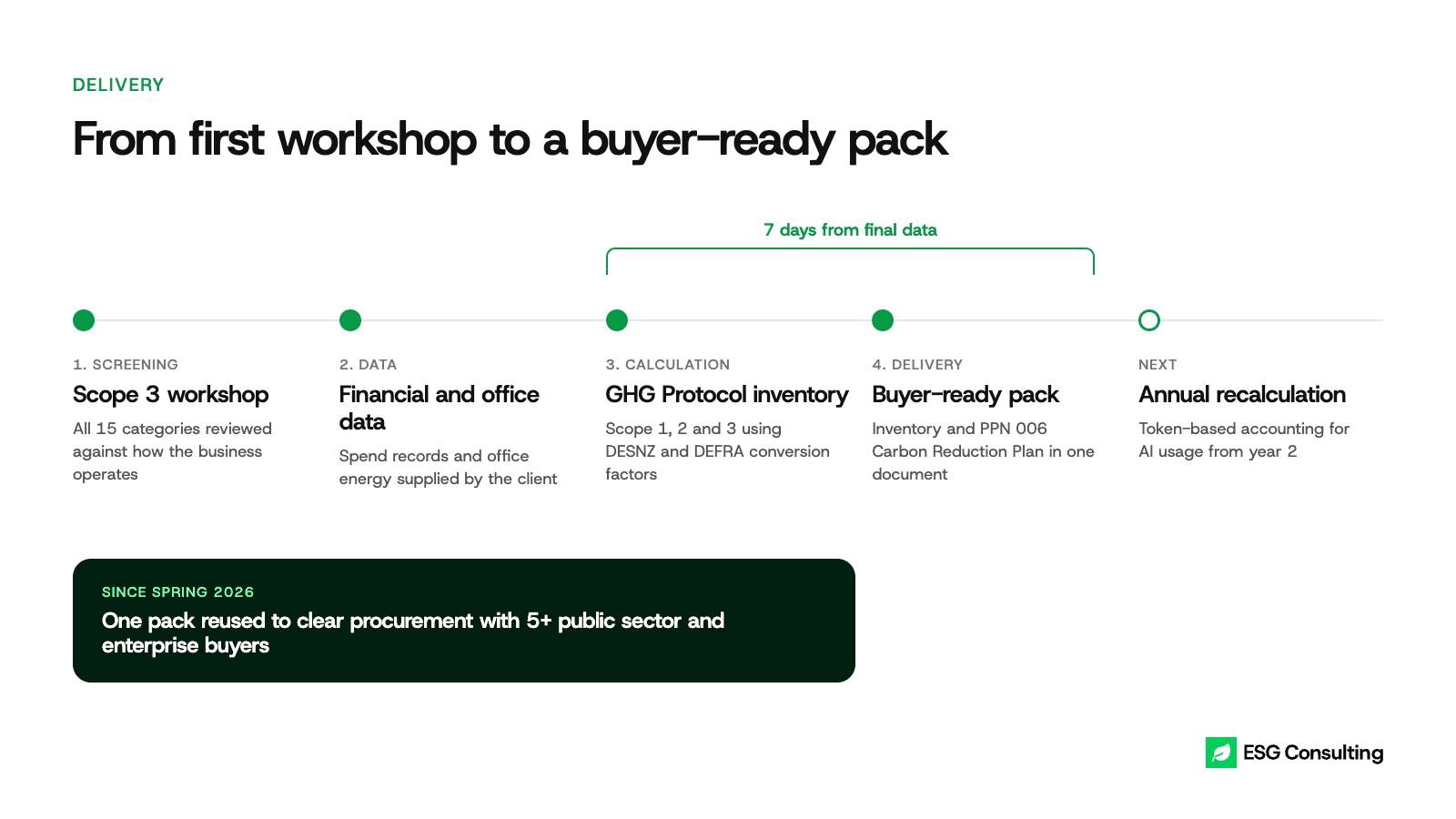
1. Scope 3 screening and boundary review
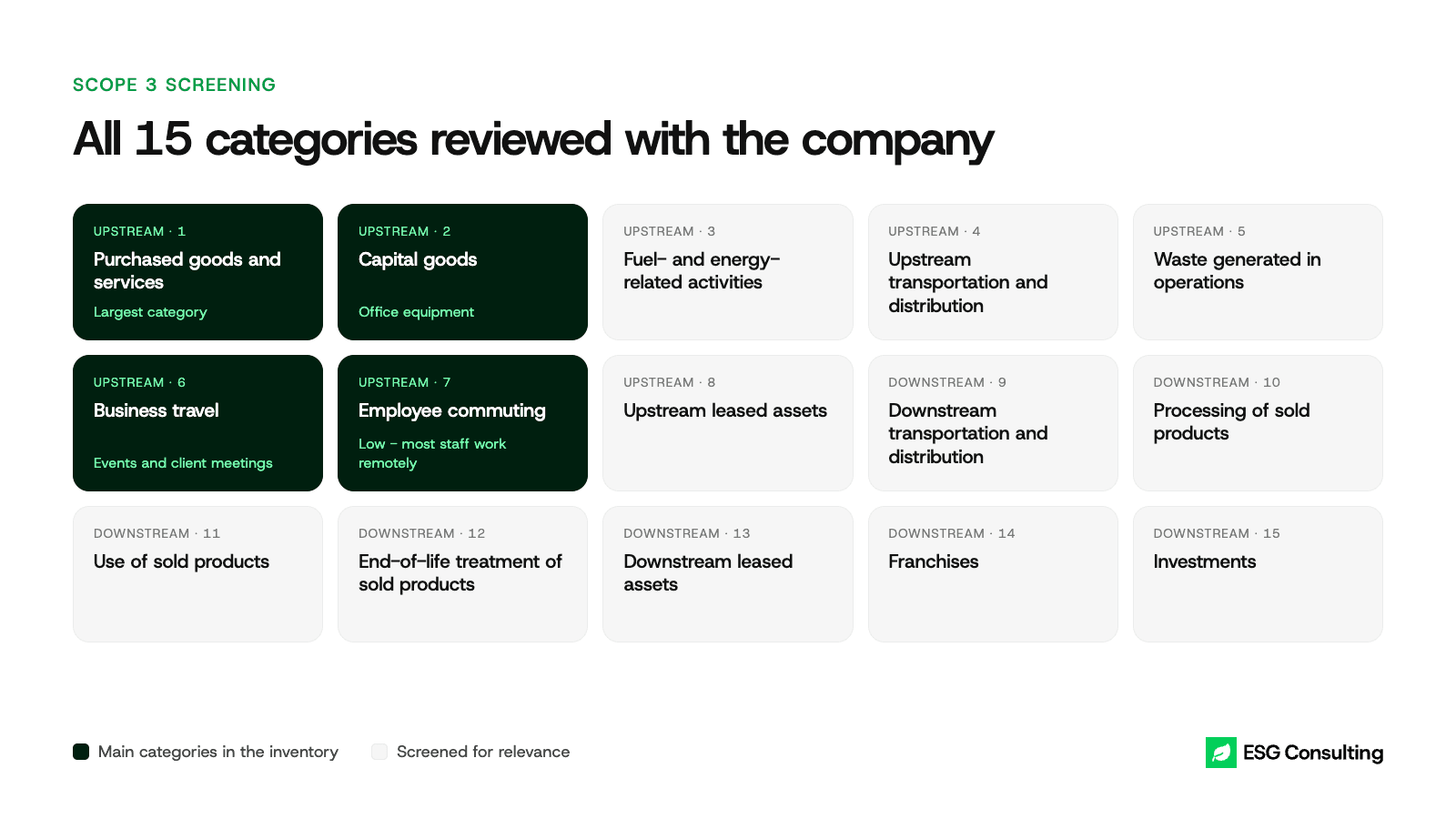
The engagement began with working sessions with the company to assess all 15 Scope 3 categories against how the business actually operates. We documented every category as included or excluded with a clear rationale, ensuring procurement teams can see what sits outside the company's boundary and why.
2. Emissions calculation
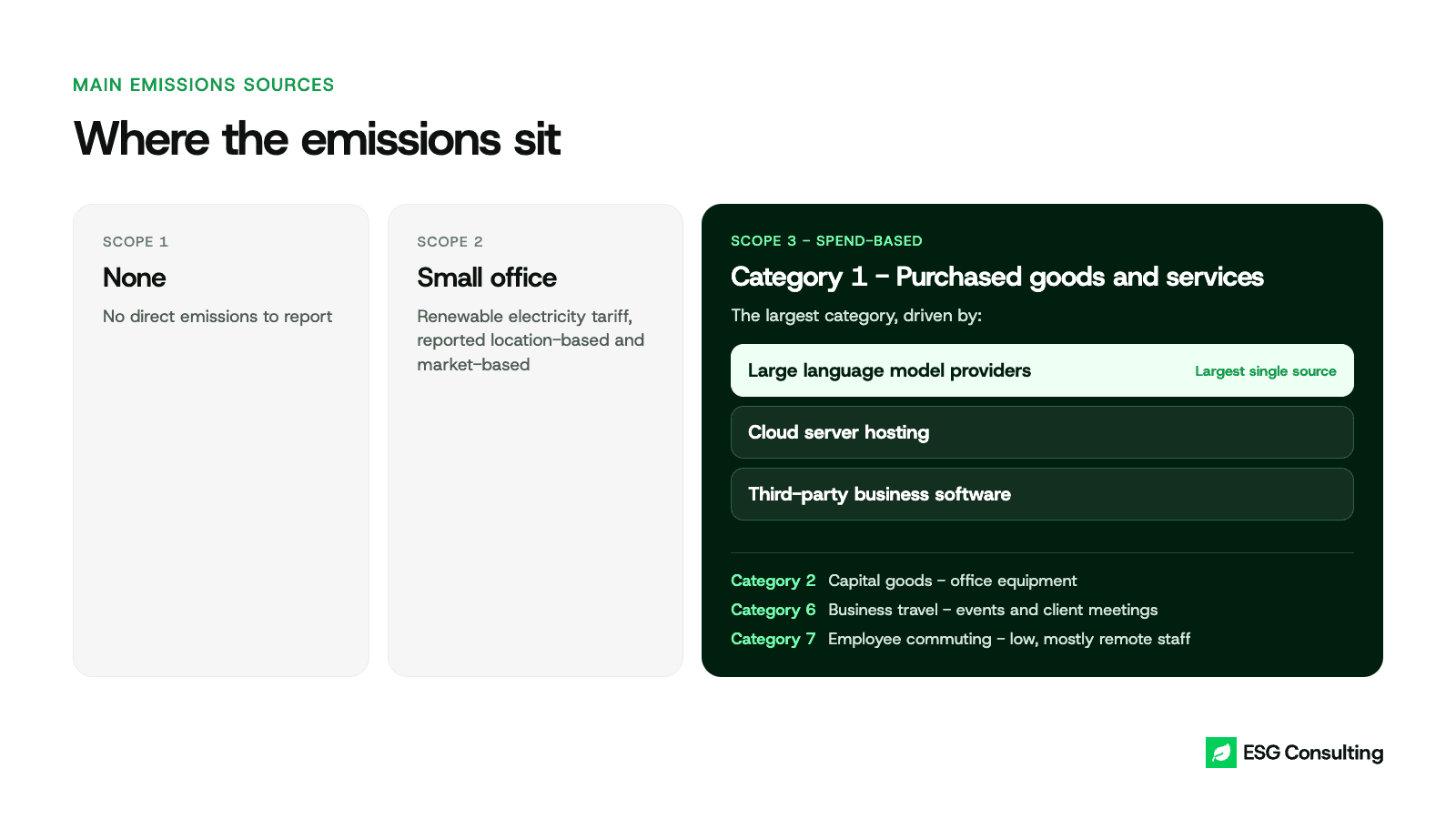
We calculated FY2026 emissions (April 2025 to March 2026) under the GHG Protocol Corporate Standard, applying official UK Government conversion factors from DESNZ and DEFRA. The business had no Scope 1 emissions. We dual-reported Scope 2 for its small office on both a location-based (grid average) and market-based (contractual tariff) basis.
Because this was a first-year baseline with no historical data, we calculated Scope 3 using a spend-based methodology drawn from financial records. The GHG Protocol accepts this method for a first baseline, and it produced a complete inventory without holding up live tenders.
3. Main emissions sources
Purchased goods and services (Category 1) accounted for the largest share of the footprint, driven by large language model providers, cloud server hosting and third-party business software. Capital goods (Category 2) captured office equipment purchases while business travel for events and client meetings sat in Category 6.
Employee commuting (Category 7) remained low because most staff work remotely rather than travelling daily to the office.
4. Reusable procurement pack
Within 7 days of receiving the final financial and operational data, we delivered the full Scope 1, 2 and 3 inventory alongside a PPN 006 Carbon Reduction Plan in a single buyer-ready pack. Because the methodology, category exclusions and assumptions are documented clearly, the client sends the same pack to every buyer that requests emissions data rather than rebuilding responses for each tender.
AI providers do not publish usable emissions data
The client's single largest emissions source was its spend with large language model providers. Those providers do not publish customer-level emissions data that organisations can attribute to their own usage. We pursued both direct supplier engagement and industry groups, confirming that no usable primary figures were available.
Rather than masking that limitation, we applied spend-based emission factors for year 1 and documented the methodological limits explicitly in the report. Financial spend is an imperfect proxy for AI workloads because commercial pricing does not track compute volume directly. Identical spend on pay-per-token API credits and on a flat-rate subscription buys very different levels of processing.
For year 2, we have agreed a plan to move this category to token-based accounting, measuring actual model usage rather than spend. Wherever providers publish supplier-specific emissions metrics, those figures will replace the spend-based factors.
Clearing procurement for 5+ new clients
Since spring 2026, the client has used the emissions pack to pass procurement and win contracts with more than 5 key public sector and enterprise customers. Supplier carbon requests no longer delay contract signatures or pull leadership away from closing new business.
The company has retained ESG Consulting to recalculate its footprint each financial year, so every buyer receives current figures calculated on a consistent method.
Cutting emissions across cloud and AI
Because the business has no Scope 1 emissions and already purchases renewable electricity for its office, further operational cuts in Scope 2 are minimal. The main reduction opportunities sit in Scope 3, specifically in the digital infrastructure powering the product.
Alongside the baseline inventory, we identified three practical reduction levers for the business to evaluate:
- Engaging existing cloud hosting providers to move workloads onto renewable-backed electricity contracts
- Migrating workloads to a cloud hosting provider powered by renewable electricity
- Hosting open-weight language models on renewable-powered infrastructure for suitable workloads rather than routing every call through major AI providers
"We had contracts ready to sign and carbon data was the one thing we could not provide. Lucy worked out what actually applied to a business our size, delivered the numbers within a week of our final data and gave us a pack we now send to every buyer who asks."
Delivered by
Lucy Berry, Senior ESG Director
Led the engagement from initial Scope 3 screening through to delivery and now oversees the client's annual recalculation.