Scope 1, 2 and 3 carbon footprints that customers and auditors accept
We calculate organisational carbon footprints and run annual carbon accounting to the GHG Protocol Corporate Standard from operational data, with every figure traceable to its source and the method documented for whoever asks next.
What our carbon footprint and carbon accounting service includes
- A Scope 1, 2 and 3 inventory calculated to the GHG Protocol Corporate Standard, covering every relevant Scope 3 category rather than the ones that are easiest to measure.
- A methodology statement setting out the organisational and operational boundary, the reporting year, the emission factors used and every assumption, so a customer, auditor or verifier can follow each figure back to its source.
- A summary report for customers, tender responses and the board, with emissions by scope and category and an intensity ratio.
- The calculation workbook, so the next year's carbon accounting starts from the same structure.
- Reduction priorities, identifying which sources dominate the footprint and which of them the business can act on.
Who needs a Scope 1, 2 and 3 carbon footprint
SMEs and large companies need a footprint when someone outside the business asks for one:
- A customer has asked for Scope 1, 2 and 3 figures to calculate its own supply chain emissions. Our supplier carbon reporting service covers the customer-specific share of the footprint and the questionnaire that usually comes with the request.
- A public sector tender requires a PPN 006 Carbon Reduction Plan, which has to be built on a baseline footprint.
- A customer wants emissions per product rather than per organisation, which needs a product carbon footprint built on the same data.
- The annual report requires SECR disclosures, or the board wants a baseline before committing to a net-zero strategy or science-based targets.
The same inventory serves all of these, so we build it once and to the standard the most demanding audience requires.
The standards behind the footprint
- GHG Protocol Corporate Standard for the organisational boundary and Scope 1 and 2.
- GHG Protocol Scope 3 Standard for the 15 value chain categories.
- Scope 2 dual reporting, on both the location-based and market-based methods.
- UK Government greenhouse gas conversion factors for the reporting year.
- ISO 14064-1 alignment where the organisation intends to seek verification.
How we calculate a carbon footprint
- Scoping. We confirm who is asking for the figures and what they need, set the boundary and reporting year and screen all 15 Scope 3 categories for relevance. The fee is agreed at this point.
- Data collection. We send a data request tailored to the business and work through the gaps with whoever holds the records - usually finance and operations.
- Calculation. Activity data is converted using the UK Government conversion factors for the reporting year, with spend-based factors only where activity data does not exist.
- Review and delivery. Our quality assurance team reviews the inventory before it is issued and the lead consultant walks the business through the results and the reduction priorities.
Carbon footprint case study
A South West B2B SaaS company with fewer than 10 employees needed a Scope 1, 2 and 3 footprint and a PPN 006 Carbon Reduction Plan before public sector and enterprise buyers would sign. We screened all 15 Scope 3 categories, delivered both documents within 7 days of the final data and now run the annual recalculation.
Frequently asked questions
What does a carbon consultant do?
A carbon consultant measures an organisation's greenhouse gas emissions, reports them to the standard its customers, regulators or investors require and identifies the reductions that will make the biggest difference. In practice that means setting the boundary, collecting energy, fuel, travel and purchasing data, calculating the Scope 1, 2 and 3 inventory and documenting the method so a third party can follow it.
What is the difference between Scope 1, Scope 2 and Scope 3 emissions?
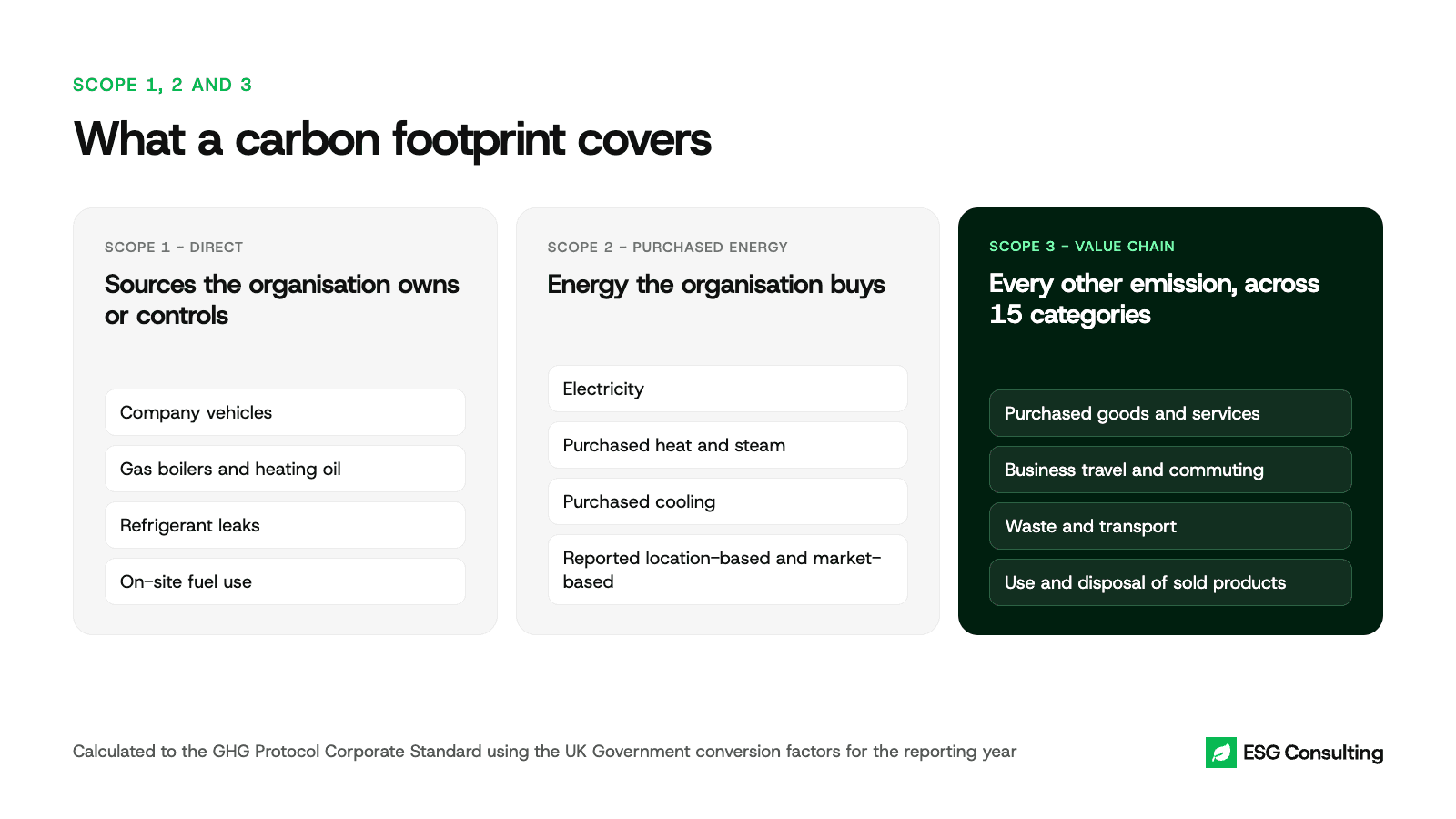
Scope 1 covers direct emissions from sources the organisation owns or controls, such as company vehicles, gas boilers and refrigerant leaks. Scope 2 covers emissions from the electricity, heat, steam and cooling it buys. Scope 3 covers every other emission in its value chain, across the 15 categories of the GHG Protocol Scope 3 Standard - from purchased goods and services to business travel, employee commuting and the use of products it sells.
What data does a carbon footprint need?
For Scope 1 and 2, energy bills or meter readings for electricity, gas and other fuels, vehicle fuel or mileage records and any refrigerant top-ups. For Scope 3, the purchase ledger, waste records, business travel bookings and an employee commuting and homeworking survey. Where activity data does not exist we use spend data and record the assumption.
How much does a carbon footprint consultant charge?
The cost depends on the work rather than a day rate. The main drivers are the number of sites and vehicles, how many Scope 3 categories are relevant, the state of the data and whether the client also needs customer-specific figures, a Carbon Reduction Plan or verification-ready documentation. We agree the scope and fee before any work begins.
How long does a carbon footprint take?
Turnaround depends on how quickly the data arrives rather than the calculation itself. For a UK B2B SaaS company with fewer than 10 employees, we delivered a Scope 1, 2 and 3 footprint and a PPN 006 Carbon Reduction Plan within 7 days of receiving the final data.
Does a small business need to report Scope 3 emissions?
No UK law requires a small business or SME to report Scope 3. The requirement usually comes from a customer that needs its suppliers' emissions for its own Scope 3 reporting, or from a public sector tender that asks for a PPN 006 Carbon Reduction Plan, which must include Scope 1, 2 and a defined subset of Scope 3.