SECR disclosures that trace back to invoices and meter readings
Streamlined Energy and Carbon Reporting requires energy use, emissions, an intensity ratio and the actions taken to improve efficiency in the annual report. We prepare every element and leave an evidence trail the auditor can follow.
What is SECR?
Streamlined Energy and Carbon Reporting is the UK framework that requires in-scope companies and LLPs to report their energy use and greenhouse gas emissions in their annual report. It was introduced by regulations made in 2018 and applies to financial years beginning on or after 1 April 2019.
Who must report under SECR
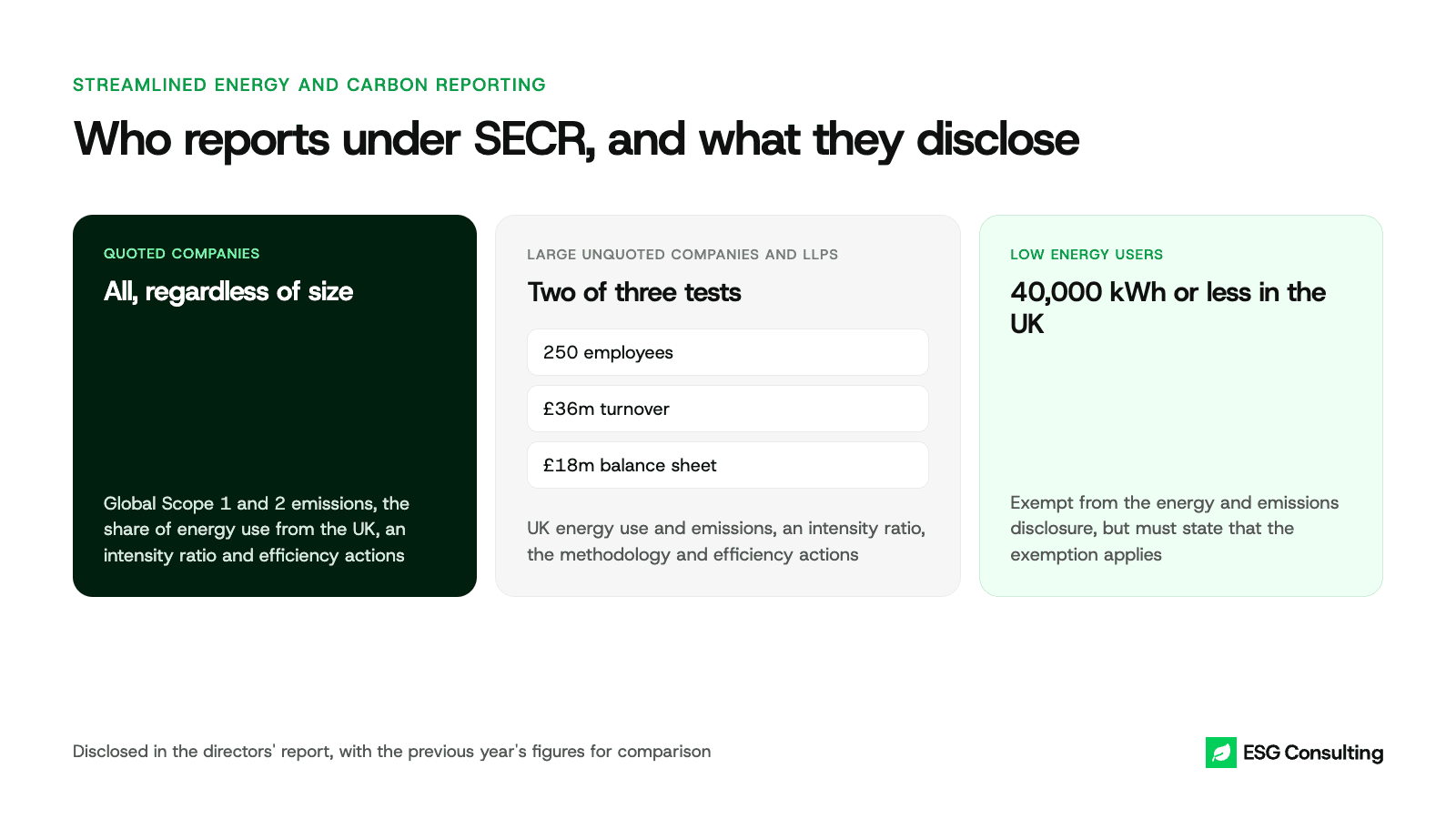
- Quoted companies, which report their global Scope 1 and 2 emissions and the share of energy use from the UK.
- Large unquoted companies and LLPs meeting two of three tests - 250 employees, £36m turnover and an £18m balance sheet - which report UK energy use and the associated emissions.
- Low energy users that consumed 40,000 kWh or less in the UK are exempt from the figures but must state that they rely on the exemption.
What an SECR report includes
For a large unquoted company, the disclosure covers:
- UK energy use in kWh, covering gas, electricity and transport fuel at a minimum.
- The greenhouse gas emissions from that energy use, in tonnes of CO2e.
- At least one intensity ratio, chosen to be meaningful for the business and comparable year on year.
- The methodology used to calculate the figures.
- The energy efficiency actions taken in the financial year.
- The previous year's figures for comparison.
Quoted companies report their global energy use and global Scope 1 and 2 emissions, with the proportion that relates to the UK. Large LLPs report the same information as unquoted companies, but in an Energy and Carbon Report rather than a directors' report.
SECR and ESOS
SECR is an annual disclosure in the annual report, filed with the accounts. ESOS is a separate scheme run by the Environment Agency, under which large undertakings audit their energy use every four years and notify compliance. The energy data behind the two overlaps, so we build it once for both.
What our SECR service includes
- A scope check confirming whether each company and LLP in the group falls within SECR and which disclosure set applies.
- Energy and emissions figures for the reporting year, calculated from invoices, meter readings and mileage records using the UK Government conversion factors.
- An intensity ratio chosen to be meaningful for the business and comparable year on year.
- The directors' report text, including the methodology statement and the energy efficiency actions taken in the year.
- An evidence file linking every figure to its source data, ready for the auditor.
SECR uses the same Scope 1 and 2 data as climate-related financial disclosures and UK SRS. Companies that want to go beyond SECR to Scope 3 start from a full carbon footprint.
How we prepare SECR reports
- Scope and boundary. We confirm which entities report, the reporting period and the boundary, consistent with the financial statements.
- Data collection. We request energy and fuel data for every site and vehicle and resolve the gaps with the people who hold the records.
- Calculation and drafting. We calculate the figures and draft the disclosure, with the prior year restated where methodology has changed.
- Audit support. We answer the auditor's questions on the evidence file before the annual report is signed.
Auditors and investors now test SECR methodology, boundaries and restatements against source data far more closely than when the regime began in 2019.
Frequently asked questions
Is SECR reporting mandatory in the UK?
Yes, for every company and LLP within its scope. Quoted companies and large unquoted companies and LLPs must include SECR disclosures in their annual report for each financial year, unless a large company or LLP qualifies for the low energy use exemption.
What are the qualification criteria for SECR?
All quoted companies report. Unquoted companies and LLPs report when they meet two of three tests - 250 employees, £36m turnover and an £18m balance sheet. Those thresholds did not change when the company size thresholds rose in April 2025, so a company now classed as medium-sized for its accounts can still fall within the scope of SECR.
Is there an example SECR report?
An SECR report for an unquoted company sits in the directors' report and usually takes the form of a short table and narrative. The table shows UK energy use in kWh and the resulting emissions in tonnes of CO2e for the current and previous year, alongside an intensity ratio such as tonnes per £m of turnover. The narrative states the methodology used and the energy efficiency actions taken in the year.
Is there an exemption for low energy users?
A company or LLP that consumed 40,000 kWh of energy or less in the UK in the reporting period does not have to disclose its energy and emissions, but it must state that it falls under the exemption.
Is UK SRS replacing SECR?
No. UK SRS replaces the TCFD-aligned listing rules for listed companies from accounting periods beginning on or after 1 January 2027, but SECR continues alongside it. The government's post-implementation review, published on 26 May 2026, recommended retaining SECR with targeted amendments and a standard template and nothing changes for FY2026 or FY2027 reporting.