TCFD and CFD climate disclosures that hold up to auditor challenge
We prepare climate-related financial disclosures under the Companies Act and the TCFD recommendations, including the scenario analysis and board governance narrative that auditors most frequently challenge.
What is TCFD reporting?
TCFD reporting is climate disclosure structured around the recommendations of the Task Force on Climate-related Financial Disclosures, published in 2017. The recommendations ask how climate change affects a business financially, rather than how the business affects the climate, and organise the answer into four areas:
- Governance - how the board and management oversee climate-related risks and opportunities.
- Strategy - the risks and opportunities that affect the business, and how resilient its strategy is under different climate scenarios.
- Risk management - how the business identifies, assesses and manages climate-related risks.
- Metrics and targets - the measures used to track climate risk, including Scope 1, 2 and 3 emissions, and the targets set against them.
UK TCFD and CFD reporting requirements
| Regime | Who it applies to | Status |
|---|---|---|
| Companies Act climate-related financial disclosures (CFD) | Traded, banking, insurance and AIM companies with 500 or more employees, and other companies with 500 or more employees and £500m turnover | Continues, with a government review due to conclude in spring 2027 |
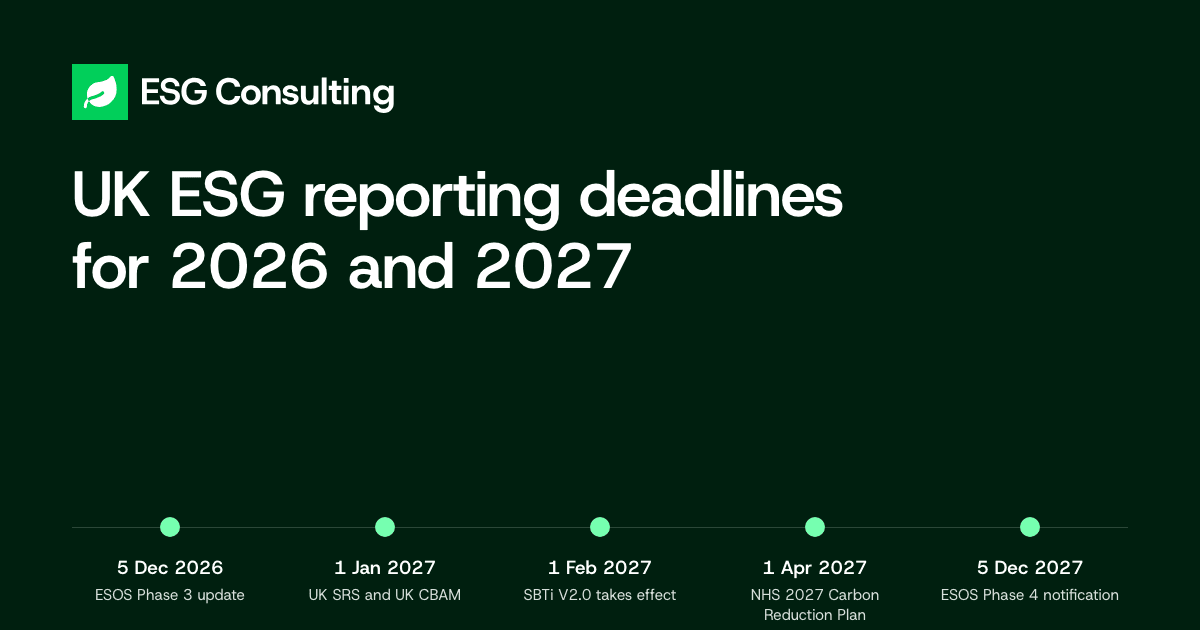
| TCFD listing rules | Listed companies | Apply to accounting periods beginning before 1 January 2027 |
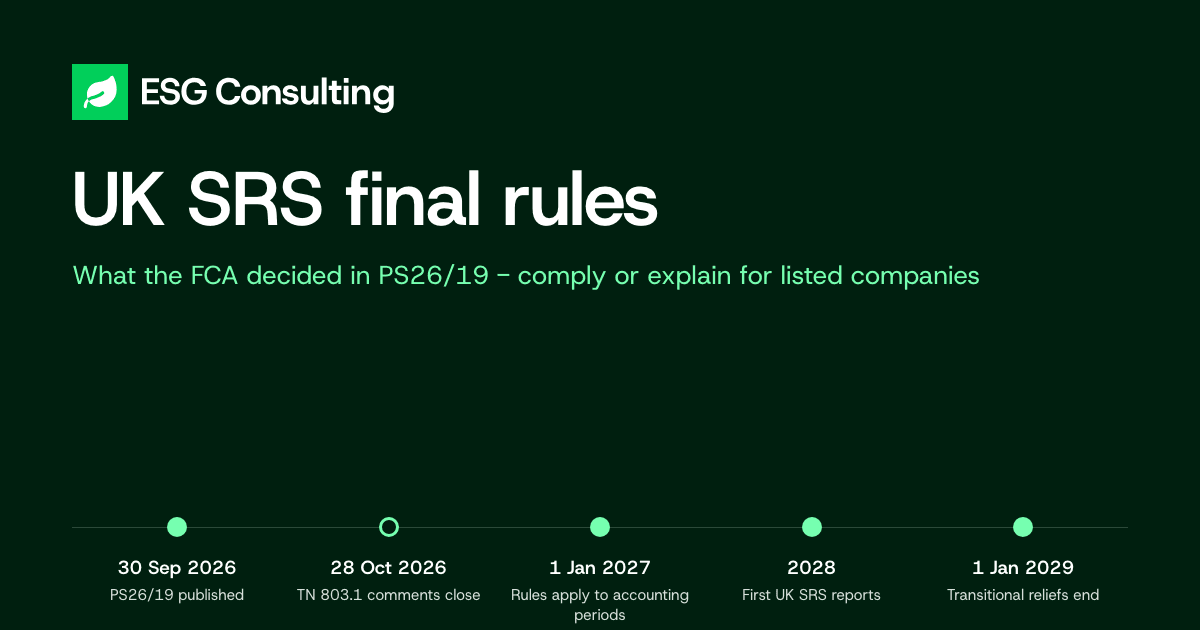
| UK SRS listing rules | Listed companies | Replace the TCFD listing rules from accounting periods beginning on or after 1 January 2027 |
A UK SRS S2 report satisfies the Companies Act requirement, so no company needs to report twice.
What our TCFD reporting service delivers
- A scope check confirming whether the company falls within the Companies Act climate-related financial disclosures, the TCFD listing rules or the UK SRS listing rules for each reporting period.
- Climate risk and opportunity assessment, identifying the physical and transition risks material to the business and the time horizons over which they arise.
- Scenario analysis testing the resilience of the strategy under different climate pathways, documented so an auditor can follow the assumptions.
- The governance narrative describing how the board and management oversee climate risk, which is the section auditors challenge most.
- Metrics and targets, including Scope 1, 2 and 3 emissions calculated to the GHG Protocol.
Companies setting out how they will meet their targets can extend the work into a climate transition plan.
How we prepare climate-related financial disclosures
- Scoping. We confirm which regimes apply for the next reporting period and review the last disclosure.
- Risk assessment. We run workshops with management to identify and rate the climate risks and opportunities.
- Scenario analysis. We model the material risks under the chosen scenarios and record every assumption.
- Disclosure. We draft the disclosures for the annual report and brief the board on what it is signing off.
Frequently asked questions
Is TCFD mandatory in the UK?
The TCFD recommendations themselves are voluntary, but UK law and listing rules built on them are not. The Companies Act climate-related financial disclosures apply from 500 employees for traded, banking, insurance and AIM companies, and from 500 employees together with £500m turnover for all other companies. Listed companies report under the TCFD listing rules for accounting periods beginning before 1 January 2027.
Will UK SRS replace TCFD?
For listed companies, yes. The FCA's UK SRS listing rules replace the TCFD listing rules for accounting periods beginning on or after 1 January 2027, on a comply or explain basis. UK SRS S2 is built on the same four areas as the TCFD recommendations.
Is TCFD still valid?
The recommendations remain in use. The Task Force itself disbanded in October 2023, but its recommendations are built into the ISSB climate standard, IFRS S2, and remain the basis of the Companies Act climate-related financial disclosures.
Why was TCFD disbanded?
The Task Force had completed its remit once the ISSB published IFRS S1 and S2 in June 2023, which fully incorporate the TCFD recommendations. The Financial Stability Board asked the IFRS Foundation to take over monitoring of companies' climate disclosures and the Task Force disbanded in October 2023.
Do companies have to report under both CFD and UK SRS?
No. The government confirmed in February 2026 that a UK SRS S2 report satisfies the Companies Act climate-related financial disclosure requirement.