Science-based targets modelled, submitted and validated by the SBTi
The Science Based Targets initiative validates corporate emissions targets against what climate science requires. We build the baseline, model targets that meet the SBTi criteria and prepare the submission.
What is the Science Based Targets initiative?
The Science Based Targets initiative (SBTi) sets the criteria that corporate emissions targets must meet to count as science-based, and validates the targets companies submit against them. It was founded in 2015 by CDP, the UN Global Compact, the World Resources Institute and WWF.
The SBTi validates two kinds of corporate target:
- Near-term targets, which cover a period of five to ten years from the date of submission.
- Long-term net-zero targets under the Corporate Net-Zero Standard, which set the depth of reduction the company commits to across its value chain.
The Corporate Net-Zero Standard V2.0
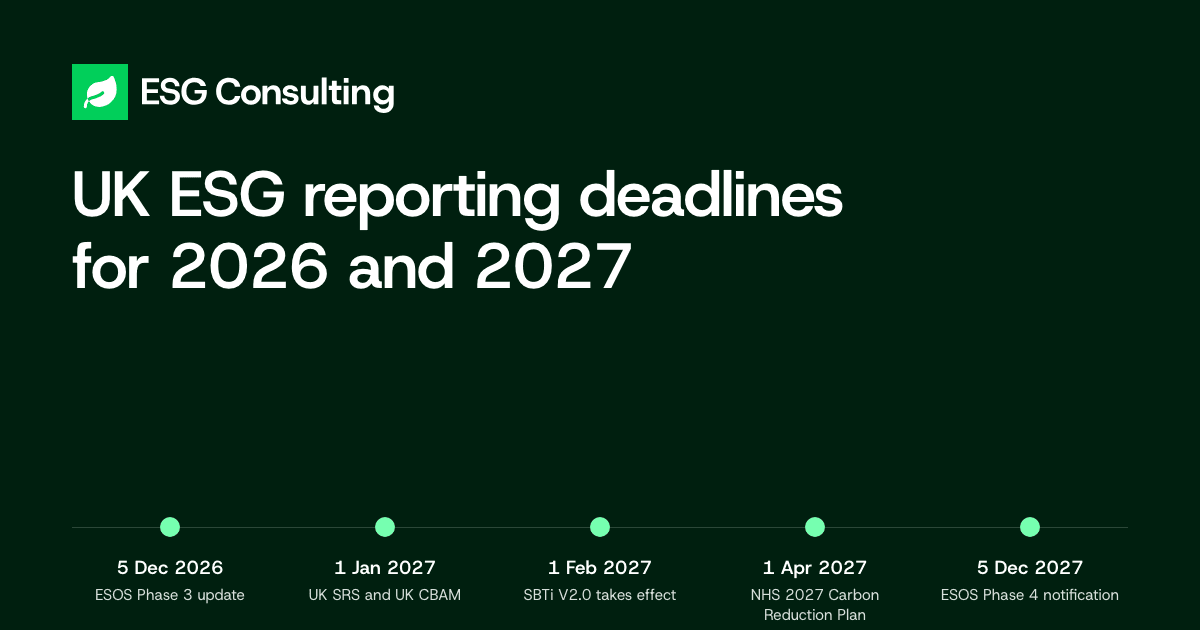
The SBTi published the final version of the Corporate Net-Zero Standard V2.0 on 11 June 2026 and it takes effect on 1 February 2027. Companies can continue to submit under the current standard, V1.3.1, until 31 January 2028, and from 1 February 2028 every new submission must use V2.0.
- Scope 1 and Scope 2 receive separate targets, and Scope 2 is measured on a location-based method.
- Scope 3 targets must cover every category that represents 5% or more of a company's Scope 3 total, replacing the previous 67% coverage rule.
- Category A companies, those with turnover of €450m or 1,000 employees, must disclose a transition plan and obtain limited assurance over base-year data.
A company close to submission files under V1.3.1. A company more than a year from submission models against V2.0 from the start, because re-baselining after validation costs more than setting the boundary correctly the first time.
What our SBTi service delivers
- A target-ready baseline of Scope 1, 2 and 3 emissions, recalculated where the existing carbon footprint does not meet the SBTi requirements.
- Target modelling for near-term and long-term targets, using the method that fits the company's sector and emissions profile.
- The submission to the SBTi, with the supporting documentation and answers to the SBTi's questions during validation.
- A delivery plan linking the targets to the measures in a net-zero strategy.
- Annual progress reporting against the validated targets, including through CDP.
Who needs science-based targets
- Companies whose customers, investors or lenders have asked for validated targets.
- Companies with significant Scope 3 emissions, which need targets covering the value chain.
- Companies deciding whether to submit under the current standard or under V2.0.
How we set and validate science-based targets
- Baseline review. We check the base year inventory against the SBTi criteria and close the gaps.
- Modelling. We model the target options and show the board what each requires in reductions.
- Submission. We prepare and submit the targets and handle the validation queries.
- Tracking. We report progress against the targets each year and recalculate the baseline when the business changes.
Frequently asked questions
What is a science-based target?
A science-based target is an emissions reduction target in line with the reductions climate science says are needed to limit warming to 1.5°C. A target only counts as science-based once the Science Based Targets initiative has reviewed it against its criteria.
What are SBTi validated targets?
Validated targets are targets the SBTi has reviewed against its criteria and approved. The SBTi publishes them on its target dashboard, which is where customers, investors and lenders check whether a company's targets are validated or only committed.
How is a science-based target set?
A company calculates a Scope 1, 2 and 3 baseline for a recent base year, models targets against the SBTi criteria for its sector, submits them to the SBTi for validation and then reports progress against them every year.
What is the difference between the SBTi and net-zero targets?
Any organisation can announce a net-zero target, and nothing checks whether it is credible. The SBTi is the body that validates targets, including net-zero targets under its Corporate Net-Zero Standard, which require deep emissions reductions across the value chain before residual emissions are neutralised.
What is changing under the Corporate Net-Zero Standard V2.0?
Version 2.0 of the SBTi Corporate Net-Zero Standard takes effect on 1 February 2027. It brings separate Scope 1 and 2 targets, location-based Scope 2, a 5% Scope 3 threshold and transition planning into scope. Companies can still submit targets under the current standard until 31 January 2028, and every new submission from 1 February 2028 must use V2.0.
Why do customers ask suppliers to set science-based targets?
Companies with validated Scope 3 targets need their suppliers to reduce emissions too, so many now ask key suppliers to set their own science-based targets as part of supplier engagement.